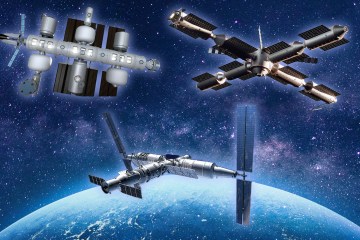
THE race to replace the ageing ISS is heating up with a unique contender that has a few tricks up its sleeve.
A group of engineers have come up with an inflatable space station to create shape-shifting rooms that change to suit visitor needs.
But that’s not the only special move that sets it apart from rivals vying to orbit Earth once the ISS retires at the end of 2030.
Thunderbird Station, made by US start up Max Space, can be launched and ready to go in just one rocket trip.
Usually space stations require multiple launches carrying various modules up at a time.
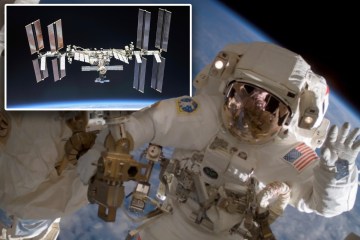
The ISS has had more than 40 assembly flights, starting back in 1998.
Instead, the Thunderbird Station is blasted off into Lower Earth Orbit compactly.
It’ll hop on the back of a single standard Falcon 9 rocket.
Sign up for The Sun Tech newsletter for gadgets, games & more

Hello! I’m Sean Keach, The Sun’s Head of Technology and Science
I’ve been writing about gadgets, games and the future of technology for more than a decade.
During that time I’ve penned thousands of articles, filmed hundreds of videos, talked tech on TV and radio, and travelled around the world to bring you the latest on Apple, Meta, Google, Amazon, Netflix and more.
And I’ve got a weekly newsletter called The Sun Tech that you can read for free every Thursday.
I bring you the latest from the world of tech, including behind-the-scenes action, exclusive content, expert analysis, and plenty of help advice – so please follow along!
It can then expand 20 times the size once in orbit with a volume of 350 cubic meters.
That’s around one third the volume of the ISS.
Once its ready, the station will be able to house up to four astronauts at a time.
It’ll have two docking ports for visiting vehicles to hook up to as well.
Bosses hope that the space station will not only serve as a lab looking over breathtaking views of Earth, but one day be used for missions over the Moon and to Mars.
Max Space burst onto the scene in April 2024 with a plan to offer module technology for others to build a space station.
But now the company is pressing ahead with its own concept entirely.
Max Space chief executive Saleem Miyan has likened their expandable idea to moving furniture around the home.
You can expect to see soft elements inside the station and an adjustable layout.
“We effectively have a highly customizable internal environment,” he told Space News.
“It allows us to create usable volume, personalized space for astronauts, and a large amount of space that can be readily leveraged for large-scale manufacturing in orbit.”
The company is set to launch a small prototype dubbed “Mission Evolution” in early 2027.
That’s ahead of its flagship Thunderbird Station which is planned to blast off in 2029 if all goes to plan.
Hot competition

The ISS has been orbiting Earth since 1998 – but nothing within Earth’s orbit can stay in space forever.
The station will continue working until 2030, before plunging into the Pacific Ocean in early 2031, according to Nasa.
In December 2021, the US space agency announced it was awarding a total of $415million (£326million) to three different companies — Blue Origin, Nanoracks (plus Voyager Space) and Northrop Grumman — to help cement their commercial space station concepts.
Nasa also has separate agreements with Vast and Texas-based Axiom Space, which is working on its own private outpost as well as a new series of spacesuits.
Northrop Grumman had initially had its own plans for a space station when Nasa funded it.
However, the company dropped its idea in October 2023, to assist Voyager Space with Starlab instead.
Image credit: Getty