Christmas carols evoke certain images: Choristers in ruffs, wise men from the orient and now, please, the often angry Right-winger Tommy Robinson. Last week Mr Robinson, who claims to have become a Christian, helped organise a carol service in Whitehall.
It attracted 1,000 souls including amigos from his English Defence League, an organisation seldom mistaken for a flight of angels. These blisters bowed their lips and crooned sentimental favourites such as that anthem to peace and celestial radiance, Silent Night.
As a lifelong churchgoer and an enthusiastic if discordant honker of carols, I am optimistic about this unexpected development in British ecclesiology. If rufty-tufty Robinson has indeed found God, well, alleluia.
But some senior Anglicans are unhappy. Rowan Williams, a former archbishop of Canterbury, talked of the political ‘weaponisation’ of Christmas. The Bishop of Manchester said Christmas must not become a ‘prop in a dim culture war’. Giles Fraser, a prominent London vicar, said he would refuse Mr Robinson communion at his altar rail.
Something is stirring in the pews. Tommy Robinson and his henchmen are not the only people suddenly opening hymn books. Polling by a Christian organisation, Tearfund, has found that 45 per cent of British adults are planning to attend church this Christmas. This is a sharp rise on recent years.
Piety is strongest in Generation Z, 60 per cent of whom (born between 1997 and 2012) will, the poll suggested, be heading for a Christmas service. Baby-boomers and the ‘silent generation’ of older pensioners are only half as devout.
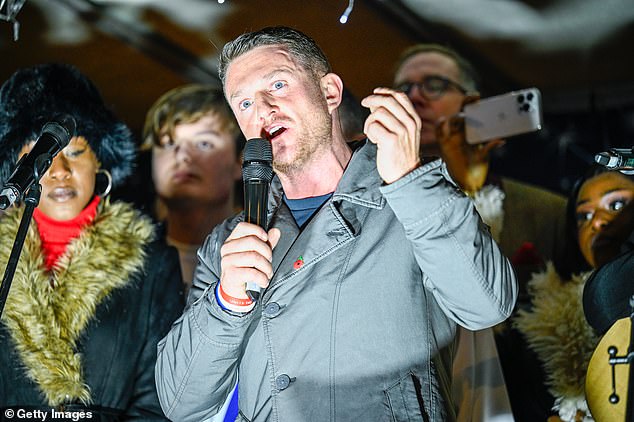
Last week Tommy Robinson, who claims to have become a Christian, helped organise a carol service in Whitehall
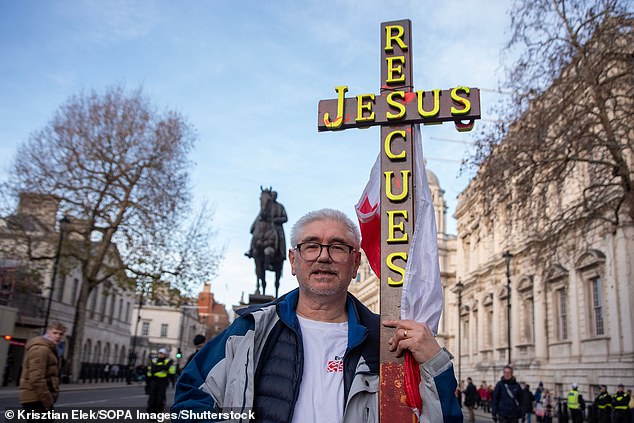
Polling by a Christian organisation, Tearfund, has found that 45 per cent of British adults are planning to attend church this Christmas. This is a sharp rise on recent years
Meanwhile, the late American activist Charlie Kirk’s Christian revival movement, Turning Point, has a British youth ambassador called Young Bob.
He is 17, highly articulate and tours campuses and public venues, setting up a trestle table and encouraging members of the public to debate him not only about theology but also its application to contentious political issues such as immigration, nationalism and multi-culturalism.
Just yesterday he announced his engagement in fittingly reverent style: ‘Glory be to God, the happiest day of my life. A new chapter begins.’
Young Bob, real name Thomas Moffitt, is in some ways a Right-wing version of Greta Thunberg, but without the scowl. He is cheerful, polite, brave and, inevitably, has attracted the attentions of Left-wing activists keen to do him down. At a London School of Economics event he says he had urine and glue thrown at him, and the pressure group Hope Not Hate obtained recordings of him saying rude things about Mr Robinson and other magnificoes of the Christian Right. Big Tommy was quick to forgive him – as a good churchgoer should – and called Moffitt ‘a young man who deserves all of our support’.
For a religion often said to be in terminal decline in Britain, the polling figures about youth churchgoing intentions are astonishing – and, surely, welcome. But not by those senior clergy mentioned above. The Guardian newspaper discerned a ‘far-Right misappropriation of Christian imagery’. The likes of Rowan Williams and the Bishop of Manchester fear that Tommy Robinson may be piggybacking on Jesus to promote nefarious political ends.
Could the English Defence League’s adoption of the Cross also lead to religious tensions with Islam? Given the tinder-basket of public opinion after dreadful events such as the Manchester synagogue attack and this week’s killings at Bondi Beach in Australia, it might not take much to spark trouble.
Before we go further, allow me to describe something I saw at Gloucester railway station last week.
A trainload of us alighted from the Paddington express and were trudging towards the exit when we had to step around a Muslim man praying on the ground. There he was, in our path, lowering his face to the damp asphalt of platform 2, pointing if not to Mecca then at least in the direction of all stations to Swindon and Didcot Parkway. This being England, nobody said a thing.
Something similar occurred when an acquaintance of mine drove his ailing father to hospital in Birmingham just over a year ago. At a pedestrian crossing a man sank to his knees and prayed for several minutes in the middle of the road. It caused quite a traffic jam. Again, no one felt moved, or dared, to toot a horn. Were those Muslims in Birmingham and Gloucester acting out of genuine devotion or out of a desire to provoke? Were they, as the Guardian might say, ‘misappropriating religious imagery’?
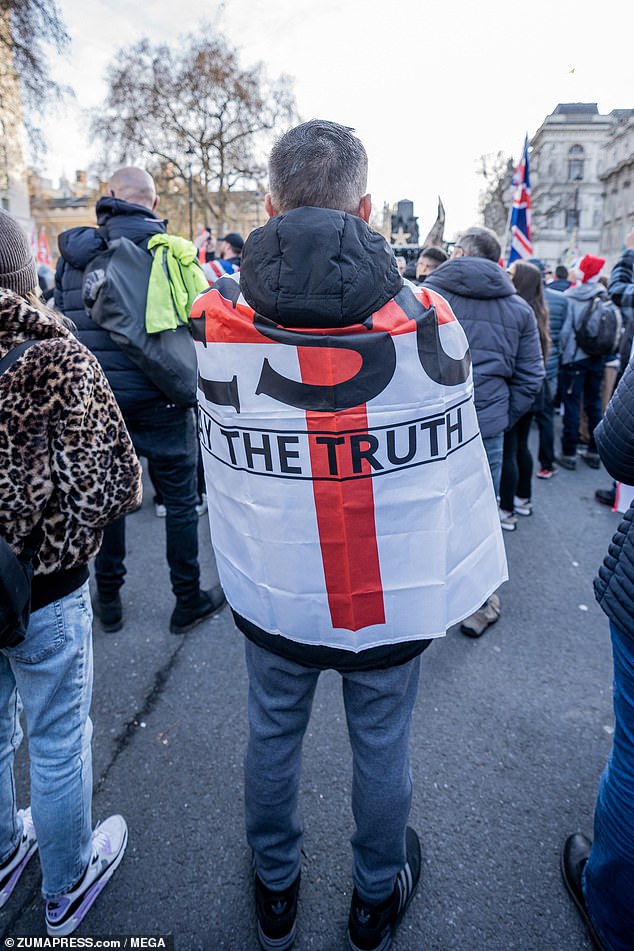
Mr Robinson’s event attracted 1,000 souls including amigos from his English Defence League – an organisation seldom mistaken for a flight of angels
That may seem an impolitic question but if we are allowed to be sceptical about Tommy Robinson’s beliefs, it must be permissible to be equally suspicious of men who drop to prayer in public places, causing inconvenience to others. Acts of political nose-thumbing? Or mere expressions of pride in their religious culture?
Celebrating our heritage has rather been drummed out of British churchgoers. National institutions and charities have adopted secular stances. Broadcasters show little appetite for airing traditional church services. The heir to the Throne, who may be the next supreme governor of the Church of England, appears to be some sort of humanist.
Atheists want Parliament to drop its daily opening prayers and Christian leaders have been oddly anxious to appease secular officialdom, as happened when the then archbishop of Canterbury, Justin Welby, forced churches to shut during the pandemic. Meanwhile the police and courts show little sympathy to fundamentalist Christians, be they anti-gay cakemakers or anti-abortion protesters.
Some Anglican and Roman Catholic clergy have become barely distinguishable from Left-wing social workers. They seem keener to proselytise about Net Zero, anti-slavery reparations and the European Union than to preach the Gospels.
Days after the 2016 referendum I attended a Sunday service where we were read an episcopal letter disapproving of Brexit. The Church of England’s top brass were almost all Remainers yet the majority of their flock was for Leave. Much of the Church has become the Liberal Democrat party at prayer.
The language used in many services has been cheapened, with prayers often now resembling ditties from Valentine’s Day cards. Hymns such as Onward Christian Soldiers have been banished.
My church-organist wife had a spectacular row, in front of congregants, with a senior cleric who told her that Onward Christian Soldiers was militaristic. The younger, churchier generation has no time for this wetness. It wants stronger religious meat, be that the bells-and-smells of Anglo-Catholicism or Rome, or the unvarnished approach of evangelical or gospel churches.
What is striking about Young Bob and some of his youthful colleagues is their readiness to formulate a calm argument. They are a lot more intellectual than many of the Anglican and Catholic clergy, including plenty of bishops, that I have listened to over the years.
The traditional Book of Common Prayer has an expression about ‘the Church militant’, meaning a Church that holds the line against wickedness. ‘Put on the armour of God to stand against the wiles of the devil,’ St Paul tells the Ephesians. There is a difference between the Church militant (good) and a Church belligerent (bad), and one trusts that distinction is made clear to former football hooligan Tommy Robinson as he lowers himself to his hassock and bows his head in prayer.
I asked a cousin of mine why he and his 20-something university friends had discovered an interest in churchgoing. It was nothing to do with Scripture or tongues or Pentecostal fire. His answer was simply: ‘We want to defend our culture.’ They were fed up with their Christian heritage being ignored and diminished by their university authorities. Dribbly middle-of-the-road Anglicanism won’t cut it for them. They want a religion that is proud of its values and doesn’t shrivel in the face of political correctness.
And they are not alone. In September the Unite the Kingdom march in London attracted vast crowds. News organisations reported at length that Tommy Robinson was involved. There was less attention paid to the preponderance, on that march, of crosses and banners bearing Biblical quotations.
A Herefordshire farmer who went on the march told me he was astonished – and impressed – by the overt Christianity of the occasion. It felt, he said, more like a religious event than a rally for the English Defence League.
Some political parties have noticed this. Both the Conservatives and Reform UK have Christian fellowship groups.
Kemi Badenoch, who says she lost her faith because of the evils perpetrated by the Austrian rapist Josef Fritzl, has spoken readily of Christian values in the debate about welfarism, arguing that it is perfectly moral to seek lower spending on benefits. At an event in London this month I heard her talk of ‘our crusade to get benefits working again’. For a long time British politicians avoided the noun ‘crusade’ for fear of offending Muslim sensibilities.
Young Bob’s social-media videos regularly talk about Nigel Farage. Both Reform and the Tories can see that young Christians are fruitful territory for them. Some commentators of my babyboom generation habitually slander Gen Z as timid know-nothings. You do not have to watch Young Bob for long to see how lazily inaccurate that attitude is.
Donald Trump caused a kerfuffle this month by saying that European civilisation is under threat. Might he not have had a point? Christ’s message of equality – and in Britain’s case, the Protestant reformers’ stress on individual responsibility – was the foundation of our laws and society.
In recent decades Christianity ossified, and with it European self-confidence withered. What is the point of fighting for your country if your country doesn’t stand for anything? The US President was not the only person to notice this Europe-wide decline. So did Vladimir Putin. So did Islamists.
European babyboomers are so deeply imbued with post-colonialist guilt that they thought the trend irresistible. The younger generation may be built of stronger stuff.
It can see the liberating virtues of Christianity and is unfazed by Left-wing neck-clutching about ‘Christian nationalism’. What is wrong with the idea of a nation built on Christianity? Such a country would have no place for hatred, be it from far-Right racist thugs or Islamist terrorists.
Anglican bishops love to spout about being ‘inclusive’. Well, they should open their hearts this Christmas to the Right-wing Christian revival. It’s probably going to happen, whatever they say.