You would be forgiven for wondering from time to time if Sen. Mitch McConnell (R-KY) is still alive. He is, by the way, and in recent weeks he’s made that fact more apparent. Though the 83-year-old (who will turn 84 in two weeks) is rarely spotted in the Capitol these days, his vocal opposition to President Donald Trump on a myriad of issues is louder and more present than ever when deemed useful for the motivated liberal press. For instance, McConnell was quoted far and wide last month after he criticized Trump’s desire to acquire Greenland, a move the Kentuckian suggested would “incinerate” the threadbare alliance that remains between the United States and NATO.
McConnell’s declining health (he has been spotted falling on multiple occasions) and his accelerating age are not uncommon sights in Washington DC, where Congress has become fertile ground for boomers who refuse to go quietly into that good night. Rep. Nancy Pelosi (D-CA) is another ever-present senior legislator, who at the ripe age of 85 finally announced in November that she will not seek reelection in 2026. In the meantime, the San Franciscan’s bank account continues to swell thanks to her remarkably accurate ability to predict the future prices of indexes. Pelosi has performed so well in predicting the ups and downs of the stock market in her latter years that popular accounts on Elon Musk’s social media app formerly known as Twitter are now dedicated to tracking her fluid and constant financial maneuvering.
Despite their inherent political differences, McConnell and Pelosi are similar in that they represent a cohort of aging legislators who likely should have retired over a decade ago. Nor are the pair alone in their desire to remain in DC, a decision that ultimately falls to the voters of Kentucky and Northern California who continue to put them there. Dianne Feinstein, the first female mayor of San Francisco and the first female senator from the state of California, served more than 30 years in the U.S. Capitol before being reduced to a punchline as the then-89-year-old publicly battled health issues.
Conservative critics—especially those in the MAGA caucus—mocked Feinstein for staying in office long past her prime. Many of those same critics have also harshly criticized McConnell’s forgetfulness and physical deterioration, despite the fact that he shares the same political party as Trump. Yet when it comes to Trump himself, who at 79 years of age is beginning to show real signs of physical and mental fatigue, age and public mishaps become almost invisible to the same critics.
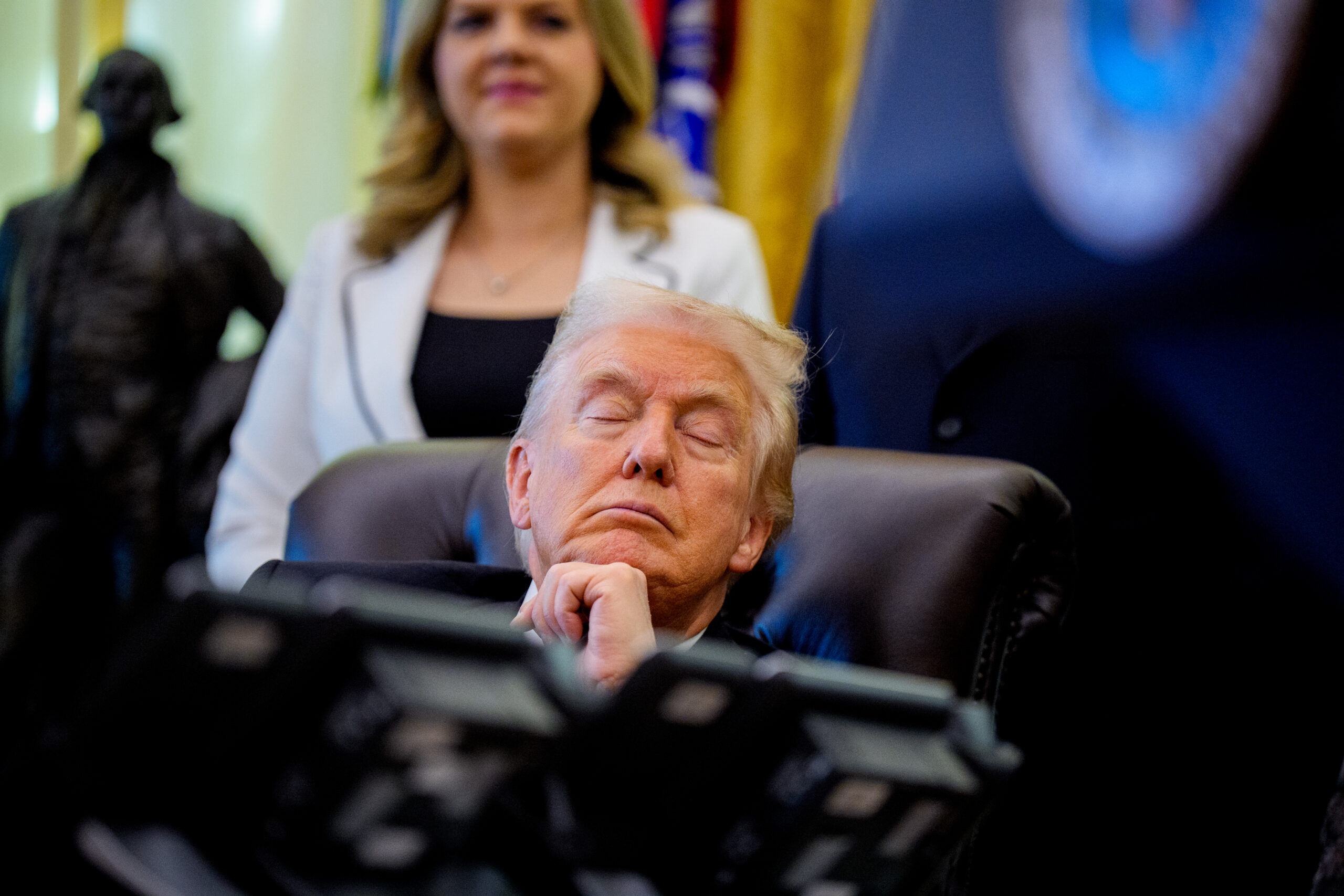
With his health under renewed scrutiny after cameras caught Trump closing his eyes repeatedly during a lengthy cabinet meeting in December, Trump has responded with defiance, addressing head-on claims that he fell asleep during the meeting. “Look, it got pretty boring,” Trump admitted on Thursday as his inner circle chuckled along in approval. “I didn’t sleep. I just closed them because I wanted to get the hell outta here.” Trump’s sleepy state during the December cabinet meeting was just the latest in a string of health concerns that have cropped up as he nears 80.
In July of last year, The White House disclosed that Trump had been diagnosed with chronic venous insufficiency after the president experienced mild swelling in his legs. Then, in September, while attending a 9/11 commemoration at the Pentagon, the right side of Trump’s face appeared to sag, leading to widespread concerns that Trump may have experienced a stroke. Around the same time, Trump disclosed that he had received an MRI at Walter Reed Medical Center, although he appeared not to know what part of his body had been scanned.
More recently, new questions have begun to swirl regarding Trump’s health after members of the press at the World Economic Forum in Davos, Switzerland snapped images of dark bruising on the back of Trump’s hand. Visible bruising has been spotted on Trump’s right hand multiple times in the past year, but the images from Davos were the first that showed the same sort of bruising on his left hand. Worse yet for Trump was the fact that one of the president’s most sympathetic voices in Europe signaled private distress regarding Trump’s mental faculties.
Speaking with European leaders in Brussels last month, Slovakia’s Prime Minister Robert Fico expressed deep concern about the psychological wellness of Trump after the pair met at Trump’s Mar-a-Lago estate only days prior. Fico, who has been a sympathetic European ally for Trump among a sea of dissenters, said Trump came across as “dangerous” as the president initially threatened to annex Greenland before walking back those remarks after meeting with NATO Secretary General Mark Rutte.
In Trump’s defense, his desire to acquire Greenland does not suggest to me that he is losing psychological grounding. In fact, as I wrote in my assessment of the president’s recent speech in Davos regarding Greenland, Trump’s initial threat to potentially use military force to acquire the island should the Danish refuse to sell the landmass was likely just the same blunt gamesmanship Trump outlined in his 1987 business advice book The Art of the Deal. However, the timing of his wild push to acquire Greenland, by hook or by crook, has undoubtedly left his European counterparts questioning if Trump is operating within the same mental framework as the man who captured the White House in 2016.
Trump’s team has consistently refuted speculation about the president’s health. White House physician Capt. Sean Barbabella stated in October that Trump demonstrated “excellent overall health” following a second checkup, which Barbabella described as “routine” after the press questioned the need for a second visit. When asked about the state of Trump’s hands, Barbabella agreed with the president’s claim that the visible bruising is due to shaking hands. When asked if Barbabella could verify such a claim, the U.S. Navy captain and osteopathic physician replied “absolutely” without hesitation.
The president himself has also denied morbid speculation that he is suffering the sort of physical and mental deterioration that all men and women his age experience. “I feel the same as I did 40 years ago,” Trump told the New York Times during a wide-ranging interview that was conducted at the White House in early January. Trump then noted that he had just played a round of golf with legend Gary Player, who had just turned 90. The president then added that businessman Bernie Marcus was “sharp as a tack” and still operating at “100 percent” in the two years before he passed away at the age of 95. When the two-hour interview with the Times wrapped, Trump jokingly told the four reporters present that he “could go nine hours.”
And it’s not just the president who believes in his physical and mental stamina. Homeland Security advisor Stephen Miller told New York Magazine this week that Trump is “superhuman” and often outpaces his younger staff members. “If you look at his EKG, that tells it all,” James Jones, a physician assistant who leads the White House medical team, told the same magazine. “The AI analysis shows he’s 14 years younger. So, age 65. His stamina demonstrates that. We get a view that nobody else does. Nobody can stay up with him. The rest of the staff is tired; we are too. And he’s not.” Weeks before the article was published, Health and Human Services Secretary Robert F. Kennedy Jr. said Trump was in “incredible health” and possessed the “highest testosterone level he’s ever seen for an individual who is over 70 years old” in a clip that went viral across X.
Subscribe Today
Get daily emails in your inbox
Beyond Trump and his close-knit team, former advisors and fans of the president firmly believe in his superhuman strength. “It’s not his final term,” former White House chief strategist Steve Bannon argued in the New York Magazine profile. “He’s going to run again in ’28; hell, he’s running now. It’s obvious. He’s got another ten years at least.” Indeed, 2028 was on Trump’s mind when speaking at an event to promote the economy in Iowa on Wednesday evening. “We won twice, we gotta do it a third time,” Trump said referring to his presidential campaigns in 2016, 2020, and 2024. Then he thought of the future. “Should we do it a fourth time?” Trump leaned over the podium and earned a roar from the crowd. “Four victories, four victories,” Trump repeated with a smirk.
Trump’s next three years in office will likely be the most difficult of his two terms. With his polling numbers cratering in real time, liberal pundits believe the November midterms will produce a blue wave the likes of which Washington and America have rarely seen. Should their prediction prove correct, and given the domestic flashpoints recently heightened between ICE and protesters in Minneapolis, Trump may spend his final two years fending off deliberate and consistent efforts to impeach him from office. In such a scenario, there will be no hiding the mental and physical realities of our octogenarian president.
Whether it’s McConnell wobbling through the halls of the Capitol, Pelosi navigating stock charts like a seasoned oracle, or Trump charming—and alarming—the world with his endless, eccentric energy, Washington has become a stage dominated by aging leaders who refuse to step aside. In today’s Washington, the debate isn’t simply about policy, it’s about who can outlast time itself. Trump, superhuman or mere mortal, will test his limits as America hangs in the balance.