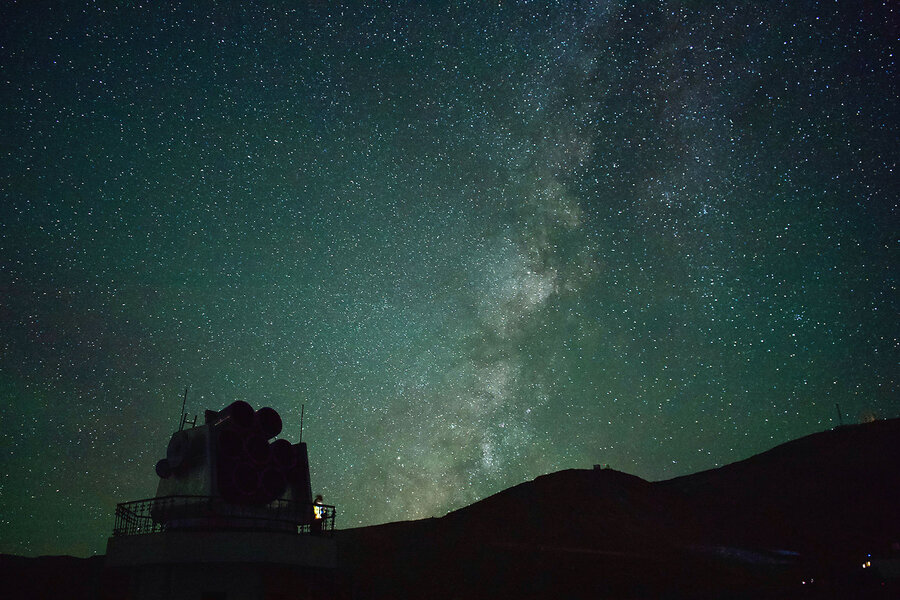
As a child, Splazer Angmo often gazed at the dome structure perched atop a hill in her village and wondered what it was. Her parents, part-time herders, were equally puzzled. The scientists who work in the village use it to look at stars, they told her.
Years later, sitting in a school classroom, she finally learned its name: telescope.
Now, she has her own telescope – a maroon, mobile instrument she sets up every evening as the village of Hanle transitions from golden dusk to a star-filled night. She is one of 25 villagers – two-thirds women – trained as “astro-ambassadors,” guiding tourists through the cosmos.
Why We Wrote This
In one of the darkest corners of the world, a group of “astro-ambassadors” are making a living off the night sky – and creating a bridge between science and tradition.
What began as an effort to preserve dark skies for the nearby Indian Astronomical Observatory has become something more: sustainable livelihoods for families who once depended entirely on herding pashmina goats and yaks. It is also helping revive interest in Hanle’s cultural heritage.
“The astro-ambassadors help us protect what makes this place irreplaceable,” says Dorje Angchuk, engineer-in-charge of the observatory. “They ensure visiting tourists understand why dark sky preservation matters, and they enforce the norms essential to maintaining the reserve. This is an extraordinary story of coexistence where science and culture strengthen each other.”

Stargazing transforms a village
Nestled between rusty-hued mountains in the cold Himalayan desert of Ladakh, close to China’s contested border, Hanle valley consists of six hamlets sitting at an altitude of nearly 15,000 feet. As night descends and villagers extinguish their lights, the Milky Way arcs starkly overhead, its stars burning with brilliant intensity against the darkness.
In 1993, Indian scientists identified this as one of Earth’s clearest observatory sites, with the valley’s skies ranking Bortle 1, the darkest classification possible. The Indian Astronomical Observatory installed the Himalayan Chandra Telescope – the dome that puzzled Ms. Angmo as a child – and several other research facilities to study the cosmos.
For years, tourists visiting Ladakh would drive to the observatory in hopes of getting to peek into the skies through these telescopes, disturbing the researchers, says Mr. Angchuk.
So, in 2022, when Hanle became India’s first dark-sky reserve – a designation that would impose stricter measures on both tourists and locals to preserve the night skies – scientists saw a dual opportunity. To help secure community buy-in for the reserve while also satisfying tourists, authorities and the observatory equipped locals with telescopes and trained them as stargazing guides.
“It was a conscious decision to train the local community so they could benefit from these skies through astro-tourism, while we continued our research,” explains Mr. Angchuk, a native of Ladakh who played a crucial role in securing community support for the project.
Locals embraced the opportunity.
“It was an amazing experience to learn about the cosmos, to understand which planets are closer to Earth and more visible,” says Ms. Angmo, who has since guided hundreds of clients through the night sky, charging about 200 rupees (roughly $2.25) a head.

The initiative has transformed the remote village, stemming the tide of rural migration as tourism businesses proliferate and revitalize the remote village’s economy. Most astro-ambassadors, including Ms. Angmo, operate their own homestays alongside their guiding work.
“Now, my husband doesn’t need to leave for work,” she says, gesturing toward a group of tourists waiting for their turn at the telescope. “While I guide visitors through the stars, he runs the homestay with me.”
Discovering Hanle’s history
Beyond income, the initiative anchors Hanle’s cultural identity. Observatory officials have encouraged astro-ambassadors to explore the astronomical knowledge embedded in Ladakhi folklore, and to reclaim this heritage.
“Our elders had a profound relationship with the stars,” says astro-ambassador Padma Ishey. “They used celestial movements for timekeeping and directions.”

Through conversations with village elders, he discovered little-known folk songs about long-forgotten constellations. “We learned by science that these stars indeed appear in the seasons our ancestors relied on them,” he says.
Tourists find this history deeply compelling.
“I’ve never seen such a clear night sky,” says Abhishek Dutta, a software engineer from Texas. “This place is extraordinary. It exists in multiple time periods at once. One foot in tradition, one in modern science. The way they coexist is beautiful.”
A 17th-century Buddhist monastery, its white walls gleaming above the valley, testifies to Hanle’s past as a silk route hub. The monks, known as lamas, say they believe that celestial movements determine auspicious timings for prayers and festivals, but this practice has been displaced by modern calendars and digital tools.
The astro-ambassador initiative has resonated so deeply that the monastery’s acting head, Nawang Tsoundu, volunteered to become one.
“The knowledge of stars is central to Buddhism, but this tradition has been fading,” says Mr. Tsoundu. “During the day, I meditate and teach. At night, I guide tourists through the stars and share celestial knowledge with the monks. I want them to understand both the science and the tradition.”