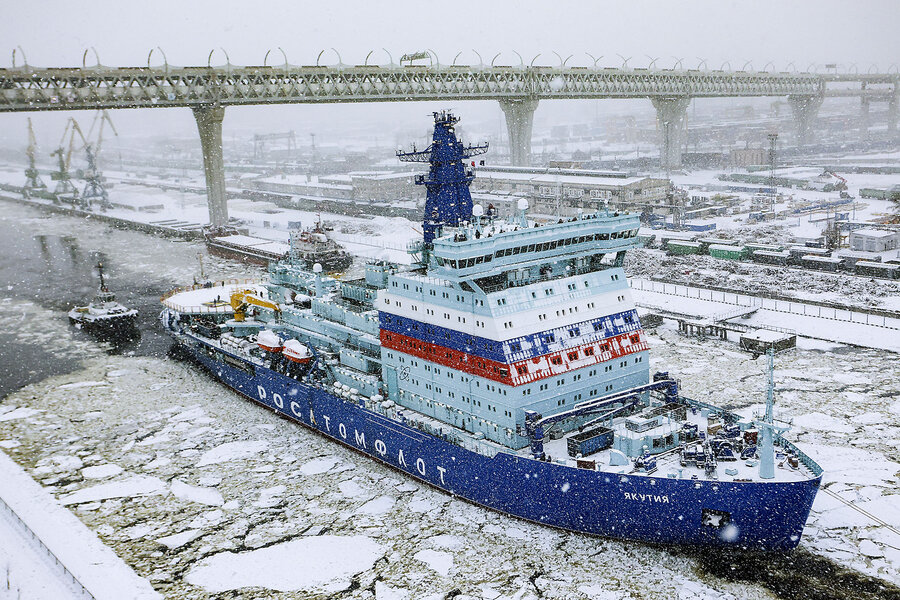
At a lavish ceremony this past November, Russian President Vladimir Putin presided over the laying of the keel for the 570-foot Stalingrad in St. Petersburg, the first step in construction of Russia’s newest nuclear-powered icebreaker.
It may not have been a coincidence that barely a week later, President Donald Trump announced an order to build 11 new icebreakers for the United States, noting the huge discrepancy between the U.S. and Russian Arctic icebreaker fleets. “We have one, Russia has 48. That’s ridiculous,” he said.
For Russia, the far north has been a zone of economic development, planned settlement, and geopolitical competition since Soviet times. It not only holds by far the largest territory of the eight Arctic nations – almost 2 million square miles of Russian land is in the Arctic. It also leads the others in terms of infrastructure, population, economic development, and military presence. Russia is currently preparing long-range plans to turn its frigid Arctic zone into a booming frontier of trade, resource extraction, and, some hope, international cooperation.
Why We Wrote This
With ice melting in the Arctic, Russia is ramping up efforts to take advantage of the newly opening territory. That means greater military and economic assertiveness, as well as attempts to build international cooperation.
It’s also building up its military forces in the region. Geopolitical tensions are on the rise, as global warming leaves more and more water ice-free for longer periods each passing year, and other Arctic countries realize the potential bonanza of undersea resources, fisheries, and potential transport routes.
Analysts say Mr. Trump’s new National Security Strategy, with its focus on hemispheric hegemony, implies greater priority in the Arctic via Canada and Greenland. The Russians say the number of NATO military drills and reconnaissance flights in the region has increased significantly in recent years, while Russia has reopened several former Soviet bases, created specialized Arctic army brigades, and beefed up its regional air force capabilities.
Some analysts suggest that a U.S.-brokered peace in Ukraine might pave the way for greater economic cooperation with Russia, in fields such as oil and gas exploration and other resource development in the Arctic. Many reports indicate that Trump envoy Steve Witkoff and Kremlin negotiator Kirill Dmitriev have been discussing wide-ranging joint economic activities, particularly in the Arctic, once a Ukraine peace settlement has been concluded.

Alexei Danichev/Sputnik/AP
“Moscow has maintained a commitment to cooperation with the U.S., and argues for separating Arctic affairs from wider geopolitical disputes,” says Pavel Devyatkin, a Moscow-based Arctic expert with the Quincy Institute for Responsible Statecraft, a Washington think tank. “In general, Russia has been adjusting its partnerships, leaning more heavily on Chinese capital and technology for Arctic development while remaining open to U.S. collaboration.”
Focusing northward
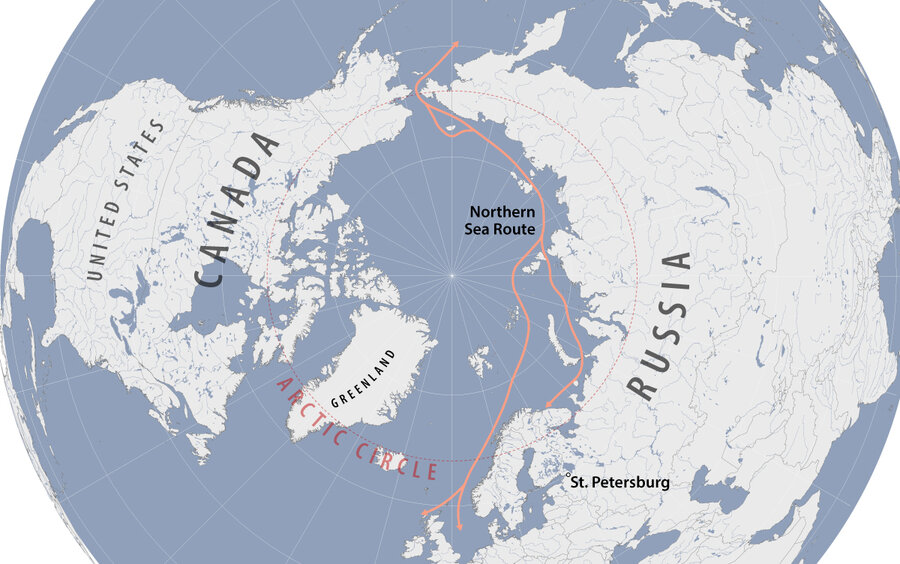
The key driver of it all is the Northern Sea Route (NSR), a 3,500-mile passage between the Far East and Europe over the top of Russia, which can save up to 15 days of sailing time compared with the traditional route through the Suez Canal. The passage is almost ice-free in summertime already due to global warming, and it is thought the seasonal window of open water will expand by months in coming decades. Until then, the icebreakers are needed to keep the sea-lane open. Hence the ambitious plans to build 14 more icebreakers, including the Stalingrad, by 2030, to add to Russia’s existing fleet of around 50 ships, eight of them nuclear-powered behemoths.
“History demonstrates that the displacement of maritime trade routes inevitably leads to the formation of new economic power centers,” says Alexander Pilyasov, an economic geographer and leading Arctic expert at Moscow State University. “Traditionally the winner will be the country that controls the route and handles the cargoes.”
This year the Northern Sea Route saw just under 40 million tons of cargo pass through it, a small fraction of the Suez Canal in a good year. But experts say the amounts are expected to increase greatly in the future. Not only icebreakers, but new logistics hubs and port infrastructure are in the works.
A statement emailed to the Monitor – signed by S.S. Litvyakov, director of the Department of State Support and Technological Development in the Arctic – said that about $35 billion in development contracts are currently underway, financed by state and private sources, for projects as diverse as modernizing port facilities, creating a fleet of search-and-rescue ships, and upgrading the satellite network.
He said dozens of new laws have been passed, aimed at stimulating economic growth and encouraging migration to the Arctic. Incentives include free land, subsidized mortgages, and other social benefits for those who move to the region. He added that all development includes environmental studies to ensure “careful and balanced approaches” that will not upset the delicate ecosystem.
“Today, the Russian Arctic zone produces 6.2 percent of Russia’s GDP and accounts for 10 percent of exports,” Mr. Litvyakov wrote. “The strategic priority is to develop the NSR,” as a transport corridor that will reshape both the Russian economy and global trade.

Russian Defense Ministry Press Service/AP/File
Sergey Grinyaev, an Arctic expert at the official Institute of Europe in Moscow, says that state-supported efforts have already improved life for denizens of the Russian Arctic, including expanded access to broadband internet – a critical factor for people who face long winters of darkness and isolation.
“The demographic situation [in the Arctic] has improved markedly” in recent years, he says. “Life expectancy in the Arctic region has increased, and the migration outflow has been cut in half. … There’s also been a lot of attention paid to the traditional economic activities of the Indigenous peoples and the development of scientific research,” in the interests of Arctic development.
Partnering up
On a recent trip to India, Mr. Putin offered Indian Prime Minister Narendra Modi privileged access to the Russian Arctic, including joint construction of Arctic-class ships and Indian access to Russian military facilities in the far north. Partnership with China is already well advanced. In addition to joint military patrols and drills, China is providing much of the capital and technology that Russia needs to modernize infrastructure, build a new generation of Arctic-capable shipping, and make the NSR into the viable East-West corridor Russian officials are dreaming about.
“More and more bilateral [Russia-China] trade is going through the Arctic seas,” says Kirill Babaev, director of the official Institute of China and Contemporary Asia in Moscow. “The Chinese are very much interested in developing the NSR as an alternative to their current routes; it will greatly benefit their external trade. And Russia is very keen to welcome foreign partners in the Arctic.”
Though Russian officials sound very upbeat about the potential for the NSR to revolutionize global trade and make Russia into a leading maritime power, few want to discuss the dark cloud hanging over all these plans. As long as the war in Ukraine continues, it will sap Russian resources and inhibit wide acceptance of the NSR as a transport bridge between the Far East and Europe.
“The imposition of sanctions against Russian companies created a serious obstacle, making it difficult to access modern technologies and attract foreign capital” into Russia’s Arctic, says Mr. Grinyaev. “In addition, the growth of NATO’s presence in the region, especially after Finland and Sweden joined the alliance, required an increase in the regional defensive capabilities of the Russian armed forces.”
The potential exists for Russia’s Arctic to become an important engine of global development and a zone of international cooperation, most experts concur. However, if the present geopolitical tensions escalate, it seems likely to become a new theater for military confrontation. That hinges upon the outcome of the Ukraine war.