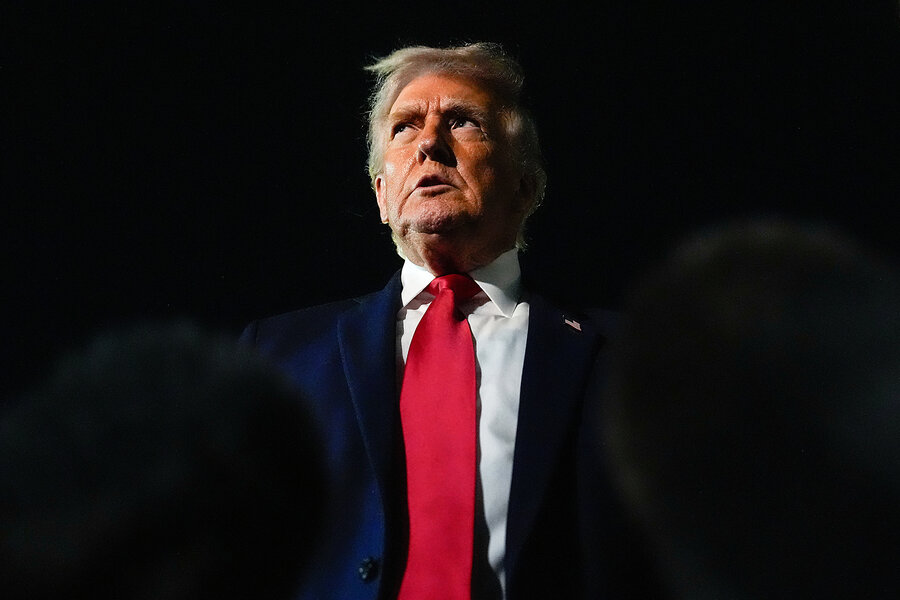
President Donald Trump is taking his boundary-pushing modus operandi on domestic affairs and applying it to the world stage.
Be it Venezuela, Iran, or even, potentially, Greenland, the president is showing a new willingness to invade or attack other countries, while running roughshod over long-standing agreements and partnerships, in a way that has put the entire world on notice.
Mr. Trump’s continued use of tariffs as leverage to gain concessions from even the United States’ closest allies demonstrates how fully he is embracing a no-holds-barred approach to global politics. He can do whatever he wants, he asserted earlier this month, limited only by “my own morality,” not international law.
Why We Wrote This
The president is showing a new willingness to invade or attack other countries, while running roughshod over long-standing agreements. Lately, his focus on Greenland has shaken the NATO alliance and put the entire world on notice.
His dogged insistence in recent days on the need to take Greenland from Denmark, despite strong opposition from Europe and even many Republican lawmakers, has set off alarm bells throughout the West.
When Mr. Trump addresses the World Economic Forum in Davos, Switzerland, on Wednesday, Greenland will be top of mind. The foundations of NATO have been shaken to their core, the transatlantic defense alliance’s very existence in peril.

“As I expressed to everyone, very plainly, Greenland is imperative for National and World Security,” Mr. Trump wrote on social media early Tuesday. “There can be no going back — On that, everyone agrees!”
Mr. Trump argues that acquiring Greenland is essential to his “Golden Dome” security proposal, which aims to protect the United States from a missile attack, and that Europe is incapable of defending the island against Russia or China. The U.S. already has a military presence in Greenland, under a 1951 treaty with Denmark, but the president calls it insufficient to protect the massive, resource-rich Arctic island. Both he and Vice President JD Vance have also targeted Greenland’s economic assets, highlighting the island’s oil, gas, and rare-earth minerals, as well as its access to shorter trade passages through the Arctic.
Democratic and European critics say that Mr. Trump’s claims about the need to take over Greenland – by force, if necessary – are unnerving.
“These are the ramblings of a man who has lost touch with reality,” Democratic Sen. Chris Murphy of Connecticut wrote Monday on X.
A pivot to international affairs
In many ways, Mr. Trump is unique in the annals of the American presidency. But in at least one regard, as a second-term president, he is following a well-trod path with his sharp pivot to international affairs.
Two-term presidents often focus on domestic matters such as the economy in their first term, as those are usually top of mind for voters, and then work on legacy-building in the second term, often in the foreign arena. For Mr. Trump, some of his foreign policy focus is a matter of circumstance, as he inherited two significant international conflicts from President Joe Biden: Ukraine and Gaza.
Still, Mr. Trump’s foreign ambitions have gone way beyond these immediate crises and into territory unimaginable until recently – from his threat to turn Canada into the 51st state, to the idea of retaking the Panama Canal, to suggestions of U.S. military action against Mexico, Cuba, and Colombia.
Mr. Trump’s insistence on hemispheric dominance has been dubbed by some analysts a new “Donroe Doctrine.” The upcoming 250th anniversary of the July 4, 1776, signing of the Declaration of Independence could also be a factor in Mr. Trump’s calculation of global image-making. But whether there’s a larger strategic imperative behind Mr. Trump’s actions, the desire for some kind of permanent legacy seems indisputable.
“The president may not have a grand strategy, but he does have a sense of his own place in the world and the American place in the world,” says Russell Riley, co-director of the Presidential Oral History Program at the University of Virginia’s Miller Center.
Winning the Nobel Peace Prize became a singular obsession of Mr. Trump’s first year back in the office, as he claims to have ended eight wars, a disputed figure. Last week, Venezuelan opposition leader María Corina Machado – the winner of the 2025 peace prize – gave the president her Nobel medal during a visit to the Oval Office, though the Nobel Foundation stated that the prize cannot be transferred, “even symbolically.”

Daniel Torok/The White House/Reuters
On Monday, news broke that Mr. Trump had sent the Norwegian prime minister a message indicating that his push to take over Greenland was tied to his not winning the Nobel Peace Prize. The president wrote that he no longer feels an “obligation to think purely of Peace.” (Norway’s government responded by noting that it does not actually award the peace prize.)
Trump’s travels
Mr. Trump’s international focus this term has been reflected in his travel schedule. In the first year of his first term, he took four international trips, with his trip to Davos on Jan. 25-26, 2018, marking the fifth. In this second term, Davos will be his ninth international trip.
Many U.S. presidents enter office with little foreign policy experience, but by the second term, “are more comfortable dealing with the world stage,” says Tevi Troy, a presidential historian and senior fellow at the Ronald Reagan Institute. Often, at that point, signature domestic items have already been fulfilled, and the clock is ticking on their legacy.
Much of Mr. Trump’s domestic travel this term has been either to his estates in Florida and New Jersey or to sporting events. Add to that the stream of world leaders who have come to see Mr. Trump in the Oval Office, plus a key domestic trip with an international focus – his summit in Alaska last August with Russian President Vladimir Putin.

The president’s efforts to sell the public on his “Big Beautiful Bill” – the signature legislative achievement of his second term so far, including tax cuts and funding for immigration enforcement – took place largely in Washington.
Lately, top aides have been urging him to get out more domestically and talk about the economy and affordability to help Republican candidates in the midterm elections this November. At a rare rally last month in Mount Pocono, Pennsylvania, Mr. Trump said that White House Chief of Staff Susie Wiles had told him, “We have to start campaigning, sir.”
As a lame duck, Mr. Trump himself won’t be on the ballot again in 2028. Still, he knows this year’s midterms matter. His Republican Party controls the House by a tiny margin, and could well lose its majority, hindering his ability to pass legislation. In a recent speech to House Republicans, he said Democrats will “find a way to impeach me” if they retake the House.
But as Year 2 of Term 2 begins, Mr. Trump appears more confident and unbridled in his use of power than ever – and he is sticking to his international focus.
“He’s trying to do things without worrying about Congress or the courts,” Dr. Troy says. “Foreign policy is one of those things.”