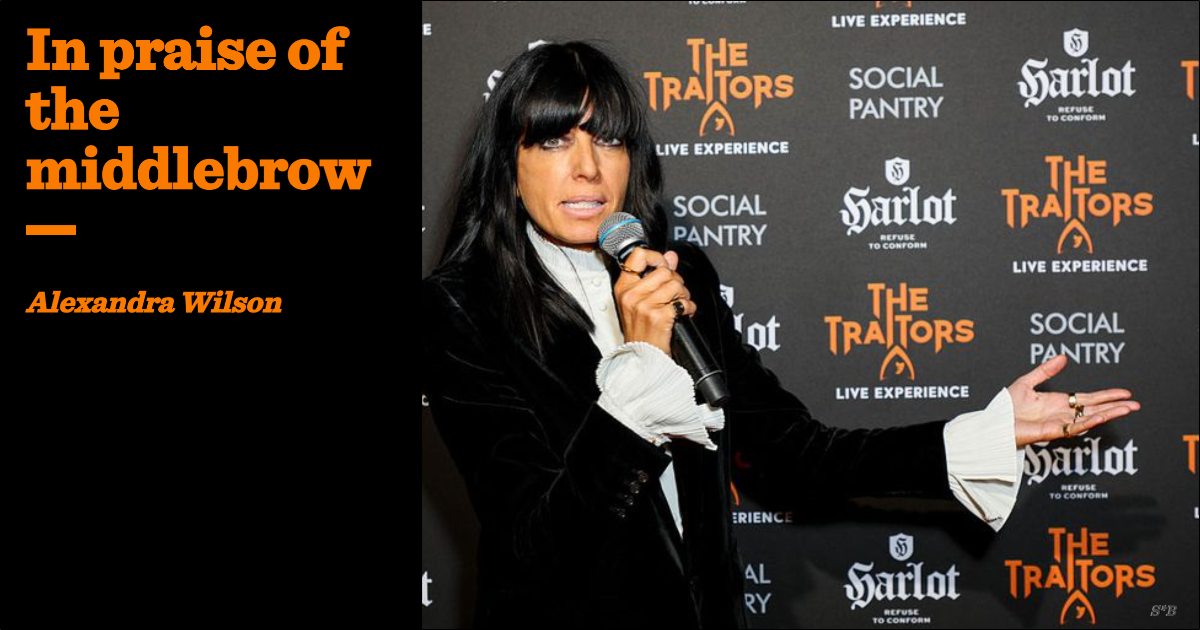
It’s become one of those tiresome social media tropes. Someone writes, “Am I the only person out there who’s never seen Masterchef / Race Across the World / Strictly?” (Delete as appropriate.) The person posting surely knows they aren’t, but they’re on the hunt for likes and comments from other people keen to boast that they too have superior tastes and would never watch such rubbish. As I write, it’s the hit series The Traitors that’s prompting displays of cultural aloofness.
I’ve been guilty of something similar myself. When my teenage son started watching The Traitors, my default reaction was to walk in, take one look and say “Turn off that rubbish!” But when I actually sat down and watched it, I discovered that it is not only tremendous fun but completely addictive. Whereas Masterchef is wallpaper TV — watchable enough but so bland you can’t remember the contestants’ names five minutes after switching off — The Traitors is clever and witty, constantly reinventing and subverting its own formula. Of course, we know full well we’re being manipulated. But the producers are highly skilled at hooking you in and keeping you hooked, making you care about the participants, whether they be national treasures (in the recent celebrity version) or people you don’t know from Adam.
The show gets better with each successive series, as the producers have begun to realise that skewing the cast slightly older raises the level of conversation. We’re seeing a shift away from a predictable type of surgically enhanced celebrity-wannabe towards a more interesting selection of people who’ve analysed the game’s structure and tactics and are there for the mental challenge. Casting not one but two barristers (one of them now a crime novelist), a psychologist and several police officers has upped the ante, though it was slightly concerning to see a detective prove no better than anyone else at identifying suspects. The addition of a “secret traitor” this time around has shown us, the audience, that it’s not as easy as it looks.
The nub of what fascinates about The Traitors is the way in which it acts as a petri-dish of human behaviour combined with a real-life game of Cluedo. What happens when you assemble a group of people from totally different backgrounds, whose paths would never otherwise cross, put them in an intense closed environment and ask them to solve a problem? It’s a completely artificial situation, and yet I can imagine exactly how it feels.
Weird though the analogy might sound, aspects of The Traitors transport me back to teaching music at Open University summer schools in the late ‘90s and early 2000s. There too we were removed from the routines of daily life, put in a group with people of all ages, occupations and backgrounds, and completely immersed in our shared passion. We studied together, ate together, drank in the bar together: one lunch and an introductory seminar in and we were the best of friends. Nobody had a smartphone or social media, of course, and for one week only nothing outside of that environment mattered. So when the contestants on The Traitors go around hugging people they have only known for a few days or saying they feel as close to another contestant as they do to their mum, I get it. The withdrawal symptoms when they leave the castle will be real.
If The Traitors appears superficially to be all about skullduggery and backstabbing, it actually has a more positive message to share — that we could bond with people who seem different from us if only we had a chance to meet them. It is cross-generational, furthermore, in both its format and its audience appeal, bringing together teenagers, parents and grandparents, a total outlier in our age of atomised viewing.
Limiting “screen time” is one of the ten commandments of modern parenting, but I’ve always regarded watching television together and talking about what we’ve seen as quality time with children, far preferable to the alternatives in an age of computer screens and smartphones. Our family viewing has ranged widely. Sometimes, it’s more serious stuff: University Challenge, Only Connect, documentaries about history or space, and all my favourite period dramas. (An encyclopedic knowledge of Pride and Prejudice gleaned from repeated viewing of the 1995 BBC adaptation offered a head-start when the book recently came up on the GCSE syllabus.) Sometimes it’s comedy: we’ve laughed and let off steam at Fawlty Towers, Would I Lie to You?, and all 201 episodes of the American version of The Office. Time wasted? I don’t think so.
More recently, my teenager has started to introduce me to enjoyable shows I wouldn’t otherwise watch, or even have known about. I’m currently hooked on a video series called Jet Lag: The Game, in which three bright young Americans play intricate games of hide and seek or tag across the rail networks of entire countries or even continents. It’s fun, it has elements of jeopardy, and it has opened our eyes to interesting locations we now might think about visiting ourselves.
Avoiding things purely because they have mass appeal isn’t a badge of honour
Of course, there is plenty of cheap filler on television today that’s well past its sell-by date and deserves to be binned. As I’ve written here before, I find it saddening that the BBC has abandoned so much of its more “highbrow” programming. The corporation needs to regain its nerve, worry less about the threat from commercial competitors, and show more high-quality arts programmes, serious dramas and documentaries, without apology.
But there is a place for pure entertainment as well and The Traitors has shown me that popular ratings hits are not all cut from the same cloth. Although my natural inclination is to go against anything that’s over-hyped, avoiding things purely because they have mass appeal isn’t a badge of honour. When it comes to culture, whether it be TV or books, I always think it’s most satisfying to have eclectic tastes, to try a bit of this and a bit of that, and to ignore any talk of “guilty pleasures”. There’s much to be said for being a middlebrow.