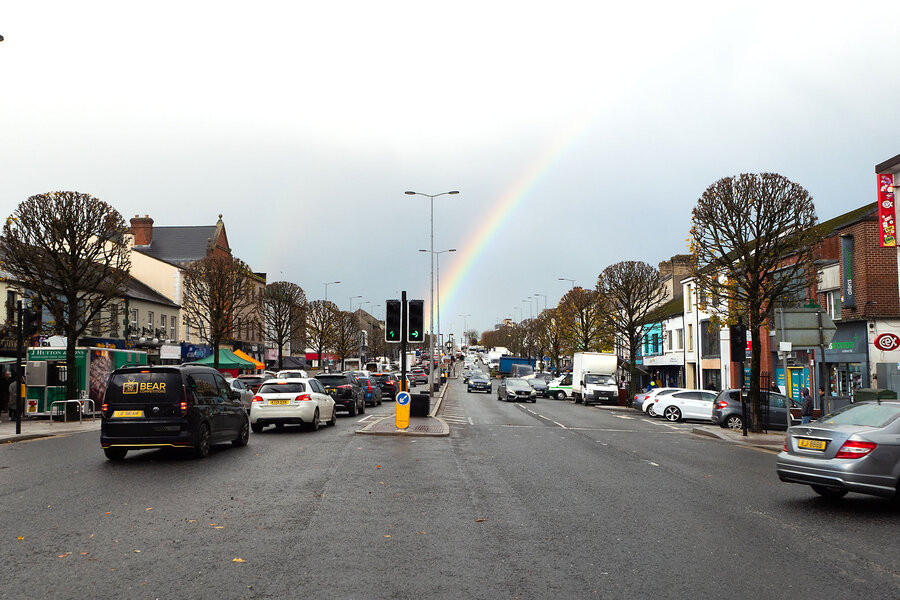
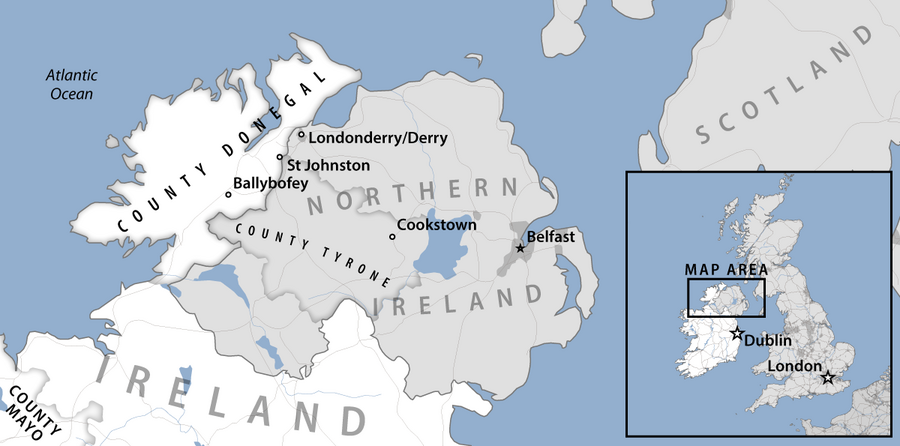
The Protestant and Catholic residents of this small town, located in the geographical center of Northern Ireland, are united in an unusual claim: that it has the longest and widest main street on the entire island of Ireland.
And people from both sides of the sectarian divide frequent the same establishments.
Indeed, Nigel Lindsay, who owns a local bicycle repair shop, says Cookstown is “one of the best towns in Northern Ireland for mixing.” Known locally as “the bike man,” Mr. Lindsay was raised as a Protestant in a unionist community traditionally attached to its British identity, but he lives right next to the Ratheen housing project, inhabited by Catholics mostly tending toward Irish nationalism.
Why We Wrote This
The winds of reunification have been blowing more strongly recently in Northern Ireland. That’s because members of traditionally unionist Protestant communities are starting to look toward the republic.
If Northern Ireland’s political future were to come to a vote, Mr. Lindsay reckons he would vote not along sectarian lines, for the unionist position, but for the republican one. “People would be better off, especially the younger generation,” if Ireland were a united island, he says.
While the Good Friday Agreement, a multinational treaty signed in 1998, brought peace of a sort to Northern Ireland after three decades of sectarian conflict known as the Troubles, the debate over whether the territory’s future lies with the United Kingdom or with the Republic of Ireland has never gone away.
Until now, the pro-British unionists have held sway. But recent political shifts in Northern Ireland and the republic have made the prospect of a reunited Ireland – that is, Northern Ireland rejoining the republic – appear more viable. And if it does one day come to pass, it will be because of voters like Mr. Lindsay.

With around 1 in 5 children living in relative poverty, according to a Northern Ireland Audit Office report last year, many people feel the same way. The big question is whether there are enough of them to swing the vote toward a united Ireland.
“There is some sign that in the coming years, there may be a move in the direction of unity, but it’s far from certain,” says Alan Whysall, an honorary senior research associate at University College London’s Constitution Unit.
Shifting views on a unified Ireland?
The process leading to the possible reunification of Ireland was set by the Good Friday Agreement. Under the accord’s terms, a vote on unification (often referred to as a border poll) could be held in the north if the British secretary of state for Northern Ireland deemed a majority there would vote “yes.”
Until recently, the Democratic Unionist Party has dominated the power-sharing Northern Ireland Assembly in Belfast, making such a majority appear impossible. But last year, the nationalist party Sinn Féin edged out the DUP in elections, putting it into power for the first time ever in the Assembly.
That shift, combined with the election of pro-reunification Catherine Connolly to the presidency of the Irish republic in late October, has built momentum for reunification.
If a border poll were held in the north today, it would still likely be defeated. A February poll conducted by LucidTalk for the Belfast Telegraph showed 41% backing a united Ireland, compared with 48% who would prefer to stay in the union with Britain.
But polling over recent years shows support for a united Ireland growing steadily. The seven-point gap in the 2025 LucidTalk poll was narrower than the 10-point margin recorded last year, following a trend that has developed over the past several years.

Unresolved questions
Reunification would bring with it a lot of questions that have yet to be seriously addressed, notes Mr. Whysall of University College London. “We have not debated many of the serious issues that would arise from unity,” he says. “When it is debated, there could be some hesitation, for example about the integration of health systems and whatever else. That sort of thing is capable of provoking a great deal of caution.”
Bryan Ferraty, a young welder from a Catholic background, appears to agree. Hanging out with friends from both communities at the Cartwheel Bar in Cookstown, he says he “feels more Irish.” But he worries about losing access to Britain’s National Health Service, with its free lifetime membership. While wages are higher in the republic, he worries that he would pay more for treatment in Ireland’s public-private health-care system.

His friend, Michael Conlan, a musician who is also Catholic, is tempted by the promise of a better quality of life in a united Ireland within the embrace of the European Union. But he questions whether the north would be welcomed.
“They [the republic] think that if there’s a united Ireland, the north will bring the violence with us. There will be another 2 million people to look after, mouths to feed, more people to educate,” he says.
Floating voters?
Elsewhere in the Cartwheel, best friends Gracie Mae Hunter and Erin Greer, both 18, come from opposite sides of the sectarian divide: Ms. Hunter is Catholic, Ms. Greer a Protestant. But the two women share the same preference for quitting post-Brexit Britain because of British policy on the Israel-Palestine conflict. Ms. Greer criticizes Westminster for continuing to approve arms exports to Israel. “I would never want to be affiliated with a government that did that,” she says.
Ms. Greer is keen to know what position the Alliance Party will take on reunification. The Belfast Assembly’s third-largest bloc has gained in popularity in recent years, attracting voters who are not wedded to either side of the old ideological divide. But it has yet to stake a position on reunification.
Alliance has pushed for more access to integrated schools teaching children from a mix of backgrounds. Ms. Greer and Ms. Hunter both attended Sperrin College, one of around 70 integrated schools in Northern Ireland, where they learned the history of Ireland, including brutal episodes of British colonial rule, such as the mid-19th century famine.
“I can see very clearly that partition never should have happened,” says Ms. Greer. Unionist members of her family would not necessarily approve of her views, she acknowledges. “But at the end of the day, it’s my vote and my decision.”

Entrenched positions
Below the surface, some residents still cling to their entrenched identities. In the predominantly unionist Monrush housing development, a few Union Jacks and red and white Ulster Banners representing Northern Ireland’s six counties flutter in the wind. Standing in his garden with two yapping chihuahuas, Gary Young is adamant that he would take up arms if reunification happened. His allegiance, he says, is to the British crown. “It goes that deep.”
He agrees that Cookstown is a place where people can mix freely, alluding to his Catholic colleagues and friends. But he thinks Northern Ireland is doing fine where it is.
“When I was growing up, if you dated a Catholic, you would have your window smashed,” Mr. Young says. But now, things have changed, and people are accepting initiatives like integrated schooling, he points out. “Why keep pushing for a united Ireland when we’re integrating here?”
On the other side of Monrush, a teenager out to buy milk confesses that he sees the republic as a “better option.” Speaking on condition of anonymity, he does not identify with the brand of British pride espoused by the Reform UK party, which is polling well on the mainland. But he says he could never share his views on the estate.
He reckons people will “assume that it’s the end of the world and start to attack each other,” if a border poll were held now. “Give it 50 years and a lot of the sectarianism will have gone,” he says. ”It’s just a pity I’ll be 70 by then.”