Just as Iraq was emerging from the shadows of decades of conflict and enjoying a surge in economic activity and stability, the country is being dragged into a regional war.
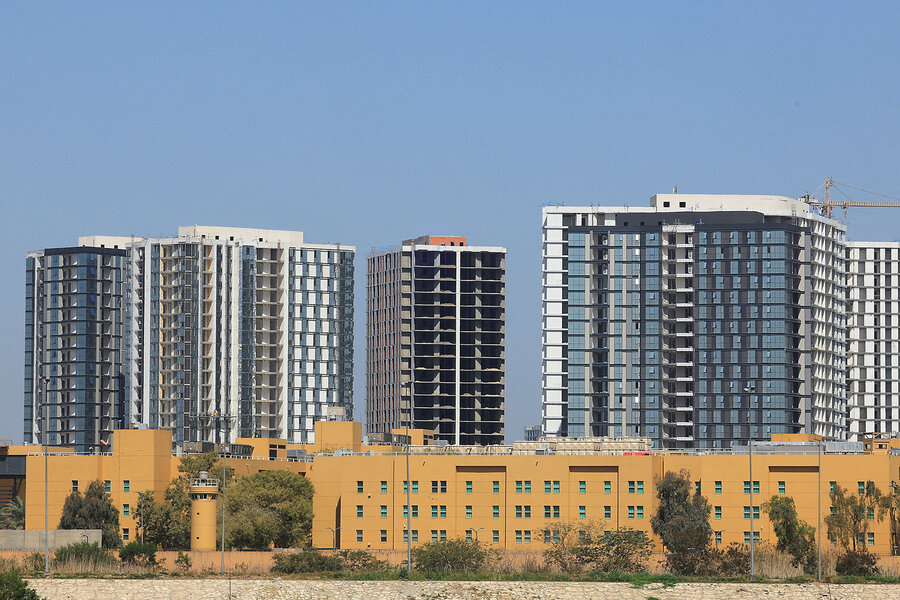
Prior to the United States and Israel launching their attacks against neighboring Iran on Feb. 28, construction in Iraq was booming. Baghdad, the scene of countless suicide bombings over years of sectarian strife, was witnessing a renaissance.
Energy, commercial, and housing projects were sprouting up, paving over damage left behind by the 2003 U.S. invasion and occupation and, years later, the war against the Islamic State group, which had conquered parts of Iraq and Syria in its bid for an independent Sunni Muslim caliphate.
Why We Wrote This
After decades of conflict, Iraqis have enjoyed increased political stability and a promising future, even embracing a unified national identity. But attacks by Iran, the United States, and homegrown militias are tugging at the divides that had held Iraq back.
Iraq, an important center of Shia Islam, has a Shiite majority but large Sunni Arab and Kurdish minorities, each, traditionally, with their own political goals. But a unified Iraqi national identity has been emerging in line with the country’s embrace of an increasingly stable democracy.
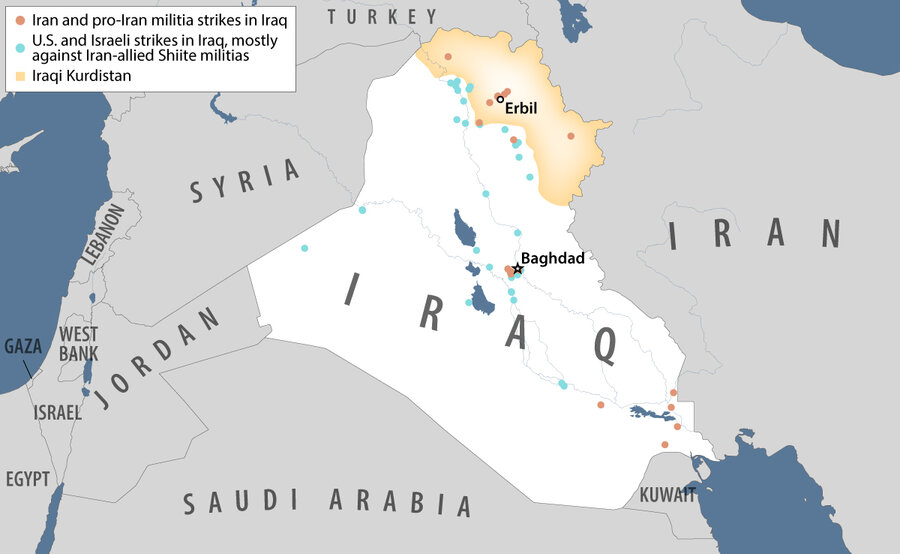
Then, late Tuesday, Iraq was witness to a worst-case scenario: an attack by Iran-allied Shiite militias on the U.S. Embassy compound in Baghdad, the biggest such attack in years, and missiles and drones raining down in the capital and in Erbil in the Kurdish north. The strikes, which continued on Wednesday, highlight the potency of the Iraqi Shiite paramilitary groups, which have political and armed wings loyal to Tehran.
Beyond the militias’ targeting of U.S. bases and diplomatic missions – hundreds of U.S. military personnel, diplomats, and contractors reportedly remain in Iraq – the conflict is tugging at the old sectarian, ethnic, and political divisions that had held the country back for decades.

Khalid Al-Mousily/Reuters
Paramilitary groups
The war is jeopardizing a period in which Iraq’s sectarian groups and political factions had started to peacefully share the country’s resources, though not always transparently or fairly, giving Iraq a recent aura of calm.
Many of the pro-Iran paramilitary groups fall under the umbrella of the Popular Mobilization Forces, armed Iraqi Shiite groups that were formed to fight the Islamic State group in the mid-2010s and are recognized by the state.
As semi-official entities, they receive funds from the Iraqi budget and have a mandate from Parliament. The groups were believed to be committed to parliamentary politics, and only weeks ago had their eyes on Cabinet posts and new lucrative government contracts.
Yet, even before this war, pressure was mounting on the government to bring them firmly under control.
The caretaker prime minister, Mohammed Shia’ al-Sudani, and other Shiite political officials previously were able to rein them in; during last June’s Israel-Iran war, in which the U.S. took part, the officials prevented conflict from spreading into Iraq.
Institute for the Study of War and AEI’s Critical Threats Project
|
Jacob Turcotte/Staff
In this war, it was hoped that, as in last June, these groups would not risk their economic and political gains on Iran’s behalf. Baghdad’s efforts were successful for a few days. Then, the missiles and drone strikes came.
In addition to hitting the U.S. Embassy, the militias have struck Baghdad International Airport, the U.S. Consulate in Erbil, airports and hotels in Iraqi Kurdistan, and Baghdad’s Rashid Hotel, which houses diplomatic delegations of the European Union and Saudi Arabia, sparking an exodus of diplomatic staff from the Iraqi capital.
U.S.-Israel attacks “hit close to home”
Observers say these groups were swayed by the killing of Shiite clerics in Iran.
“The way in which the U.S. and Israel killed the supreme leader of Iran in its opening salvo, the symbolism of him being an ayatollah, a religious leader, had an impact” on these groups, says Hamzeh Hadad, a political analyst and adjunct fellow for the Center for a New American Security in Washington.
The U.S. launching of the war “hit close to home for a country that was invaded in 2003,” Mr. Hadad says.
In response to the militia attacks, the U.S. has launched deadly airstrikes targeting paramilitary leaders in Baghdad residential neighborhoods, killing innocent civilians as well.
Kata’ib Hezbollah, considered to be the most powerful armed Shiite Iraqi group, vowed in a statement on Wednesday that it will continue attacks “until the last foreign soldier leaves Iraqi territory. … Either everyone enjoys security, or no one does.”

The spiraling violence finds Iraq without an elected government. Inconclusive parliamentary elections in November have been followed by contentious horse trading among the parties in an attempt to form a governing coalition. The paramilitaries’ strikes are testing a delicate balance maintained by the lame-duck government headed by Mr. al-Sudani, who is still in the running to form a new coalition.
Mr. al-Sudani has rejected Iraq being used to launch attacks against other countries, a point directed at the U.S., and opposes strikes on its territory.
On Wednesday, his office stated that “outlaw groups have carried out a criminal act of aggression” in the U.S. Embassy attacks, saying it “constitutes a blatant terrorist assault on Iraq’s sovereignty” and might lead to “measures that threaten the interests of our nation and our people.”
Mr. al-Sudani has consistently courted Washington and promoted Baghdad as a government that shares U.S. President Donald Trump’s vision of economic prosperity and dealmaking.
But there are limits as to how far Mr. al-Sudani can curb these paramilitaries, insiders warn.
Kurdistan, “the other Iraq”
Pro-Iran militias and Iran have struck Iraqi Kurdistan with dozens of missiles and drones since the conflict began, shattering its stability. For two decades, the autonomous Kurdish region has been a safe haven amid Iraq’s turmoil, earning it the nickname “the other Iraq.”
Kurdish officials are accusing Baghdad of refusing to act against the Shiite groups. Aziz Ahmad, deputy chief of staff to Kurdistan Prime Minister Masrour Barzani, charged on Saturday that “these militias are part of the government and Parliament.”
Iraqi militias and Iran have also targeted Iranian Kurdish opposition groups, who have been living in Kurdistan for decades, and whom the U.S. and Israel have looked toward as potential partners in the war.

Iraqi Kurdistan President Nechirvan Barzani has pledged his region would “in no way be part” of the war in Iran, and stressed in a phone call this month with Iranian Foreign Minister Abbas Araghchi that Iraqi Kurdistan will be a “factor of peace.”
Yet this has not slowed the attacks.
The government in Baghdad has warned Kurdistan not to allow Iranian Kurdish fighters to get involved and threatened to send federal troops into the autonomous region, a move that could potentially put the two regions of Iraq into direct conflict.
As part of previous agreements with Iran, Iraqi Kurdistan has kept opposition groups away from the border, but, notes Middle East political analyst Shivan Fazil, a Kurdistan expert, Iraqi Kurdish officials are under pressure from Iran, Iraq, and the U.S.
“If push comes to shove, and the grand plan comes [for] toppling of the regime, it will be very hard for border units to hold back their fellow Kurds from Iran” from seizing the opportunity and opening up a Western front, Mr. Fazil says.
“This could be an opportunity,” he cautions, “but it can also threaten the institutions and model system [that] Iraqi Kurds have built the last three decades.”
Dwindling oil production
Iraq is confronting the deteriorating political and security situation amid economic turmoil.
Because of Iran’s closure of the Strait of Hormuz, Iraq cannot ship oil from its vast reserves in the south, bringing to a halt Iraq’s normal prewar exports of some 3.4 million barrels per day.
Iran has also struck Basra’s oil fields multiple times and hit Iraqi oil tankers standing in Iraqi waters. The attacks have cut Iraq’s oil production by about two-thirds.

Iraq is dependent on oil sales for 90% of government revenue and roughly half the country’s gross domestic product.
In a rare breakthrough, late on Tuesday, Baghdad came to an agreement with Kurdistan to export Basra’s oil via the country’s last working pipeline – running from Kirkuk, on the edge of Iraqi Kurdistan, to Turkey. Yet the Kirkuk-Turkey pipeline can carry just 450,000 barrels per day.
As the war continues, observers say both Iran and the U.S. are hurting their support among Iraqis fed up with external interference and war.
“One side is attacking your oil in Basra, the other is attacking neighborhoods in your capital,” and killing civilians, notes Mr. Hadad, the analyst.
Iraq’s political elites and observers are wary that the violence and pressures could make it vulnerable to U.S. sanctions.
“Despite Iraq’s problems, it still had an open avenue to the global market,” says Mr. Hadad. “Iraq is a democratizing state with free and fair elections, with ties to Iran, [the] U.S., and the Gulf, and the ability to speak with everyone.
“The fear is this time if the violence grows, Iraq will be pushed into becoming a pariah state.”