The Iran War got a lot more complicated for President Donald Trump this week. For while he was able to trumpet the enormous damage being inflicted on Iran’s missile, drone, and naval forces, he also found himself facing a new, far trickier kind of adversary.
Not a drone factory to be rocketed, a naval vessel to be torpedoed, or a bunker to be busted.
Instead, he’s confronting a stubborn economic reality – one that had frustrated him long before the war, and which he has spent much of his first year back in office trying to redefine according to “America First” rules, imposing protectionist tariffs on U.S. trading partners.
Why We Wrote This
The Iran war shows that despite President Trump’s rejection of globalization in favor of U.S.-dominated mercantilism and tariff pressure, the world economy still relies on a complex set of international links that can impact all, including the United States.
It’s globalization: the intricate series of connections through which countries have for decades ordered a growing trade in the resources, commodities, manufacturing components, staple goods, and consumer products that keep the world’s economy running.
This week’s leap in oil and gas prices drove home the continuing importance of these global connections – and how the war, by imperiling them, is exacting a pocketbook price in countries worldwide.
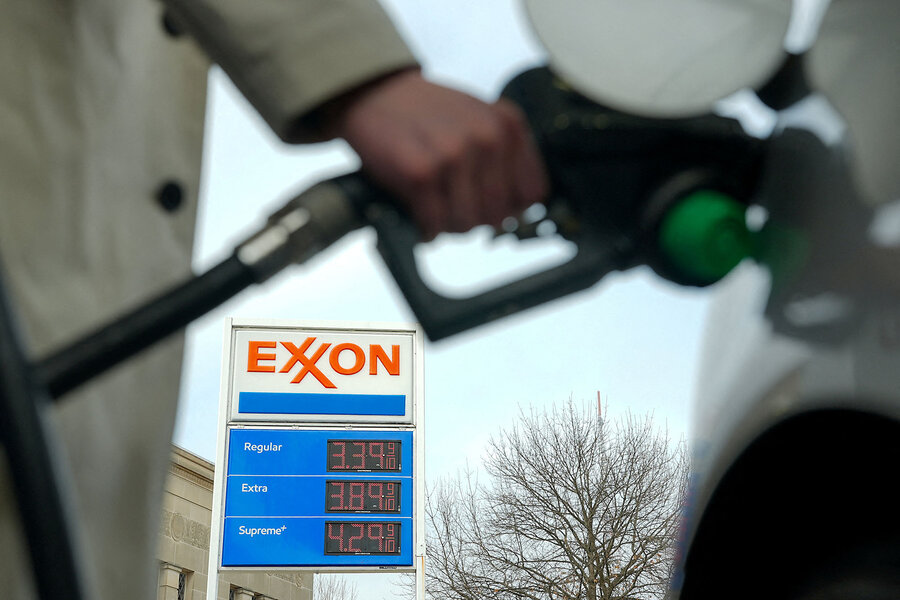
In America, too: gas-pump prices have increased sharply, and American farmers face the prospect of a similar spike in fertilizer costs.
The challenge for President Trump is that the longer the trade disruption goes on, the harder it’s going to be to mitigate the economic shock waves – with potential political implications in the run-up to this November’s midterm elections.

That may be why he has alternately been threatening fearsome retribution if Iran continues to enforce a closure of the critical Strait of Hormuz oil-shipping route, while also hinting he might call an early end to the war.
In another sign Mr. Trump is keenly aware of the economic spillover from the war, the United States joined other major member states in the International Energy Agency on Wednesday in agreeing on the largest-ever release of world oil reserves: 400 million barrels in all.
The aim is to avoid further price hikes. But even the record size of the IEA intervention won’t compensate for the reduction in world supply if the war goes on for much longer. Before the war, a fifth of the world’s oil passed through the Strait of Hormuz, the bottleneck at the lower end of the Gulf.
The spike in oil and gas prices has implications beyond the gas pump: Fossil fuels remain essential to almost all national economies. A sustained price increase risks hurting producers and consumers alike, adding to inflation, pushing up interest rates, and potentially slowing growth.
That’s an especially urgent worry for Asian countries, energy importers that get most of their oil, and liquid natural gas, from the Gulf. Europe is also heavily reliant on liquid natural gas from the Gulf state of Qatar.

And while one of Mr. Trump’s policy priorities has been to expand domestic oil and gas production, even that can’t insulate American consumers from the kind of international price increases seen since the start of the war.
The world oil price is a function of overall global supply and demand. The removal of a sizable chunk of supply means that the price for everyone, everywhere has gone up.
Yet the global trade tremors go beyond oil and gas.
Arab Gulf nations – targeted by Iran in a bid to widen the war and bring pressure on Mr. Trump to end it – also produce other commodities, including aluminum and nitrogen.
And three Gulf countries – Saudi Arabia, Qatar, and Iran itself – provide more than 10% of the world’s fertilizer.
All of these exports typically go through the Strait of Hormuz, and their world-market prices have shot up.
Iran this week repeated its threats to fire on any ships trying to enter the Strait of Hormuz. On Tuesday, the U.S. destroyed 16 Iranian vessels to pre-empt attempts to mine the waterway. Yet hours later, Iranian projectiles hit three cargo vessels attempting to pass through the strait. Overnight Thursday, attacks on two oil tankers prompted two neighboring states, Iraq and Oman, to shut oil terminals.
The war has also impacted global trade in another way: not just on the water, but through the air.

In recent years, the United Arab Emirates has become a major global air-cargo hub, handling everything from specialized industrial components to computer chips and smartphones. Its Dubai Airport has become the world’s second busiest.
Both the UAE and other Arab Gulf states had to close their air spaces early in the war. Though they’ve mostly reopened, they still remain vulnerable to Iranian attacks.
Some freight carriers, meanwhile, have been rerouting flights into a narrow corridor across central Asia – between the conflict zones around Ukraine and Iran – even though that’s added to transport costs, since the price of jet fuel has also been driven up by the war.
That hard-nosed business decision highlights the dilemma facing Mr. Trump as he weighs when and how to bring it to an end.
Yes, U.S. forces, along with Israeli airstrikes, have destroyed much of Iran’s military infrastructure.
But as the redrawn air-freight route reflects, they’ve not yet been able to dismantle Iran’s military capacity altogether, and keep the Iranians from continuing to mount targeted missile or drone strikes against shipping and oil facilities in the Gulf.
Mr. Trump may decide – as he told a rally in Kentucky Wednesday – to try to “finish the job” militarily.
But he’ll know that until and unless that happens, his other adversary – the economic dislocation and damage being caused by the war – won’t be easily defeated.