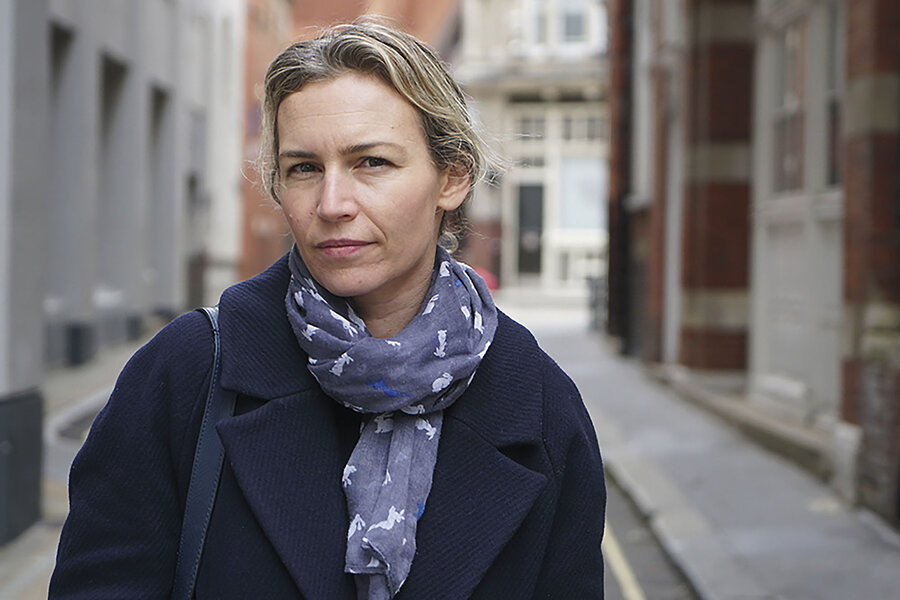
Political philosopher Lea Ypi, while visiting Greece, mentioned to a young intellectual that she was there to research her late grandmother’s life in the government archives. “Women and archives,” he replied. “Good luck with that. You’re better off writing a novel.”
In a way, Ypi has. “Indignity: A Life Reimagined” charts her attempts to locate information about her grandmother, Leman Ypi, in the declassified records of communist Albania’s secret police, among other places. In 1936, at age 18, Leman gave up a privileged existence in Salonica, Greece – where her family was part of an ethnic Albanian minority – to move, alone, to the Albanian capital of Tirana.
To compensate for the many gaps in the archives, Ypi, a professor at the London School of Economics, has created an arresting hybrid work. “Indignity” features nonfiction chapters detailing her investigation into Leman’s life, reproductions of historical documents pertaining to her family, and fictionalized sections in which she imagines her grandmother’s experiences as she navigated a tumultuous historical era.
Why We Wrote This
Family stories are often half-remembered by the tellers. But sometimes, facts are left out and questions remain unanswered, especially when the family history intersects with war, dictatorship, and survival.
A stranger’s post on social media prompted Ypi to write the book. The post featured a photograph, unfamiliar to the author, of Ypi’s paternal grandparents on their honeymoon in the Italian Alps in 1941. The photo was unsettling to Ypi, as her grandmother, with whom she was close, appears relaxed and smiling even as World War II raged and Mussolini’s Italy was allied with Nazi Germany. (Leman died in 2006, while Ypi’s grandfather, Asllan Ypi, died in 1980, when the author was an infant.)

Ypi was further unsettled by reactions to the photo, which was widely shared in Albania because of the author’s prominence. (Her first book, 2021’s “Free,” a memoir in which Ypi recalls growing up in an Albania transitioning from communism to capitalism, was a bestseller that also made her a target of criticism in her native country.) Some of the commenters condemned Ypi, but one zeroed in on Leman, claiming that she was “a communist spy. And before that, a fascist collaborator.” Ypi writes, “What if those anonymous users commenting on the photo have uncovered something that has been hidden from me?” “Indignity” represents her effort to answer that question.
The vivid fictional chapters elaborate on family stories told to Ypi by her grandmother years ago – a great-great-grandfather who died after gorging himself on baklava, a great-aunt desperate to escape an arranged marriage. The author creates scenes explaining why the fiercely independent Leman left Greece for Albania, a country she had never seen, suggesting that Leman herself hoped to avoid an unwanted marriage.
In Tirana, Leman found work as a civil servant and met Asllan, son of Xhafer Bey Ypi, who briefly served as Albania’s prime minister. Unlike his father, who supported fascist Italy’s occupation of Albania during World War II, Asllan was a leftist. He was also old school friends with Enver Hoxha, the communist dictator who went on to rule Albania for four decades beginning in 1944.
Leman was introduced to Hoxha one afternoon with Asllan at a cafe; she pulled her chair away from him to escape the “unbearable” combination of the smell of his lavender hair pomade and the raw onion on his breath. “Later,” Ypi writes, Leman “would revisit this moment with anxious precision, the sort of precision with which one reconstructs past events in one’s life whose significance is not at all obvious at the time, but becomes undeniable in the light of what follows.”

What follows, after Hoxha came to power, was a ruthless purge that included Asllan’s arrest in 1946 on charges of collaborating with British intelligence officers; he was imprisoned until 1960. Leman, who a government informant claimed might be spying for Greece, was assigned to forced labor while raising their son, Zafo – the author’s father – on her own. Reflecting on the fact that she would not have been born had her grandmother not moved to Albania, Ypi writes, “In the end, my life is owed to the harm she endured. I came into being not despite but because of it.”
Many of the answers Ypi seeks about Leman remain out of reach. But the book was also inspired by the author’s concern that the photograph of her grandmother, picked apart by online trolls, was turning her into “a caricature,” somebody “stripped of context, memory, evidence, or even the basic sympathy we extend to strangers when we encounter them in person.” In addition to penetrating some of the mysteries of her grandmother’s life, Ypi writes of Leman’s most painful experiences with compassion and empathy. Above all, she is interested in defending her grandmother’s dignity, and in that she has succeeded.