As Hungarians head toward parliamentary elections on April 12, the war in next-door Ukraine looms large. Posters of Ukrainian President Volodymyr Zelenskyy are so ubiquitous across Hungary that one would be forgiven for thinking he is on the ballot.
That’s because Prime Minister Viktor Orbán and his ruling Fidesz party are framing the election as a choice: between security and peace under his leadership, or the possibility of Hungary being dragged into the war between Russia and Ukraine – possibly by seeing its EU-allocated money tapped to fund the conflict, or worse, being caught up directly in the fighting if it expands.
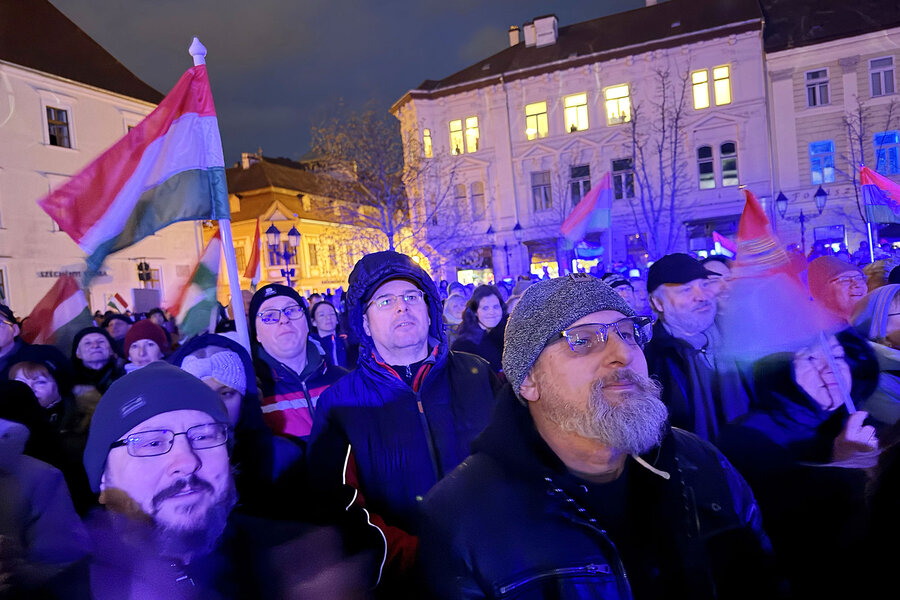
“In 2026, we and only we are capable of saying ‘no’ to the Ukrainians, to preserve Hungary’s peace, security, and the possibility of economic development,” Mr. Orbán told a crowd of devoted, flag-waving supporters in Győr, a western industrial hub and key electoral battleground. Many attendees held signs bearing the names of the smaller villages from which they had traveled.
Why We Wrote This
Hungary is going to the polls on April 12, and the future of Prime Minister Viktor Orbán’s government looks doubtful. So he’s turning to a familiar boogeyman on the campaign trail: the war in Ukraine and the danger he claims it poses to his fellow citizens.
“Dear Ukrainians, we will not ruin Hungary for your sake,” the prime minister continued. “We will not give up our children, we will not give up our sons, our weapons, and we will not give up our money either!”
Fidesz’s central campaign argument asserts that Hungary’s security and economic stability depend entirely on staying out of the war in Ukraine. It leverages a deeply ingrained national narrative of resisting foreign domination, including Soviet rule, by framing Hungarian pushback against demands from Ukraine and the European Union as defensive sovereignty.

But for many voters, Mr. Orbán’s position appears increasingly at odds with reality, and his message just isn’t getting through to voters beyond the core Fidesz supporter.
“Orbán’s touring is not working so well,” says Stefano Bottoni, a historian who published a biography on the leader. “Many people who go [to rallies] just go there to whistle or to do catastrophic tourism just to see what happens, like in a movie. Orbán [is used to] mastering the masses … and it is not working anymore.”
Wayward flock?
Hungary has often broken ranks with the EU on support for Ukraine, opposing or delaying both sanctions against Russia and aid packages for Ukraine. It has pushed for a non-escalatory approach with Moscow, a stance shaped in part by Hungary’s heavy reliance on Russian energy imports. The EU is withholding billions in funds for Budapest due to concerns over rule of law, corruption, and democratic backsliding.
Hungary and Ukraine are also at odds, with the leaders of both nations regularly trading barbs. On Sunday, Mr. Orbán and the president of Serbia announced that explosives were found near a pipeline in Serbia that transports Russian natural gas to Hungary. Mr. Orbán said that “there was an act of sabotage prepared,” and noted that “Ukraine has been trying for years to cut off Europe from Russian energy,” though he did not directly blame Ukraine for the alleged incident. Ukraine denied any involvement, and said the incident was likely a false-flag operation intended to affect Hungary’s elections.
Those geopolitical frictions have made the war into a central campaign issue, say observers.
“The issue of the war is a major theme in the campaign and divides the electorate,” explains Ágoston Mráz, chief executive officer at the Nézőpont Intézet, a Budapest-based, government-affiliated research institute. The institute has forecast victory for Mr. Orbán and Fidesz, though many independent pollsters show the public favoring challenger Péter Magyar, a conservative and former government insider, and his Tisza Party.
“Those supporting the governmental party believe that if Magyar becomes prime minister, the new government will give a green light to sending funds and European troops to aid Ukraine,” say Mr. Mráz. “Whereas the voters of the opposition are less aware of this or are clearly backing Ukraine’s war efforts and its potential EU membership.”
The tension is palpable at campaign rallies. In Győr, faithful Fidesz voters bickered with disenchanted, but cosmopolitan teens who dared boo the ruling party.
“It is either a Hungarian government or a Ukrainian government,” snapped an older lady dressed in white, denouncing the opposition. “Tisza is the puppet of the Ukrainian government.” She declined to comment further.
Nearby, a man dressed in a full traditional shepherd outfit, made fun of Orbán supporters. With a serious face and a slight twinkle in his eye, he told local reporters to keep an eye on his “flock,” i.e., Fidesz voters, before saying he was “very disappointed” with Mr. Orbán.
A stale strategy
Among those expressing frustration with Mr. Orbán was Ákos, a resident of a nearby Fidesz-voting village who declined to give his last name for fear of reprisals. He expects his neighbors and parents to vote Fidesz, a sign of deep rural and generational divides.
Fidesz remains particularly strong in rural areas and among older voters, especially those over 60. Many in this segment of society have benefited from a range of government policies under Mr. Orbán, including generous pension increases, utility price caps, tax breaks for families, and rural development programs.
“[Fidesz’s] message is not credible to us,” insists Ákos. “It’s the same posters all the time: Brussels, war, hatred. There is no good reason to vote for him. We are biting the hand that is feeding us when we attack Brussels.”
By way of example, “ever since Brussels stopped sending funds to Hungary,” Ákos says, “roads are in bad shape.” His village is part of the Hungarian Village Program, a government initiative launched in 2019 to support rural communities. He says the program now produces sloppy repair work, with new layers of pavement laid over old ones, raising roads to the point they overlook peoples’ gardens.
But his family does not draw the same link between economic decline and poor relations with Brussels. And security is their chief concern. “My parents are actually afraid of war,” he says, shaking his head. “When I try to convince my mother to vote against Orbán, she starts crying and saying, ‘I can’t believe I have to hear this from you.’”
For Mr. Mráz, the government strategy remains effective. “‘You need a strong leadership in turbulent times’ is a solid offer,” he says. ”The real challenge for Fidesz is the potential of protest-voting that is a normal phenomenon in a democracy after 16 years in power. The question is whether Magyar can upscale this and unite all with opposition sentiment behind his own party.”
Dr. Bottoni, the historian, says Mr. Orbán’s fearmongering as a strategy is getting stale. He also sees darker undertones of antisemitism in the campaign’s harsh focus on Mr. Zelenskyy as the anchor point of broader fearmongering. He recalls previous campaigns against George Soros, a billionaire philanthropist who has long been a target of government-backed messaging in Hungary. While Mr. Magyar is a Christian, both Mr. Zelenskyy and Mr. Soros are Jewish.
“They are running against Volodymyr Zelenskyy because they can’t admit the fact that Peter Magyar is untouchable, so they try to harm the guy that some people could still hate in Hungary … like they did Soros,” Dr. Bottoni says.
In Dr. Bottoni’s assessment, Mr. Orbán is panicking. He points to March 15 as a turning point in the campaign. On that day, rival rallies were held in Budapest to mark the 1848 Revolution. The opposition turnout exceeded that of Fidesz by at least several tens of thousands, according to independent media reports. “That was an alarm bell for Orbán.”
Still, loyalty to the prime minister remains firm among many voters.
Német Gergely, a 62-year-old farmer and fourth-generation landowner, says his support for Mr. Orbán is unwavering. He has voted for Fidesz since its years in opposition in the early 2000s, and remains loyal today. He was among the farmers who came to Győr in polished tractors with light-up signs spelling “Fidesz.”
In his view, Mr. Orbán is safeguarding Hungary’s security from European Union policies, while also strengthening the country’s economic position by pursuing market opportunities with Russia.
“Everyone tries to exploit us,” he concludes. “But Orbán is the best prime minister. There is no one like him. He protects his people until the end.”