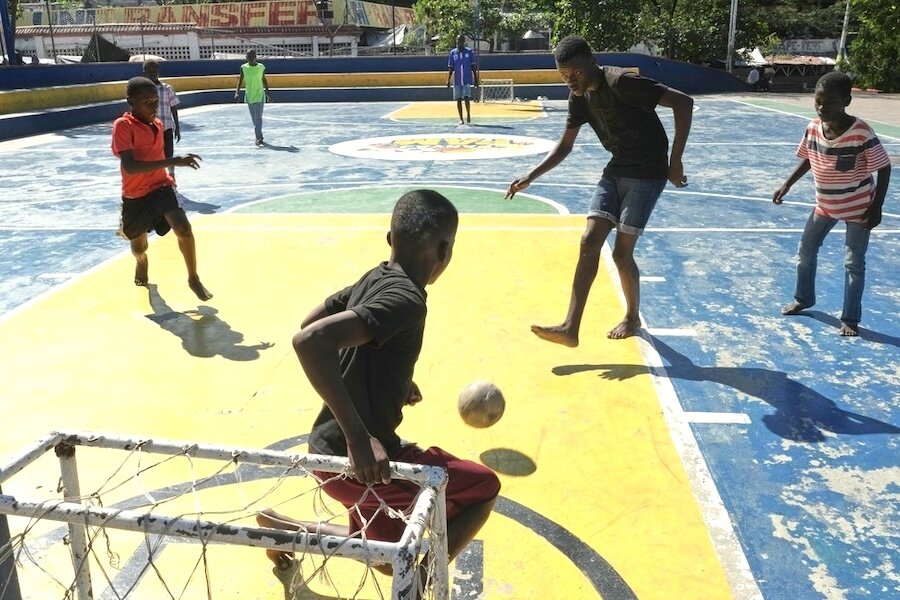
It’s been nearly 10 years since the people of Haiti have voted in an election – and more than 50 since this soccer-loving nation has fielded a team in the World Cup tournament.
In 2026, they’ll get to do both.
On Dec.5, a few weeks after Haiti’s November qualifying victory, World Cup organizer FIFA announced group draws for the competition. Around the same time, with somewhat less fanfare, Haiti’s transitional government announced election plans. Meanwhile, the United States called on countries to support a new United Nations-approved multinational mission to quell rampant gang violence in the Caribbean island nation.
Neither the World Cup berth nor the proposed international Gang Suppression Force promise easy wins for Haitians. But they hint at a possibility of parlaying the unity and persistent effort demonstrated on the soccer pitch to the arena of politics and governance.
“This victory brings a moment of joy,” Pierre Jean-Jacques, a young mechanic, told The Associated Press. “It means more than just a win. It is hope, it is unity at a time when the country faces so many challenges.”
Several soccer players have pushed the “Open the Country” (#OuvèPeyiA) social media campaign, calling on gang leaders to end the brutality that has killed thousands and displaced more than 1.4 million Haitians. Gangs frequently shut down the country’s main seaport and airport; carry out extortion, rape, and murder; and are linked to international drug trafficking.
The 5,500-person international suppression force, if fully constituted and funded, could help restore basic calm and security, which another recent U.N. effort was unable to do. And more economic and humanitarian aid are also essential in the Western Hemisphere’s poorest country.
But durable freedom from repeated political dysfunction and violence is built on more than strong security or repaired roads. It requires a thought-shift and strengthening of human connections, an “infrastructure” of collective worth and individual dignity not susceptible to physical destruction or social division.
“Take the [soccer] team’s unity as an example,” star striker Duckens Nazon urged fellow Haitians. “‘L‘Union fait la force’ isn’t just a slogan but a mentality, a way to live,” he said, referring to the national motto, “Unity creates strength.”
Or, as community activist Louis-Henri Mars told Monitor correspondent Linnea Fehrm in October, “We must build relationships.” That’s why he founded Lakou Lapè (“Courtyard of Peace”) – to bring together business leaders and gang members to share meals and life stories. In his work, Mr. Mars says he holds to simple principles: See individuals for their humanity, not only their violent actions, and be open and truthful.
These are tenets that Haiti’s leaders – and its international security partners – can well apply. Haitians deserve no less.