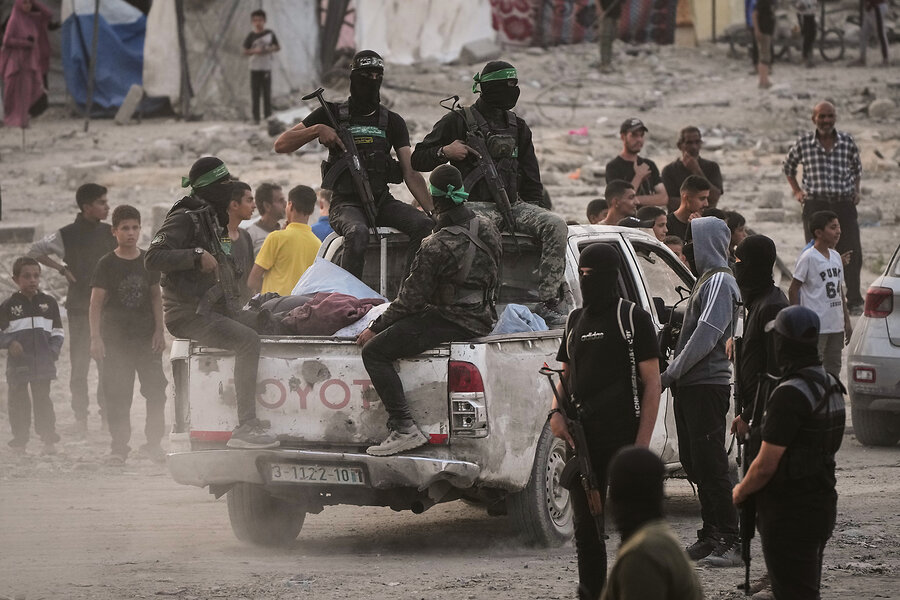
In a bid to turn a fragile ceasefire into peace, and to ensure a Palestinian role in the governance of postwar Gaza, Hamas is reaching out to rivals it has spurned for decades.
Ten Palestinian factions – including Hamas and Islamic Jihad – have been meeting for the past three weeks in Cairo, seeking agreement on a common position: their readiness to take part in U.S. President Donald Trump’s peace plan.
Hamas’ overture comes as Washington gathers support for a draft U.N. Security Council resolution granting a broad two-year mandate to an international security force and an administration to govern Gaza.
Why We Wrote This
After two years of punishing war with Israel, Hamas is seeking to bolster its position in planned new Gaza governance arrangements. To do so, the radical Islamist group is drawing closer to rival Palestinian factions.
The resolution, submitted by the United States on Wednesday, with broad Arab support, foresees eventual Palestinian self-government in the Gaza Strip, according to a draft leaked to the media.
Behind Hamas’ increasing pragmatism, observers say, is a desire to avoid renewed warfare and a concern that the Palestinians should not be left behind by U.S.-backed, international plans for Gaza.
“These factions are meeting … unifying their visions to work through the Trump Plan,” says Dimitri Diliani, a spokesman for the Democratic Reform Bloc, which is taking part in the talks. “The most important thing now is to make the Trump plan work and the ceasefire stick.”
Keeping Gaza Palestinian
In the talks, which one participant described as “constructive,” Hamas is closing in on an agreement with other Palestinian factions on the formation of an apolitical group of Palestinian technocrats to assist in the administration of Gaza, providing services and rebuilding homes, and the creation of a Palestinian police force to provide security.

The agreement would ensure formal support of all Palestinian factions for the incoming International Stabilization Force that would enforce the ceasefire, and for the “Peace Board,” headed by President Trump, that would oversee the work of the Palestinian technocrats’ committee.
It is a sign, insiders say, of beleaguered Hamas’ desire to hand off responsibility for Gaza to Palestinian hands and prevent Gaza’s internationalization.
It remains unclear whether the Palestinian Authority (PA) – Hamas’ arch-rival and the main governing body in parts of the West Bank – would be ready to work with Hamas. The same goes for the Palestine Liberation Organization (PLO), a nationalist coalition that represents Palestinians globally. The Islamist group expelled both the PA and PLO from Gaza in 2007 in a bloody civil conflict that separated Gaza from the West Bank.
Alongside the inter-factional talks, Hamas officials are also holding direct negotiations in Cairo with representatives of Fatah, the party which dominates the PA, and with the PA itself.
They are hoping to agree on the role of the Palestinian technocrats’ committee, the scope of the PA’s influence over Gaza’s administration, and procedures for Hamas’ disarmament.
Qatar’s prime minister, Mohammed bin Abdulrahman Al Thani, told CNN this week that the hoped-for agreement between the PA and Hamas aims to ensure that the incoming Palestinian technocrat committee will be “apolitical, it will take care of Gaza in this transition period, and it will be linked somehow to the Palestinian Authority.
“The Palestinians should take over governance in Gaza and the West Bank together,” he added.
The disarmament conundrum
One of the reasons Hamas is willing to work with its rivals is that it needs them in order to comply with Phase 2 of Mr. Trump’s peace plan: the surrender of its weapons.
A Hamas source outside Gaza, who declined to be named for security reasons, said the movement “would only hand over arms of the resistance to a legitimate Palestinian entity … not to a foreign occupying force.”
The solution under discussion, observers and Palestinian officials say, is that Hamas would hand over its heavy weapons to a Palestinian police force.
“Hamas would rather die than appear to be surrendering to Israel,” says Mohammed Daraghmeh, the bureau chief in the Palestinian territories for Asharq News. “They prefer to surrender their weapons to a Palestinian unity government,” he explains.
“Hamas is in a tough position: They want to avoid war, and they want to rebuild Gaza and that won’t happen if they continue to stay in power or hold their weapons,” Mr. Daraghmeh says. “The Palestinian Authority is the ladder Hamas needs to climb down.”

The Cairo talks mark the closest coordination between Hamas, Fatah and other Palestinian factions for 18 years, which have seen repeated failed reconciliation attempts.
While a number of prominent PLO factions – including Fatah, the late Yasser Arafat’s power base – appear ready to reach an agreement with Hamas, one key figure is reportedly reluctant to take such a step.
Will the PLO leader play ball?
The increasingly isolated and aloof Palestinian Authority president, Mahmoud Abbas, who rules the PA with an iron fist and also sits atop the Palestine Liberation Organization, which comprises all Palestinian factions except Hamas and Islamic Jihad, is dragging his feet, sources say.
Knowing that Hamas now needs the PA after years of spurning it, Mr. Abbas is reportedly holding out for more concessions.
“The Authority and Fatah under Mahmoud Abbas think they have all the leverage,” says political analyst Hani al-Masri, director of the Palestinian Centre for Policy Research and Strategic Studies, in Ramallah.
“But that is a grave misreading of the situation” he says. “This is a time for action and proactive solutions. We are not seeing that.”
According to a source close to Fatah, Mr. Abbas believes that, after dragging the Palestinians into their most devastating war, Hamas should come hat in hand to the PA, agree to disarm, join the PLO and be subservient to the Authority – including a commitment to nonviolence and a pledge to agree to the Oslo peace treaty with Israel.
Mr. Abbas’ control over the PLO means he could yet stymie the breakthrough talks in Cairo.
“Any agreement needs the blessings of the PLO as the sole representative of the Palestinian people,” says Mr. Diliani, “Unfortunately, Abbas resides on top of that.”