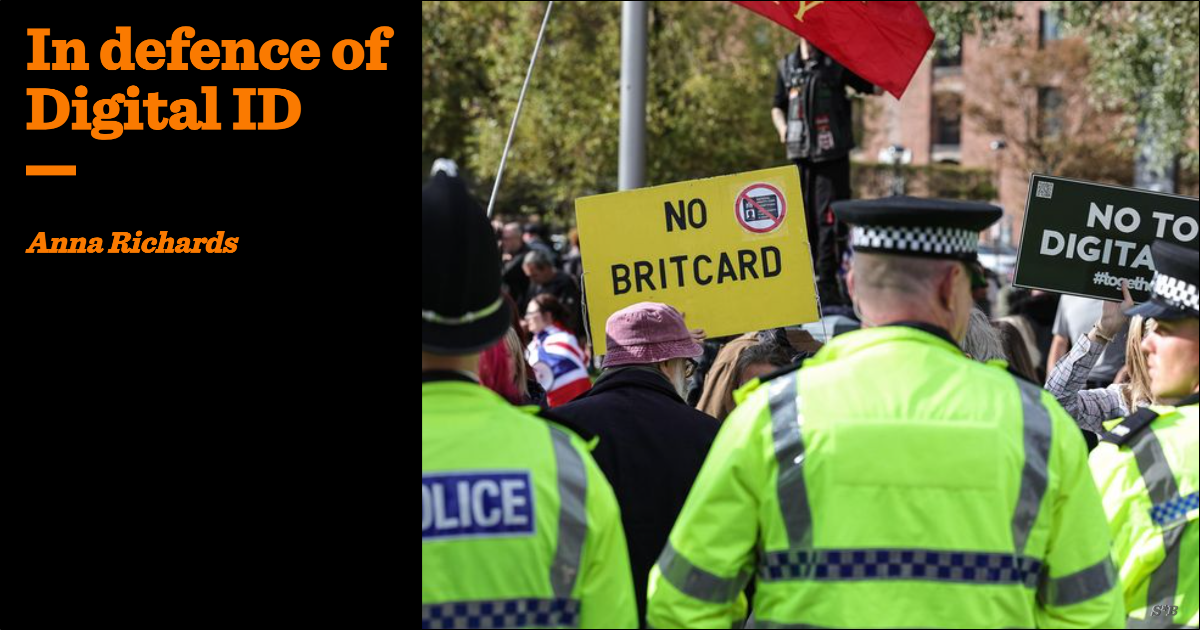
It is the adaptation of traditional values to modern circumstances that puts the strength of underlying principles to the test. Recently, the Government responded to a petition signed by 2.8 million people calling for Labour’s proposed Digital ID system to be scrapped by saying it would be going ahead with plans to introduce BritCard by 2029. So, why exactly is Britain so reluctant to introduce digital ID?
Digital ID gives young professionals independence based on citizenship
It can’t really be about data collection. Digital ID merely facilitates the aggregation and streamlining of data which already exist. This argument is also becoming increasingly meaningless in a world where most people enthusiastically hand over personal data to social media companies in return for cat memes. Most UK professionals in white-collar jobs already have to pass a DBS check, a provisional driving license must be updated with a current address by law, and to open a bank account in the UK one has to show three bills with a UK address. The UK’s obsession with proof of address, as opposed to proof of identity, is a bureaucratic hurdle which slows down the young and mobile, and favours those who are rooted in place — usually pensioners. Digital ID gives young professionals independence based on citizenship, which they de facto have, rather than the fiction that they live at their own address and pay their own bills — something which just over half of them are able to do.
Britain has run down the clock on its ability to fudge the extension of a property-based franchise in a world where financialised capital is restricting the ability of individual voters to own property. The British aversion to ID cards is not, in fact, about data protection at all – it’s about the clash between a concept of citizenship based on natural rights, and one based on property rights. A series of 19th-century reforms beginning with the 1832 Great Reform Act broadened an electorate originally predicated on the ownership of rural freehold property — first to urban freehold property owners in larger industrial towns, then, with Disraeli’s Second Reform Act (formally known as the Representation of the People Act 1867) to leaseholders (or urban workers), and finally, with the 1884 Representation of the People Act to the rural poor. This gradual broadening of the franchise through incremental change saved Britain from the revolutionary movements experienced by Europe and was widely thought of as a success. In 1918 property qualifications were removed for men, but retained for women over 30, and in 1928 they were formally removed for all voters. Nonetheless, the link to property and address remains in the context of a first-past-the-post electoral system where people vote in constituencies. The right to occupy a property temporarily in exchange for rent — otherwise known as leasehold — was obviously a problematic basis for enfranchisement, because it was time-bound. This created de jure, if not de facto, two different types of voting rights in England prior to 1928 — one perpetual, the other time-limited. The historical legacy of this system is logically incoherent with natural rights as the modern basis of citizenship.
Now, with the Conservative and Reform parties proposing the repeal of the Human Rights Act, and Labour putting forward plans for compulsory Digital ID, the British narrative about citizenship is in the crosshairs once again. The right wing parties need a new strategy because not enough people will own their address anymore to make constituencies meaningful — and Labour need a new strategy because the rise of AI will reduce the cost of labour, diminishing the bargaining power which was leveraged to introduce the universal franchise in the first place. Digital ID cards would, in this context, reinvent the UK system around allegiance to nation, rather than borough, prioritising citizenship over residency. Conservatives should reflect that citizenship-based digital ID does at least offer the advantage of binding British people to their country in an era when hyper-mobile professionals have stronger ties to corporations than they do to localities — although this may change when AI amalgamates the professional workforce, and mass layoffs de-centre the stabilising role of the corporation in the lives of employees, possibly leading to a renewed reliance on land and local community.
An alternative to a citizenship-based system would of course be a property-based system — although virtual and digital assets would presumably have to take their place alongside real property, which again risks giving more influence to passive shareholders than active administrators. Sadly, casting passive shareholders as the stewards of good government does not seem to guarantee as robust a system as that built by the active administrators of the past. Since passive ownership takes less skill and responsibility than active stewardship, and since the active stewardship of assets will increasingly be in the hands of human-supervised AI models, such a system would likely compound the influence of financialised capital rather than mitigate against it, and the disproportionate purchasing power of financialised capital is precisely what is precipitating the political crisis.
Looking to Europe, by late 2026 the EU will mandate that each member state provide at least one national EU Digital Identity wallet to citizens and residents. BritCard is presumably Sir Keir Starmer’s attempt to harmonise with this system. Mandatory digital ID may be controversial in the UK, but in Estonia it’s nothing new — they’ve had it for twenty years. In Poland, a voluntary app-based system called mObywatel is thriving, with over 10 million users as of July 2025 — that’s already around one third of all adult Poles, and the current target for Poland’s Digital Strategy is to double that by 2035. Two centuries of partitioning and occupation gave the Poles a framework which is instinctively traditional in private, while being technologically and systemically innovative in the public sphere, and this combination tends to produce robust economies and resilient societies. Where each generation has had to invent new systems, or where independent or unofficial systems of government have had to be built underground, with disregard for, or in explicit resistance to an overtly wrong rules-based system such as communism, attachment to systems becomes flexible and adaptable to modernisation.
Every generation must shed something of the past to learn something new for the present, retaining only a select few core values for the future. Change is inevitable, and thus to be welcomed energetically. For Britain, digital ID is an opportunity to wake up to the fact that our once-great culture of gradual political compromise is weakening the nation, by comparison with countries which are prepared to act more swiftly and decisively. Something we, the British, have been slow to admit, we must now face up to, if we want to grow; the skills which got us through the 19th century with spectacular success already struggled to get us through the 20th, and are now utterly failing at adapting us to the 21st.