Campaigners hailed a major victory for free speech yesterday as a man who burned a Koran saw his conviction overturned.
Hamit Coskun, 51, shouted ‘f*** Islam’ as he set fire to the text outside the Turkish consulate in London in February.
After being convicted of a religiously aggravated public order offence and fined £240 in June, he appealed – and a judge has now ruled that Mr Coskun has a ‘right to offend’.
Mr Justice Bennathan told Southwark Crown Court: ‘Burning a Koran may be an act that many Muslims find desperately upsetting and offensive.
‘The criminal law, however, is not a mechanism that seeks to avoid people being upset. We live in a liberal democracy. One of the precious rights that affords us is to express our own views… without the state intervening to stop us doing so.
‘The price we pay for that is having to allow others to exercise the same rights, even if that upsets, offends or shocks us.’
Mr Coskun said he burned the Koran to highlight how Turkish president Recep Tayyip Erdogan’s constitutionally secular government had become an ‘Islamist regime’.
However during his protest, he was attacked by Moussa Kadri, 59, with a knife who later told police he was protecting his religion.

Campaigners hailed a major victory for free speech yesterday as a man who burned a Koran (pictured) saw his conviction overturned
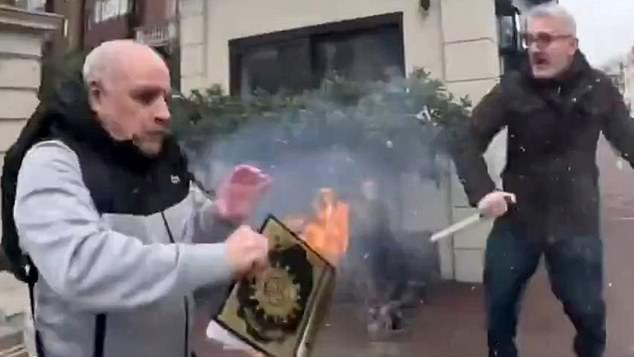
Hamit Coskun, 51, shouted ‘f*** Islam’ as he set fire to the holy text outside the Turkish consulate in London in February
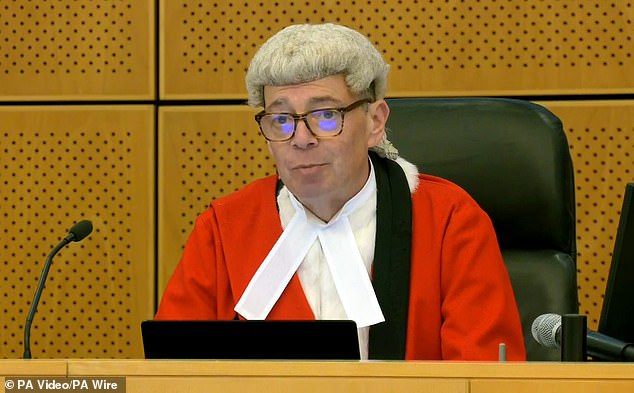
Mr Justice Bennathan (pictured) told Southwark Crown Court: ‘The criminal law is not a mechanism that seeks to avoid people being upset’
Yesterday, the Free Speech Union said the ruling sends a message that ‘anti-religious protests, however offensive to true believers, must be tolerated’.
Lord Young, director of the union, which helped fund Mr Coskun’s legal case, said: ‘Had the verdict been allowed to stand it would have sent a message to religious fundamentalists that all they need to do to enforce their blasphemy codes is to violently attack the blasphemer, thereby making him or her guilty of having caused public disorder.’
National Secular Society chief executive Stephen Evans added: ‘Mr Coskun’s protest was a lawful act of political dissent.
‘There is no need to condone the nature of his demonstration – what is important is that it was not criminal.’
The Humanists UK charity said yesterday it was ‘delighted’ and ‘relieved’ by the decision to overturn the conviction.
Shadow Justice Secretary Robert Jenrick said while he did not agree with what Mr Coskun had done, he didn’t think ‘it was a crime’.
He, along with fellow campaigners, argued Mr Coskun’s prosecution had been an attempt to bring back blasphemy law ‘by the back door’.
In a statement following the ruling, Mr Coskun, who is half-Kurdish and half-Armenian, said: ‘I am reassured that – despite many troubling developments – I will now be free to educate the British public about my beliefs.’