The killing of a woman by an Immigration and Customs Enforcement agent in Minneapolis on Wednesday has reignited a national debate over the appropriate use of force by federal agents in carrying out immigration raids.
Renee Good, a mother of three who had recently moved to the city, was fatally shot while in her car, which had been partially obstructing federal officers’ vehicles. Administration officials said the officer acted in self-defense and sought to blame Ms. Good for the tragedy. Videos of the incident show an officer standing in front of Ms. Good’s SUV firing multiple shots as she began to drive her car away from the scene, as she had been reportedly ordered to do by other agents. The car then plowed into a stationary vehicle and a utility pole on the snow-lined street.
On Thursday, a few hundred people gathered in bitter cold at the scene. Clergy members spoke at the memorial site – flowers, candles, and a cross – that had spread across a sidewalk. “She was not armed. She was not a threat. She was standing for freedom,” said JaNaé Bates Imari, a minister and a co-director of a faith-based nonprofit. “And the federal government answered her courage with a bullet.”
Why We Wrote This
President Trump’s aggressive immigration enforcement has roiled cities across the U.S., including Minneapolis, where a federal agent shot and killed a woman. The incident spotlights questions over when use of force is appropriate.
“Murder!” someone called out from the crowd. “Murder! Murder!” others yelled.

Ms. Good’s shooting comes after a year of aggressive immigration actions organized by the Trump administration, often in Democratic-run cities. The rapid expansion of ICE and increased use of other federal agencies to detain unauthorized immigrants have raised questions about the rules that govern their operations and whether the administration has ignored them in its pursuit of deportations after millions entered the United States during Joe Biden’s presidency. Ms. Good is among several people physically harmed during ICE operations, including a deadly shooting in Chicago.
On Thursday, two people were shot and wounded in Portland, Oregon, during a vehicle stop by U.S. Border Patrol agents. The Department of Homeland Security said the agents were trying to apprehend an unauthorized immigrant when the driver tried to run over the agents, and one of them fired.
Minnesota investigators had begun to work on the case of Ms. Good’s shooting in collaboration with federal investigators. But that process halted, according to the state’s Bureau of Criminal Apprehension, which said the FBI would take over the investigation and that the BCA would lose access it needed to investigate the incident. Federal officers generally have immunity against state prosecution for actions taken during their official duties.
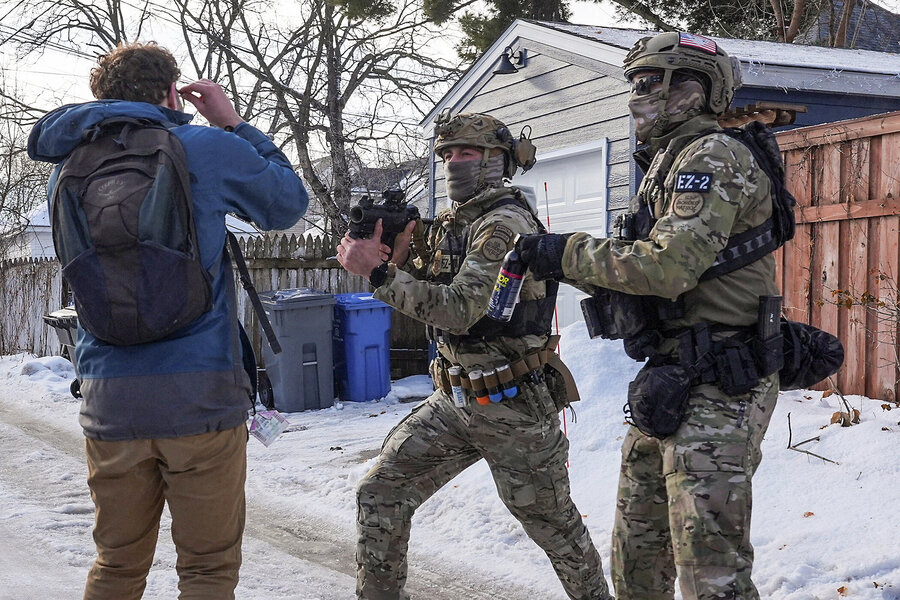
Around 2,000 federal agents have deployed in Minneapolis in what administration officials say is their largest operation so far. As in other cities, they have faced protesters opposed both to the immigration policies of President Donald Trump and to how ICE operates. Agents have used unmarked vehicles to track and snatch immigrants off the streets across the country, including foreign students.
ICE-led operations and protests against them have raised tensions in other cities. Administration officials say activists have impeded law enforcement and endangered themselves and agents in the field, such as by blocking building entrances.
Questions on use of force
For months, questions have swirled about ICE policy on the use of force, both in making arrests and confronting protesters. Under federal policy, officers must only use deadly force when they believe it would stop an imminent threat of death or serious injury to the officer or other people, says Udi Ofer, a Princeton professor of public affairs who worked in the Biden administration.

Mr. Ofer helped to draft the Justice Department policy on when federal officers can shoot at a moving vehicle. All federal agencies were required in 2022 to adopt guidelines that match or exceed the DOJ standards, says Professor Ofer, via email. The policy makes clear that “firearms may not be discharged to disable moving vehicles unless there is a threat of death or serious physical injury to the officer AND no other reasonable means of defense exists,” he wrote.
This includes an officer moving out of the way of the vehicle, so as to avoid being injured. The policy also directs federal officers not to shoot to stop a moving vehicle, a practice that has been largely banned by many police departments. The Department of Homeland Security, which oversees ICE, also directs officials not to use deadly force “solely to prevent the escape of a fleeing subject” in its policy on use of force, dated from 2023.
ICE continues to use that policy, said Tricia McLaughlin, an assistant secretary of Homeland Security, in a statement.
“ICE law enforcement officers are trained to use the minimum amount of force necessary to resolve dangerous situations to prioritize the safety of the public and our officers,” she said. “Officers are highly trained in de-escalation tactics and regularly receive ongoing use of force training.”
Mr. Trump claimed on Wednesday that Ms. Good “ran him over,” referring to the ICE officer, and that made the shooting an act of self-defense. DHS Secretary Kristi Noem repeated this claim on Thursday, as did Vice President JD Vance, who said that Ms. Good had been “brainwashed” and referred to protests as “terrorism.”
“This vehicle was used to hit this officer,” Ms. Noem said at a news conference. “It was used as a weapon, and the officer feels as though his life was in jeopardy. It was used to perpetuate a violent act, and this officer took action to protect himself and to protect his fellow law enforcement officers.”
The claim that the ICE officer was run over appears to be at odds with multiple videos posted online. No body-camera footage has been released that would show how the situation looked to the officers on the scene. Experts on how such incidents are investigated say that evaluating the lawful use of deadly force depends on what constitutes an “imminent threat.”

Sarah Matusek/The Christian Science Monitor
“Was [Ms. Good’s] driving and her vehicle posing an imminent threat to this officer who shot and killed her?” asks Geoffrey P. Alpert, a criminologist at the University of South Carolina. “If there was an imminent threat that’s reasonable, then the officer was justified. If there wasn’t, the officer wasn’t justified.”
But it’s premature to assess without a “thorough and transparent investigation,” he adds.
John Gross, a law professor at the University of Wisconsin who studies how police officers use force, says the videos appear to show Ms. Good’s car partially obstructs the road but doesn’t pose any threat to human life. “The use of deadly force needs to be reasonable under all the surrounding circumstances. And, so, nowhere in the video does it appear that the individual who was shot is a threat to the officers to physically harm them,” he says.
Moreover, federal policy states that law enforcement officers shouldn’t fire on moving vehicles except under specific circumstances. “The policy explicitly says that officers should get out of the path of the vehicle instead of shooting at it. And that’s a very practical policy,” says Professor Gross.
Luis Robles, an attorney in New Mexico who defends police misconduct cases and trains law enforcement, said he has seen no video that shows the incident from the perspective of the officer who fired his gun. But generally, he said, officers are “trained not to stand in front of vehicles.”
“The case law is also consistent with that: Don’t create the danger that might require you to shoot your way out.”
“I just want to be safe”
In September, an ICE agent fatally shot a Mexican immigrant in Chicago who was accused of using his car as a weapon to impede his detention. Surveillance videos contradicted accounts given by administration officials who said the agent who fired had suffered “severe injuries.”
A month later, a federal agent in Chicago shot a woman who had joined protests against immigration raids. Marimar Martinez was inside her vehicle when she was fired upon and wounded. Federal officials said the protesters had “boxed in” agents and that officers had been forced to take evasive action. Ms. Martinez was later charged with assault and attempted murder. But the charges were dropped in November amid claims that federal officers had tampered with evidence and that the official account of events had been distorted. The Department of Homeland Security had labeled Ms. Martinez and a co-defendant in the vehicle as “domestic terrorists.”

E. Jason Wambsgans/Chicago Tribune/AP
Immigration agents have faced judicial scrutiny over their operations in Chicago and the handling of mostly nonviolent protests. In November, a federal judge found that the use of force had been excessive and that official accounts of events were misleading and unreliable.
Critics of federal immigration enforcement say that officers, who often wear face coverings as a defense against what they say are retaliatory actions such as doxing, act with apparent immunity. Agents who are involved in on-duty shootings are rarely punished. An investigation by the Trace in 2024 found that 59 such shootings occurred between 2015 and 2021, of which 23 were fatal. No agents were prosecuted over these shootings.
Back in Minneapolis, Mohamed Abdi joined Thursday’s gathering at the memorial site. A nurse from St. Paul, the nearby twin city, Mr. Abdi saw the incident as an avoidable tragedy. The officer “had time to move,” he said.
Mr. Abdi, from Kenya and of Somali descent, is now an American citizen. Yet amid the immigration enforcement surge here, he carries around his U.S. passport for proof. “I just want to be safe,” Mr. Abdi says.
“This is a moment to stand with each other,” he says. “If it was her yesterday, today it’s me. Tomorrow, it’s you.”
Staff writer Sarah Matusek reported from Minneapolis and Simon Montlake from Boston. Staff writers Caitlin Babcock and Sophie Hills contributed reporting from Washington.