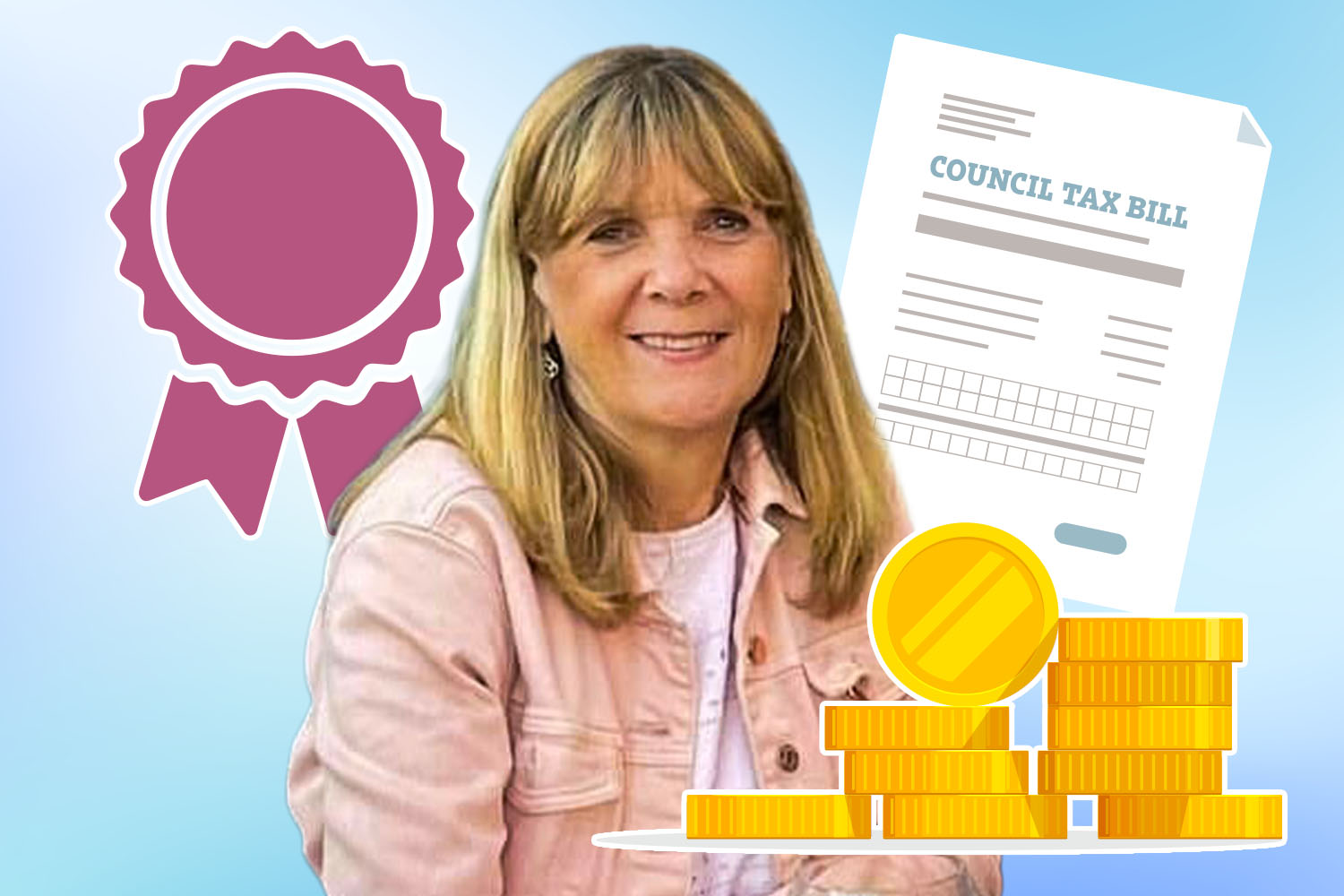
LINDA Cannon couldn’t contain her excitement as she read a letter from the government – she had been granted a £1,300 council tax refund.
Not only that, but the 64-year-old had also been put on a lower tax band – slashing her yearly bill by £600. She shares the key evidence she gathered and the tips she used to help YOU do it too.
When Linda and her husband Keith moved into their five-bedroom home in Weymouth in 2021 they were surprised by how high their council tax bill was.
There are eight council tax bands in England – A is the lowest, and H is the highest.
As their new home was in band F, their council tax bill was an eye-watering £3,320.11 a year.
The mum-of-two, who used to work in local government, explains: “We knew we were moving into a bigger house, so it would be in a higher band.


“But over time I began to think that the band seemed high based on what we bought the house for and how much council tax we paid at our old house.”
So when Linda checked the Valuation Office Agency (VOA) list she was horrified to discover that her £450,000 house was the only band F property on her estate.
The VOA list shows how much a property has been valued at for council tax bands.
Linda said: “Our home is on a 1960s estate where the houses were originally all the same but some have been extended.
“I thought it couldn’t be right as some of the houses that are much bigger than mine are in band D or E. That’s when I decided to challenge my band.”
To prove that her home should be in a lower band, Linda needed to provide addresses for up to five similar properties in a lower band to hers.
Her first step was to put together a list of her neighbours’ homes that are similar to her own.
She used her local authority’s planning portal to find old planning applications her neighbours had made, which also included their floor plans.
She then made a list of houses that had a similar number of bedrooms or square feet.
She said: “I put together a list of how much nearby houses have sold for to use as evidence.”
She submitted the information in January 2024 and in October the VOA wrote to Linda to confirm that it would move her home down to Band E, saving her £600 a year.
Linda now pays £3,300.34 a year in council tax in band E, instead of £3,900.41 in band F.
“Getting the money felt like a moral victory as the whole council tax system is so unfair,” Linda said.
“We used the money to take our five grandchildren to Tunisia for my husband’s 60th.”
Thousands overpaying council tax bills
Hundreds of thousands of households may be able to cut their council tax bill by appealing it, The Sun can reveal.
Those who like Linda think they are in the wrong band should consider challenging it – but beware of the risks.
Just 1,228 appeals were dismissed in the year to April 2024, according to a Freedom of Information Request submitted by Sun Money to the VOA.
This is less than 1% of the 43,820 council tax challenges the VOA received during this period.
When an appeal is dismissed it means that the property stays in the same council tax band or is moved to a higher band.
The news comes at a time when many households are bracing for higher council tax bills from April.
Several councils have already confirmed that they will hike bills by the maximum amount possible.
Among them is Suffolk County Council which plans to increase bills by the maximum 4.99%, costing households up to £165 more a year from April.
Meanwhile, six local authorities have been given the green light to hike bills by more than 5%, costing struggling households an extra £182 a year.
With bills set to rise in months, now could be a good time to challenge your band.
When the council tax system was introduced in 1991, every property in England and Wales was valued and put into one of eight council tax bands – from A to H.
We still use these bands today.
But many of these valuations were done based on how the property looks, rather than its size or floor plan.
The Government is yet to complete an up-to-date review, which means many homeowners could be being overcharged.
But beware, challenging your band could lead to angry neighbours as if your appeal is unsuccessful then you could all be moved into a higher band.
That’s because in order to query your council tax band you need to give the VOA examples of homes that are similar to yours that have lower council tax bills.
But while your appeal could be unsuccessful and your council tax band stays the same, your neighbours’ bills could increase to match yours.
How to ask for a review – and win
Before you race to try and get a council tax refund it’s important to remember that your band could also go up or stay the same.
Make sure you are able to cover the extra cost if your band were to increase before you apply.
To ask for your council tax band to be reviewed you will need to provide evidence of why you think your home is in the wrong band.
You will need to provide the addresses of up to five properties that are similar to yours but are in a lower band.
The properties should be the same as yours in terms of age, style and design.
They also need to be the same type as yours, so if you live in a semi-detached house then you should submit evidence of other semi-detached houses.
Meanwhile, they should also be the same size, for example because they have the same number of bedrooms or total area.
If you live in a town or city then the properties also need to be on your street or in the same estate.
What council tax support is available?
THERE are several ways you can get discounts and reductions on your council tax bill.
In some cases, you can even get the bill completely wiped with a council tax reduction.
Factors such as your household income, whether you have children, and if you receive any benefits, will influence what you get.
To apply, visit https://www.gov.uk/apply-council-tax-reduction.
You’ll need your National Insurance number, bank statements, a recent payslip or letter from the Jobcentre, and a passport or driving licence when filling out the details.
Below, we reveal all the ways you can get discounts or a reduction on your bill:
Single person discount
If you live on your own, you can get 25% off your council tax bill.
This also applies if there is one adult and one student living together in a property, or if there is one adult and one person classed as severely mentally impaired in the home.
If you live with someone who doesn’t have to pay council tax, such as a carer or someone who is severely mentally impaired, you could get a larger reduction too, of up to 50%.
And, if you live in an all-student household, you could get a 100% discount.
Retirees
Pensioners may also find themselves eligible for a council tax reduction.
If you receive the Guarantee Credit element of Pension Credit, you could get a 100% discount.
If not, you could still get help if you have a low income and less than £16,000 in savings.
And a pensioner who lives alone will be entitled to a 25% discount too.
Low-income households
If you are on a low income or receiving benefits, you could be eligible for a reduction on your council tax.
Whether you are eligible will vary depending on where you live.
You could also get a deferral if you’re struggling to pay your bill, or you can speak to your council about setting up a payment plan to manage the cost.
But one thing to remember is if you are struggling you should contact your council as early as you can.
Or if you live in the countryside then they need to be in the same village or area as your home.
Ask your neighbours what their council tax band is and how much they pay.
Or you can check their band online at gov.uk/council-tax-bands.
Another option is to use the price that your property or similar properties sold for as evidence.
You can do this if you live in England and there were sales between April 1, 1989 and March 31, 1993 or April 1, 2001 and March 31, 2005 if you live in Wales.
You can search for sold property prices online by visiting gov.uk/search-house-prices.
Then compare the sale prices to the prices the properties are valued at for council tax.
If your property seems to be in too high a band then you may be able to ask for it to be reviewed.
If you live in England then you can submit your case to the VOA online at gov.uk/challenge-council- tax-band.
Another option is to email ctinbox@voa.gov.uk or call 03000 501 501.
In Scotland you can apply by visiting saa.gov.uk/council-tax/council-tax-proposals/.
A Citizens Advice spokesperson said: “If the VOA agrees to review your band they will write to you, usually within 2 months, to let you know their decision.
“Bear in mind that, if your home is already in band A, which is the lowest band, the VOA can’t reduce the band further.”