Sitting in the intensive care unit on November 7, 2018, listening to the music my husband had composed for my walk down the aisle at our wedding, I knew my life was about to split in two: before Simon, and after.
He died in my arms at 8pm that night.
Simon was 57, my son Olly was just 14, and I was 41 and suddenly a widow.
That word felt heavy, old-fashioned and suffocating. Widow. I imagined black clothes, hushed voices and a life defined by loss.
And yet, almost eight years on, I can say something that makes people visibly flinch when they first hear it: widowhood has made me happier and more confident than I’ve ever been in my life.
It’s something that’s taboo to admit. People assume that if you’ve lost the love of your life you can never be truly happy again. My experience, however, is the opposite.
This isn’t because I’m happy Simon died – I’d give anything to have him back – but losing him forced me to make a choice about how I was going to live the rest of my life. And I now feel content in a way that seemed impossible for much of my teens, 20s and 30s.
Admittedly when he died, I thought happiness was over for me. After all, Simon had been part of my life for 20 years.
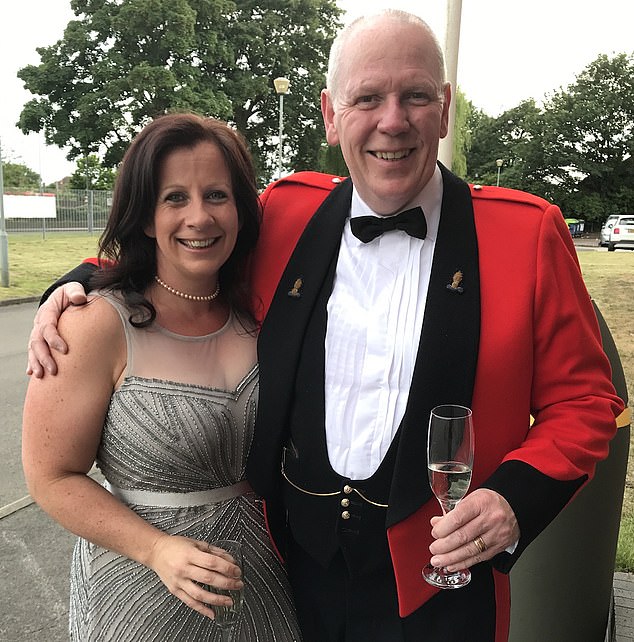
‘Listening to the music my husband had composed for my walk down the aisle at our wedding, I knew my life was about to split in two: before Simon, and after,’ says Tabby
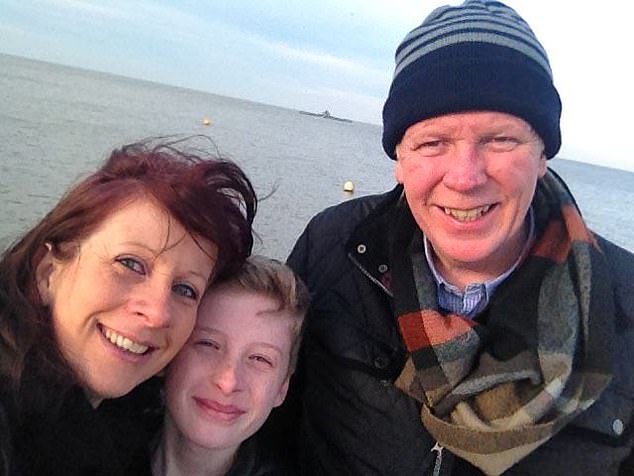
When Simon died he was 57, my son Olly was just 14 and I was 41 – and suddenly a widow
We’d met in 1998 through the brass band world when we were both in long-term relationships with other people – in my case an increasingly strained marriage.
Both musicians, I’d studied the cornet at music college while Simon was an established and respected composer, conductor and tuba player.
Initially, we worked together on publishing projects and for years were simply close friends and successful business partners.
Simon had a wicked sense of humour and was clearly very kind, always having time for anyone who needed him. His work ethic made collaborating with him a joy. Away from work I had my son, Olly, in 2004. But my marriage ended in 2010, when Olly was six.
I walked away from everything and started again from scratch as a single mum. Financially it was tough. Emotionally it was even tougher.
Simon remained my friend throughout those years. Then, at the end of 2011, we found ourselves both single when he also got divorced.
We were working together on projects in Florence and Pisa when something shifted. It wasn’t dramatic, it was simply this quiet, electric realisation that what we had was deeper than friendship.
Early one evening, as we were walking through Pisa, everything changed.
We’d been having a conversation about life and relationships, how we both wanted to move forwards, when he turned and kissed me on the forehead. The rest soon fell effortlessly into place.
We were cautious. Simon had two children, then aged ten and 13, from his previous marriage to consider. Olly was still young, but at least he’d known Simon all his life and they got on like a house on fire.
Over the coming months we spent more and more time together, even going on holiday with our children to Lake Garda the following year.
He’d stay over when the kids weren’t with him, before formally moving in with Olly and me to our home in Halifax, West Yorkshire, in the autumn of 2012.
Olly jokingly called him ‘Fo-pa’ – short for ‘fake dad’ – a name we still use when talking about Simon. Watching that relationship grow remains one of the greatest privileges of my life.
Simon proposed on my birthday in October 2014 in Castiglione del Lago in Umbria, a beautiful town we both adored. We married in April 2016, with Olly walking me down the aisle.
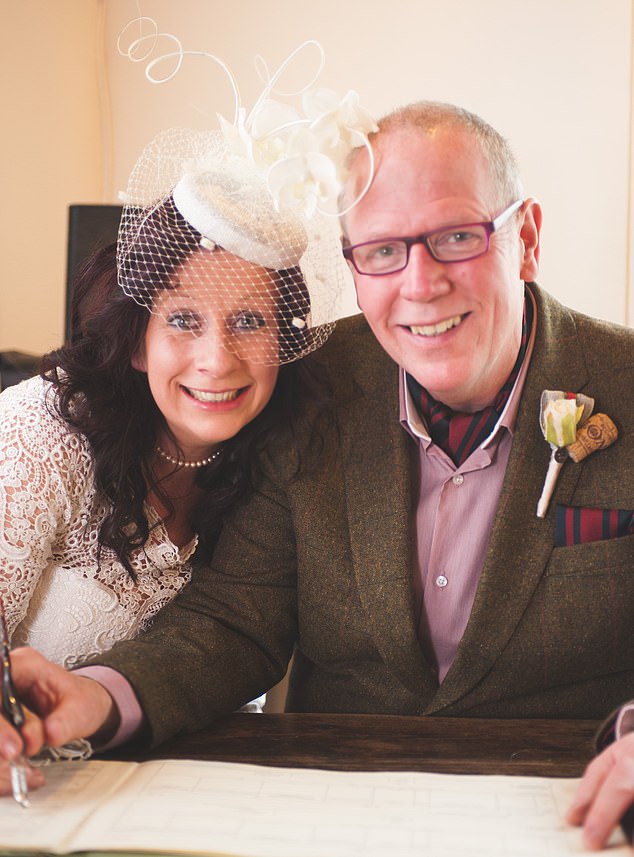
We married in April 2016, with Olly walking me down the aisle – and Simon composing the music I walked in to
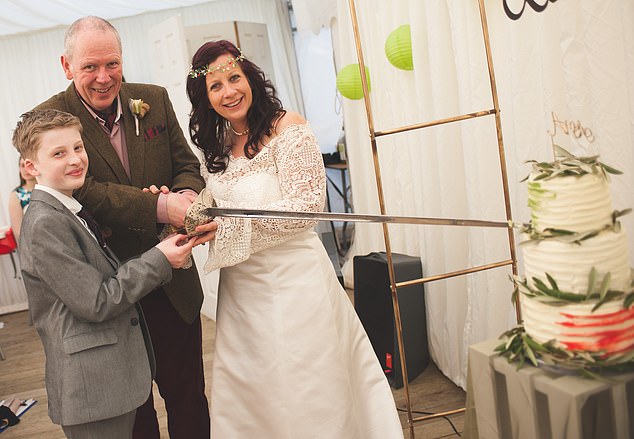
Olly jokingly called him ‘Fo-pa’ – short for ‘fake dad’ – a name we still use to talk about Simon
Simon composed the music I walked in to – a piece called La Discesa, meaning The Descent. I remember floating down the stairs towards him, feeling certain I was exactly where I was meant to be. Afterwards, our life was full and joyful.
We ran a portfolio of businesses together, including publishing, event management and providing corporate musicians for major events.
We bought a houseboat in Italy before we even owned a house in the UK. It was essentially a shed on water, but it was ours. We built everything around the ethos ‘love what you do and do what you love’.
Then, at the start of 2018, Simon developed back pain. In 2007, he had joined the Army as a reservist bandmaster, and had to maintain a high level of fitness, with regular tests. So when he experienced this new pain, we assumed it was muscular. But by June, while away with his military band, he messaged asking if I’d ever noticed a lump on his neck. He sent a photo. It was the size of a golf ball.
I knew in that instant something was terribly wrong. After months of referrals, physio and confusion, he was diagnosed on July 4, 2018, with germ cell tumours – a form of testicular cancer that had manifested as a mass pressing on his spine.
We were told it was curable and treatment began on August 1 at St James’s Hospital in Leeds.
The chemotherapy regime was brutal, with around 50 blasts over 12 weeks. Yet it seemed to work. The tumours shrank. The lump in his neck reduced dramatically. He could walk again. We dared to believe he had beaten it.
But the treatment had ravaged and weakened his body, and there were multiple hospital admissions with infections. He got sepsis, then his oxygen levels dropped. Because of a complication from one of the chemo drugs, oxygen therapy was risky. Doctors recommended a 48-hour induced coma to stabilise him.
That coma began on October 19, but 48 hours became three weeks. Infection followed infection. His body simply could not tolerate being brought round.
I lived between the ICU and home, trying to be everything at once – wife, mother, business owner. Olly was juggling school and watching the man he considered a father fight for his life.
Finally, ventilator-associated pneumonia overwhelmed him. It wasn’t cancer that killed him. It was the treatment.
On November 7, I knew it was time to let Simon go. Doctors gently withdrew the medical support keeping him alive. They warned it might take a long time. In the end it only took five minutes.
I played La Discesa, that piece of wedding music Simon had composed. As the final note faded at exactly 8pm, I felt him leave. I told him I loved him.
Being there as he died was both the most painful and the most profound privilege of my life.
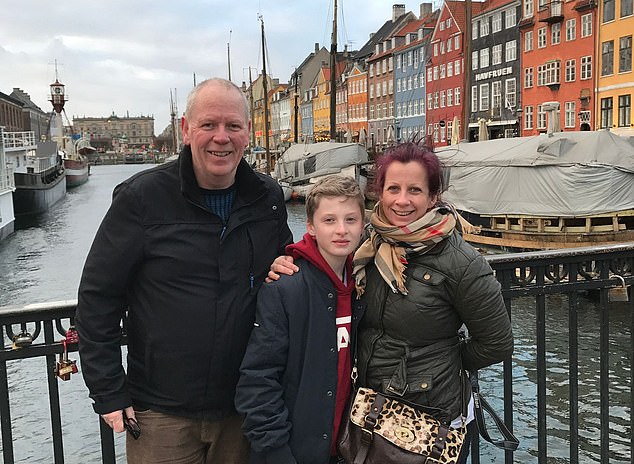
After months of referrals, physio and confusion, Simon was diagnosed on July 4, 2018, with germ cell tumours – a form of testicular cancer
His funeral was exactly what he would have wanted – a huge celebration with 300 people, his Army band, German drinking songs and even a video of him singing My Way on his stag do. He would have roared with laughter at it all.
And then the noise stopped.
To begin with I floundered, partly because this wasn’t my first experience with a major loss. I was taken back to my 16-year-old self, when my father Philip died of lung cancer aged 44.
The grief, and the struggles which followed, were in many ways still with me.
My dad was larger than life – charismatic, warm, mischievous. We were incredibly close and, a fellow musician, he’d been director of music at my prep school in Kent. When he died in April 1994, I was sent back to my girls’ boarding school almost immediately to sit my GCSEs.
Nobody asked me how I was or what I needed, there was just an expectation of resilience. On the surface I coped, passing my exams and progressing with my music studies. But under the surface, throughout my late teens and 20s grief manifested itself in quieter ways.
In sixth form, I developed an eating disorder. Thankfully, it stopped after 18 months when I got a blood infection, and realised I had to look after myself better.
I also experienced episodes of depression and anxiety, though at the time I didn’t realise how low I was. I became deeply invested in seeming ‘fine’, because that made everyone else more comfortable.
This carried on into my marriage to Olly’s father. But just before it ended, I’d gone so far as to have suicidal thoughts – the culmination of years of suppressed grief, layered with marital unhappiness and the pressure of trying to hold everything together.
I never acted on these thoughts, but I also didn’t know how to change things. Simon was the only person who saw it – he was always checking in, trying to help me see the good in things. Given my history of fragile mental health, when Simon died it could have been the moment I crumbled completely, but something else happened. When Simon was in hospital, I started journalling, using a booklet I was given by the ICU nurses to help Simon later understand what had happened.
I was never able to share it with him, but I soon realised how expressing my innermost thoughts, fears, joys was so helpful to me. It also helped me realise I’d never had time to properly process my father’s death. So the year after Simon died, I decided to do the bare minimum to keep the business going, giving me time and space to focus on myself.
I began to understand that grief didn’t have to dictate every emotion. It’s what I now call emotional duality – that you can be heartbroken and hopeful, devastated and determined, sad yet still choose joy.
Crucially, widowhood also gave me permission to stop caring what other people thought. I discovered a confidence I never previously knew I had.
For decades I’d been a people-pleaser, often at the expense of my own happiness or comfort. But when the worst thing imaginable has already happened, the fear of judgment dissolves. People asked whether I would date again, remarry, have more children. In the past I’d have felt obliged to answer, now I refused to indulge these intrusive questions. It wasn’t any of their business. It’s a widow’s privilege not to give a damn what anyone else thinks and there’s an incredible freedom in that.
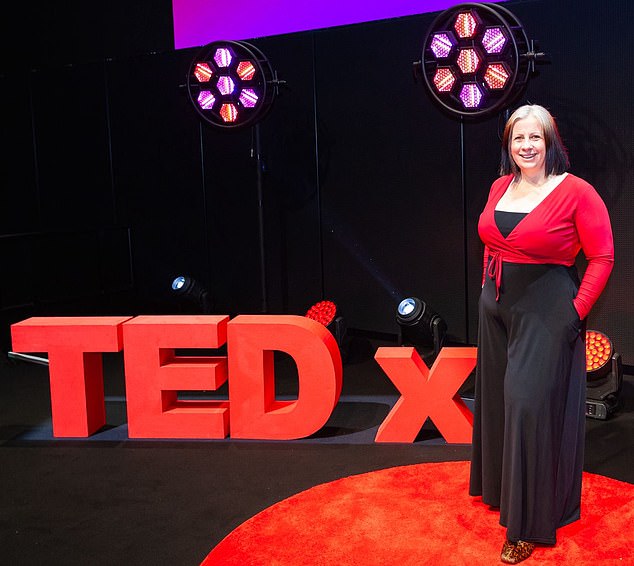
I have written books and speak publicly about grief and mental health, including in my TEDx talk, Widowhood Made Me Happier
I realised that Simon had left me with the greatest gifts – resilience, trust in myself, humour in times of darkness and courage. He didn’t need to be physically here for me to carry them forward.
Without the baggage of feeling I have to be what other people want me to be, I’m happier to be seen and heard. There’s a peace of mind I’ve not experienced before.
Previously, with my anxiety, I wanted to hide from the world. But now I’ve developed trust in myself. I even gave a TEDx Talk that has been watched by thousands of people, something that would have been unthinkable a few years ago.
This is also the first time I’ve been single in my adult life, but I travel solo around the world and feel comfortable doing so.
Some people struggle to believe I can be happy by myself, that a single midlife woman can be genuinely content – but I really do love myself, for the first time in my life. I don’t need anyone else.
In the years since Simon died I have completed a Masters in positive psychology and am now undertaking a PhD in coaching psychology. I have written books and speak publicly about grief and mental health, including in my TEDx talk, Widowhood Made Me Happier. It’s great to know I’m helping others going through something similar.
Olly has graduated with a first in law and now works with me in our business, The PERFORM Experience, which we founded in 2023 to help people protect their mental health and to grow with grief.
I miss Simon every day – his jokes, his drawer of £5 notes he called his ‘funeral fund’ (which, yes, I did use), the way he worried about me even as he went into a coma. But truly I am happier and more confident now than ever.
I allow joy without guilt, from eating and wearing what I want, to taking time for myself when I want. I’m not afraid to have the conversations that frighten us: about death, suicide, mental health.
There is a Japanese art called Kintsugi, where broken pottery is repaired with gold so the cracks become an integral part of its beauty. That is how I see grief now. The break visibly remains but it becomes the place where light enters.
Widowhood did not destroy me. It broke me open. And in that breaking, shaped by love and loss, I found freedom and a deeper, truer happiness. Simon would be proud. I just wish he was here to share it with me.
Follow Tabby at @tabbykerwin. Watch her recent TED Talk at youtu.be/T_rcCwZPiEs
For support and advice, call Samaritans on 116 123 or visit samaritans.org
- As told to Matthew Barbour