The scene that greeted detectives at the filthy terraced house in West Yorkshire was harrowing.
A middle-aged woman called Anne was supposed to be the tenant – a vulnerable character with serious health issues, struggling with addiction, and only recently placed there by the local council after months living on the streets.
But when officers forced their way inside, they found a 21-year-old man sprawled on the sofa, surrounded by drugs, cash, and weapons.
Emaciated, bruised, and terrified, Anne was locked in a bedroom.
Reluctant to speak to detectives, she mumbled that the man was ‘keeping trouble from the door’.
In truth, Anne had been cuckooed – a sinister, insidious practice in which criminal gangs take over the homes of vulnerable people to use as bases for drug dealing, weapons storage, or sex work.
The name derives from the cuckoo bird, which lays its eggs in other birds’ nests.
And Anne is one of thousands across the UK who have been victimised in this way, forgotten casualties of the growing epidemic of County Lines drug networks spreading out from cities into rural and coastal communities.

In series six of the smash hit police drama Line Of Duty, the storyline followed a gang that used the flat of character Terry Boyle, who had Down’s Syndrome, and then framed him for murder
Until now. Because for the first time the crime is being recognised in law. Earlier this year, the then Home Secretary Yvette Cooper announced that cuckooing is to become a specific criminal offence under a new Crime and Policing Bill, carrying a maximum penalty of five years in prison.
The new bill also includes legislation creating a new standalone offence allowing the prosecution of adults for criminally exploiting children.
The move follows years of dedicated campaigning from charities and frontline workers who have long warned that existing laws – often modern slavery or anti-social behaviour legislation – were failing victims and allowing perpetrators to slip through the cracks.
‘This change is long overdue,’ says Tatiana Gren-Jardan, head of Policy and Advocacy at the charity Justice and Care. ‘We’ve seen victims used as drug mules, sexually assaulted, beaten, threatened with having their tongues cut out – all in their own homes. And yet, until now, it hasn’t even been a named crime.’
Unnamed and, by its very nature, hidden behind closed doors, the practice first came to wider public attention when, in 2021, the sixth series of smash hit police drama Line Of Duty featured a storyline in which a gang used the flat of character Terry Boyle, who had Down’s Syndrome, to murder journalist Gail Vella then frame him.
And while exact numbers are difficult to establish, all the signs are that it is growing in prevalence.
In London, cases rose from 79 in 2018 to 316 by 2022, while Detective Superintendent Dan Mitchell, head of the National County Lines Coordination Centre, acknowledges that even with determined recent efforts to address the issue police ‘don’t fully understand the scale of the problem’.
‘That’s in part because cuckooing is a hidden crime and there is an absence of data,’ he told the Daily Mail. ‘But one of the best ways we can get an idea of the scale of it is through what we call intensification weeks where we will get all forces to focus their efforts on County Lines.’
In the most recent, in July, forces nationwide identified 584 premises where cuckooing was taking place. ‘That’s almost 600 premises where people are suffering,’ Det Supt Mitchell says. ‘And almost certainly that number will still underestimate the true scale of problem.’
Meanwhile, a 2022 survey by Justice and Care found that one in eight people across the country reported seeing signs of cuckooing in their local community.
’It’s not just something that happens in major cities – it’s in rural locations, coastal locations,’ says Darren Burton of Green & Burton ASB Associates, which works with police and housing authorities across the UK to address anti-social behaviour issues in the community.
‘We’ve heard of cases in rural Scotland, coastal towns and small rural villages from Yorkshire to Somerset.’

Dan Mitchell, head of the National County Lines Coordination Centre, acknowledges that even with recent efforts to address the issue police ‘don’t fully understand the scale of the problem’
And what links them all is fear and violence, says a spokeswoman for Dundee-based charity, Positive Steps, a support charity for vulnerable adults.
‘The victims are usually very vulnerable people – often with addiction issues, histories of abuse and mental health problems,’ she says. ‘They’re manipulated, isolated, and terrified. And many don’t realise they’re victims. In fact, sometimes they even feel they are benefitting from the presence of their abusers.’
In a city where some areas are ‘overrun’ with County Lines suppliers, Positive Steps are fielding spiralling cuckooing referrals, with cases doubling last year from the previous year to 52.
‘We are seeing the use of more violence, with reports of use of guns and stabbings,’ the spokesperson says. ‘But we are also getting more examples of people you would not necessarily class as vulnerable being targeted.
‘We had a case of a woman who had a good job but had a cocaine addiction. She took someone home from a club who then subsequently used her flat as a base to deal drugs for a year.’
In such instances, she says, it is tempting for those on the outside to think ‘well she let him in’.
‘But this doesn’t take into account how manipulative and clever these people are,’ she says. ‘They don’t just move in overnight. It’s gradual, subtle, clever. Sometimes it can literally start with someone buying you a drink or a bump of drugs.’
And where it ends is in abject cruelty. ‘They take your property, your belongings, they empty your bank accounts,’ she says. ‘There’s people being made to sleep in a cupboard, a cellar, or a box room. Sometimes people are kept bound and gagged in their own homes.’
One terrified former victim is Laura – not her real name – who was cuckooed after being befriended by a couple she met at a soup kitchen.
She let them stay at her modest home ‘for a few nights’, but within days, the couple had taken her phone, stolen her bank cards and tied her up.
‘The woman sat with a knife to my neck and said if I didn’t hand over the card, she’d slit my throat,’ Laura told BBC Scotland. ‘They force-fed me crack cocaine. I was hallucinating. I wasn’t allowed to leave, wasn’t allowed to sleep. They smashed up the house. I thought I was going to die.’
She was only rescued when a family member called her phone – which her abusers answered – and demanded to speak to her.
They alerted the police, whose intervention Laura believes saved her life.
Three hundred miles away in Manchester, John, a 58-year-old man living alone in a one-bedroom council flat in a deprived area of the city, also found himself a target of a County Lines gang following the death of his wife from cancer.
Isolated and struggling with depression and a dependency on alcohol, he was ‘befriended’ by two local men offering food, cigarettes and companionship.
Grateful for the attention, John welcomed them into his home – only for the dynamic to shift as the weeks went on: the visitors began staying longer, bringing unknown individuals into the flat, and using it as a base to store and sell drugs.
When he protested, he was threatened with violence, and told that if he tried to raise the alarm in any way, his ‘friends’ would target the home of his elderly mother who lived nearby.
‘I couldn’t see a way out,’ he recalls.
Perhaps there wouldn’t have been one, were it not for a watchful neighbour, who, having noted the heightened activity around his flat, alerted the local housing association.
Following a joint response by police, housing officers, and social care professionals, John was relocated to another part of the city, as well as receiving mental health support and ongoing social care.
John was one of the lucky ones – as Positive Steps points out, it’s not uncommon for gangs to target the same person twice.
‘There’s an intervention, they move somewhere new, and the same gang finds them again,’ she says. ‘One of the things we try to do to help prevent this is to link victims with a support worker to address the trauma they have experienced and better equip them with the skills that may prevent this from happening again once they are suitably rehomed.’
In some instances, cuckooing does not necessarily spring from gang activity, but instead ruthless individuals or couples seizing an opportunity.
‘We’ve had situations where someone’s benefit money was being taken by the abuser,’ says a spokesperson from the Loughborough-based homeless charity, The Exaireo Trust.
‘In one case, an older man was kicked out of his bed and forced to sleep on a chair while a couple took over his flat. It was only noticed because staff at the soup kitchen he attended raised concerns.
‘Happily, through working with the local authority, we were able to help him find alternative accommodation in sheltered housing.
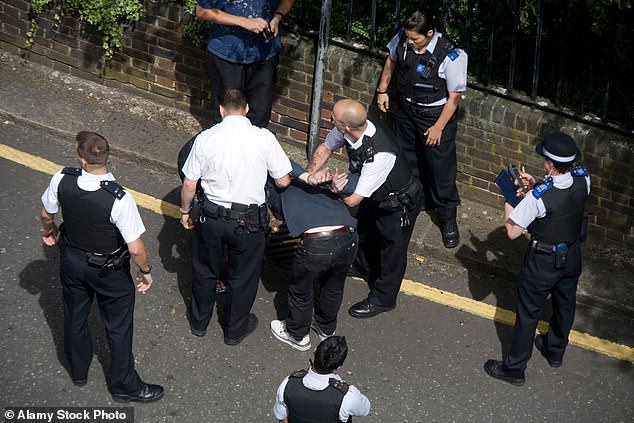
A new bill includes legislation that aims to give police (pictured making an arrest in London) the power to charge those who exploit the vulnerable, and will give victims access to safeguarding and support
‘We have even been aware of cuckooing unfolding in shared houses, where the other occupants were too intimidated by the perpetrator to speak out.’
Until now, the challenge in many cases like these was how to prosecute criminals exploiting the vulnerable in this way, with police and prosecutors forced to rely on modern slavery laws or even anti-social behaviour which did not always fit the bill.
‘The law didn’t always see taking over someone’s property as exploitation,’ as Tatiana Gren-Jardan puts it. ‘But it is. It’s the total domination of someone’s life.’
‘There’s been a fundamental misunderstanding,’ says Darren Burton. ‘For too long, the focus was on what’s happening at the address, not what’s happening to the person. That’s now starting to change.’
The new legislation aims to further shift that perspective, giving police the power to charge those who exploit the vulnerable in this way, and giving victims access to safeguarding and support.
‘We hope this will finally allow a proper understanding of the scale of this problem,’ says Gren-Jardan. ‘Only then can resources be directed where they’re truly needed.’
Not in the least because of the criminal capacity to adapt. ‘We’ve heard about cases where a gang moved from one flat to another in the same building. Plus there’s no shortage of vulnerable people to target – or re-target. That’s what makes this such a pernicious crime,’ she adds.
In the case of Anne – the woman found locked in her bedroom by West Yorkshire Police – it took a move to another county, the consequence of months of coordinated work between police, social services and charity partners, for her to slip the grip of her tormentor.
Even after his arrest, her ‘cuckoo’ found ways to intimidate her, sending messages via associates threatening her with reprisals if she gave evidence against him.
’People were turning up at her home and making threats while the investigation continued,’ a spokesperson for the Centre for Social Justice said, adding that Anne was in ‘a very bad state’ for a long time.
After being rehoused many miles away, she embarked on a detox programme, and was able to reconnect with her children, with whom she had lost contact.
A happy ending then – although as Gren-Jarden points out, the trauma often lasts far beyond the immediate abuse.

Cuckooing is a sinister, insidious practice in which criminal gangs take over the homes of vulnerable people to use as bases for drug dealing, weapons storage or sex work (picture posed by models)
‘This isn’t like being burgled,’ she says. ‘We expect our homes to be places of safety, a refuge from the outside world. But for victims of cuckooing, their homes become a living nightmare, a place of fear and abuse. They become enslaved in their own house. It takes a lot to get over that.’
There are reasons for optimism. Not only is the crime finally being recognised, in the last year, as Det Supt Mitchell points out, the police have closed down a record number of County Lines – more than 2,300 so-called ‘deal lines’ have been shut off in the 12 months since July 2024 and 1,120 gang leaders have been prosecuted.
‘We’re also at the point where we’ve got about 34 forces now that have implemented structured responses to cuckooing. There’s obviously more to do, and the significance of response does vary from force to force, but we’re proud of that,’ he says.