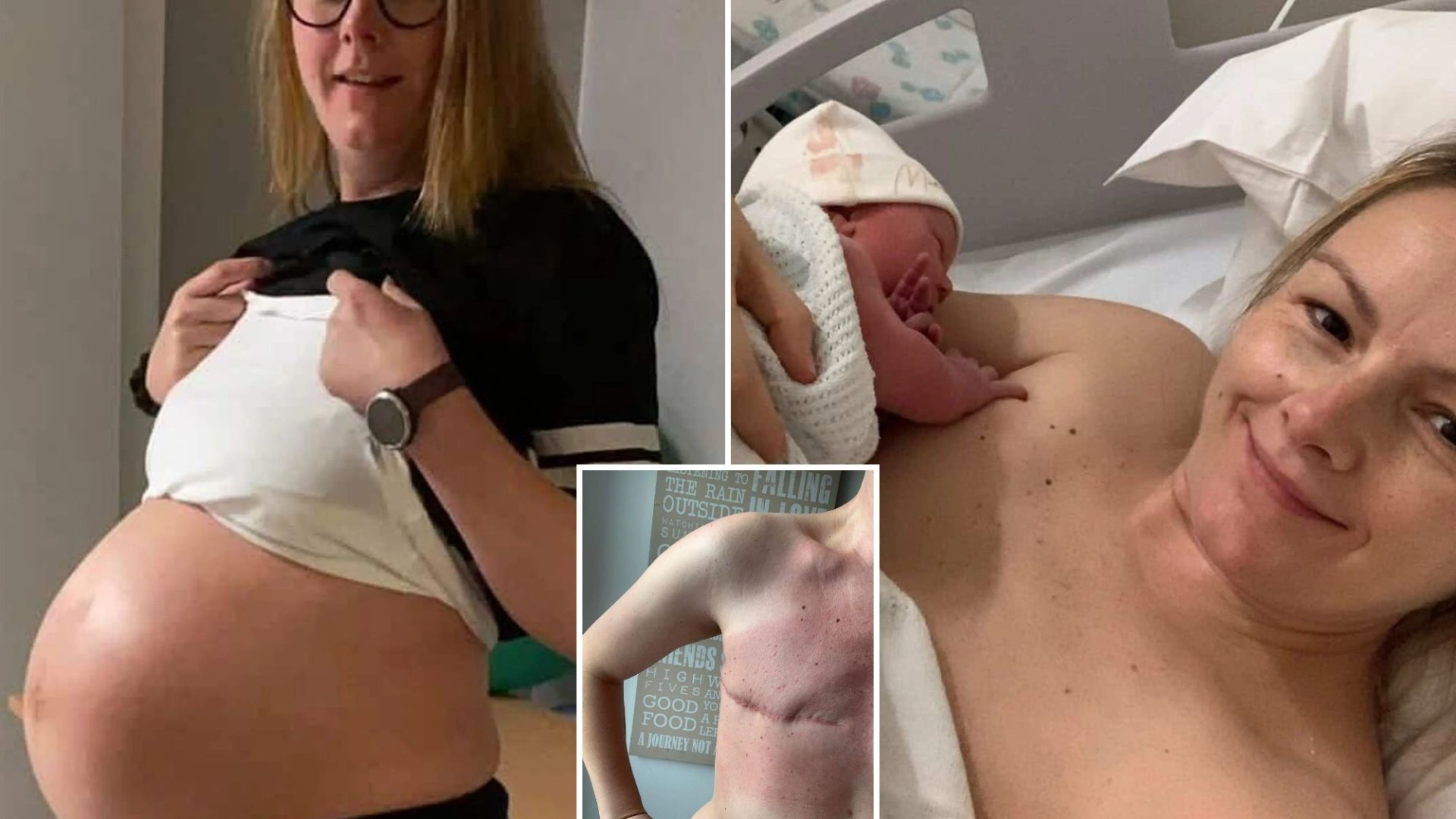
A NEW mum put her ‘wonky’ breasts down to pregnancy changes – only to learn it was a sign of incurable cancer.
Gemma Fish says her right breast began to shrink while she was pregnant with her daughter, but she brushed it off.
But after giving birth to her daughter, the 43-year-old’s breast continued to shrink, eventually ending up three cup sizes smaller than the left one.
Gemma said she continued to think nothing of the change, until she noticed that her nipple was inverted 14 months later.
The mum then visited her GP and was referred for a mammogram, ultrasound and biopsy – which led to her being diagnosed with stage one breast cancer.
The charity founder underwent a single mastectomy on her right breast followed by six sessions of chemotherapy and radiotherapy, before learning it had progressed to stage four.
Three years on from her initial cancer diagnosis in February 2023, Gemma is now urging other women not to ignore any changes to their breasts and to visit their GP if they do.
Gemma, from Salford, Greater Manchester, said: “My boobs looked wonky.
“Obviously in pregnancy, your body changes with every part of you.
“As other things settled down, one of my breasts was still quite large and one was shrinking.
“There was nearly three sizes difference between the two breasts, which is massive.
“I fobbed that off as a change after pregnancy and, as that continued, that breast continued to shrink.”
Gemma spotted that the nipple on her right breast was inverted in January 2023 and raised it with a GP the following month.
Gemma said: “My nipple started to turn inwards and I was like ‘I really need to get this checked out’.
“I still put it off a little bit longer but then went and had that checked in February 2023.
“I wouldn’t have gone if I hadn’t noticed that the nipple was inverted.
“I was still just putting it down to how the changes happened during pregnancy.
“As soon as I went into the doctor’s appointment and explained everything I could tell by her face that it was serious.
“The right breast had shrunk to the size of the tumour in the end.”
Gemma received the devastating diagnosis of breast cancer on February 17, 2023, recalling: “It was just really, really surreal. I was like ‘how the hell am I going to deal with this?’
What are the signs of breast cancer?
BREAST cancer is the most common type of cancer in the UK.
The majority of women who get it are over 50, but younger women and, in rare cases, men can also get breast cancer.
If it’s treated early enough, breast cancer can be prevented from spreading to other parts of the body.
Breast cancer can have a number of symptoms, but the first noticeable symptom is usually a lump or area of thickened breast tissue.
Most breast lumps aren’t cancerous, but it’s always best to have them checked by your doctor. You should also speak to your GP if you notice any of the following:
- a change in the size or shape of one or both breasts
- discharge from either of your nipples (which may be streaked with blood)
- a lump or swelling in either of your armpits
- dimpling on the skin of your breasts
- a rash on or around your nipple
- a change in the appearance of your nipple, such as becoming sunken into your breast
Source: NHS
“I was thinking ‘I’m a single mum, I just don’t have any ability to deal with the logistics of being poorly’.
“At that point I wasn’t thinking ‘I’m going to die from this’, I was just like ‘this is something that we have to deal with and get treated’.”
Gemma had a single mastectomy on her right breast on March 21, less than four weeks after her diagnosis.
She underwent chemotherapy treatment from April to August 2023 and had radiotherapy sessions in October 2023.
After having her ovaries removed in January 2024, it was confirmed that Gemma had stage four breast cancer.
Gemma said: “I had my ovaries removed in January 2024 because my cancer was oestrogen-fed.
“As part and parcel of surgery they were sent off for testing and it came back that the breast cancer was in my ovaries.
“I’m classed as living with stage four breast cancer, but I will always take it as a win because it was found in the lab after they’d been removed from my body.”
In March 2025 Gemma underwent a mastectomy on her left breast and has chosen not to have reconstructive surgery.
Gemma said: “When I had the single mastectomy I just lived asymmetric.
“Since then I now just live flat chested, which was a massive adjustment.
“It was easier to live with one breast than I found it to live with no breasts which sounds bizarre – but it was a massive mental toll getting used to my body again.”
Gemma, whose daughter Rosie is now four, is classed as living with incurable stage four cancer.
Gemma said: “It’s no longer curable, it’s only treatable.
“The aim of the game then changes to keeping everything stable and hopefully getting to the point where there’s no evidence of actual disease.
“Living with stage four cancer is completely different now compared to how it was years ago.
“It’s no longer a straight death sentence so to speak, there’s lots of ladies that live long lives on various different treatment lines.
“It was really hard initially to accept that, particularly being a single mum to Rosie.
“There were lots of decisions and things I had to put in place for her future, shall I not be here, but all of that is done and dusted.
“Now we live as happily as we can and enjoy as many things as we can.
“I think that’s the one thing that cancer teaches you is, that our time is the most important thing in the world.
“We should spend every minute, of every day, of every week, doing something that makes us happy because life can change in an instant so that’s what we do.”
Now, Gemma is encouraging other women to visit their GP if they spot any changes with their breasts.
Gemma said: “Just don’t ignore it, because if I had gone initially and not ignored it and not buried my head in the sand, it would have been caught a hell of a lot sooner.
“The whole treatment plan would have been completely different from what I’ve ended up doing and possibly avoided it spreading.
“All of that is hindsight, but my advice is if something changes,just go and get checked out.
“The doctors won’t mind, you’re not wasting time, it’s better to be safe than sorry.
“Prevention is better than cure.”
How to check your breasts
IT is important to regularly check your breasts for any changes.
Breast tissue reaches all the way up to your collarbone and across to your armpit, so it’s vital to check these areas too.
If you feel or see any changes in your breast, you should always consult your GP.
Charity CoppaFeel! recommends checking your breasts monthly, so you can pick up on any changes quickly.
Breasts do change naturally as part of your monthly menstrual cycle, so you should get to know your breasts, how they feel and what changes they usually go through to know if anything is out of the ordinary.
Five-step check
There is a five-step self exam you can do at home to check for any changes.
Step one: Begin by looking in a mirror, facing it with your arms on your hips and your shoulders straight. You should be looking for any dimpling, puckering, bulging skin, redness, soreness, a rash or changes to the nipple.
Step two: Still looking in the mirror, raise both arms above your head and check for the same changes.
Step three: With your arms still above your head, check for any fluid coming from the nipples. This can include milky, yellow or watery fluid, or blood.
Step four: While lying down, use your opposite hand to check each breast. Using a few fingers, keeping them flat and together, go in a small circular motion around your breasts. Make sure you feel the entire breast by going top to bottom in these small circles. It helps to develop a system or pattern to make sure every inch is covered. Use light pressure for the skin and tissue just beneath, medium pressure for the tissue in the middle of your breasts, and firm pressure to feel the tissue at the back, feeling down to your ribcage.
Step five: Feel your breasts while either standing or sitting, using the same small circular motions.