IRANIAN missiles struck towns in the Negev Desert, near Israel’s secretive arsenal of nuclear weapons.
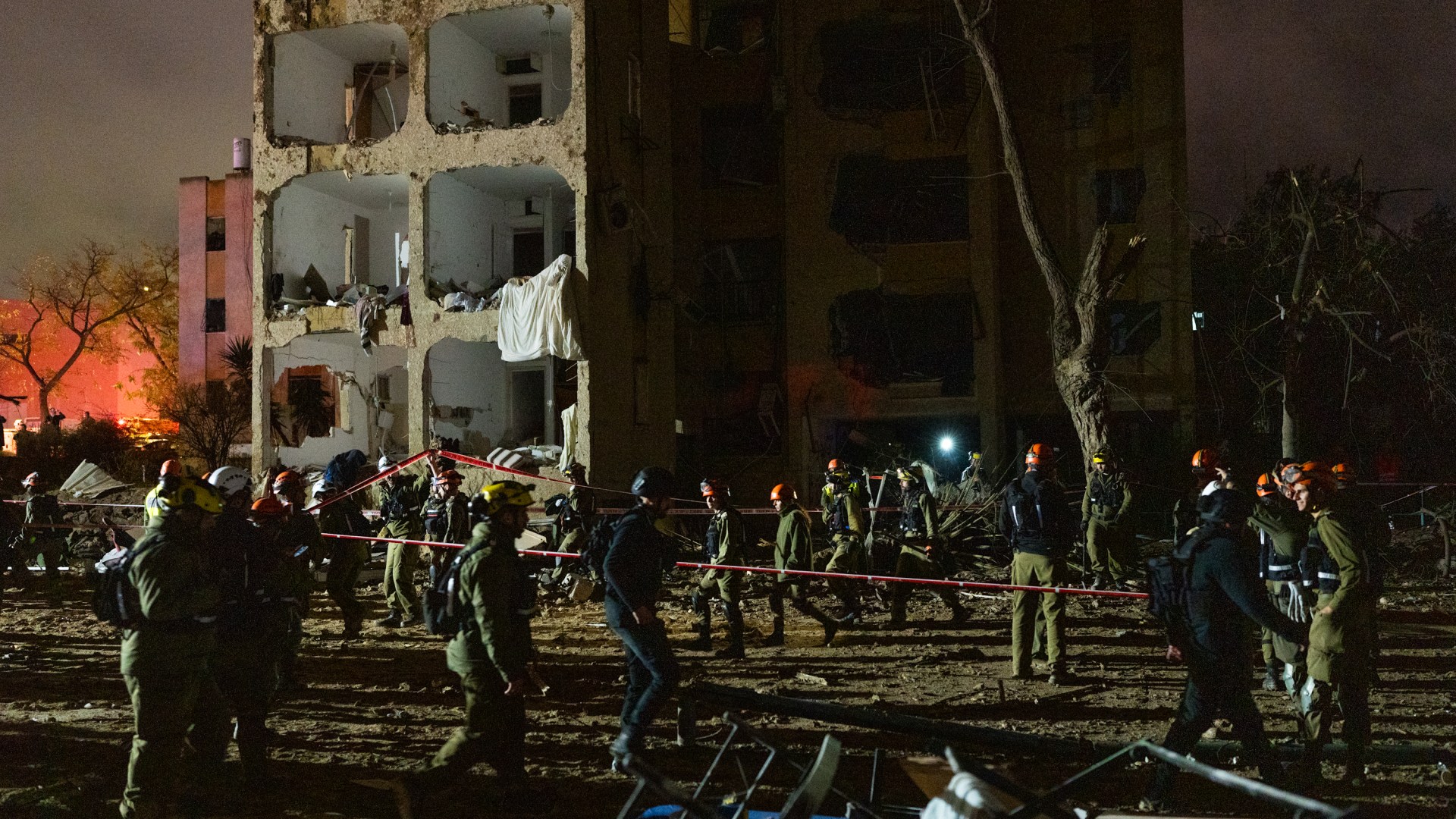
Almost 100 people have been wounded – including two children in serious condition – in Dimona and Arad, in southern Israel.
Footage circulating on social media shows the moment an object hurtled out of the dark sky at high speed before crashing into Dimona.
Israel’s Iron Dome failed to knock down the ballistic missile, even though the military said “interception attempts were carried out.”
“In both Dimona and Arad, interceptors were launched that failed to hit the threats, resulting in two direct hits by ballistic missiles with warheads weighing hundreds of kilograms,” Israeli firefighters said.
Emergency services said teams are treating a large number of casualties, including a five-year-old girl in serious condition and a 10-year-old boy who is fighting for his life after being injured by shrapnel.
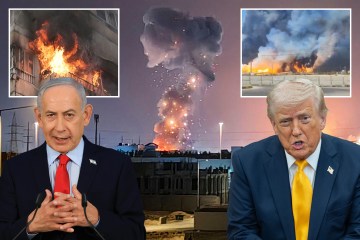
Extensive damage was reported in the two cities as Benjamin Netanyahu admitted that his country has suffered “a difficult evening” and vowed to “continue to strike our enemies on all fronts”.
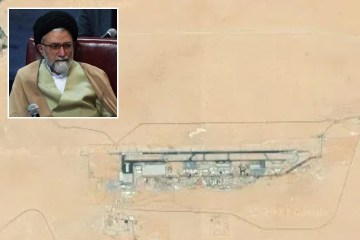
Iran said the strikes were retaliation for attacks on its own nuclear site at Natanz, one of the country’s most important uranium enrichment sites, about 135 miles southeast of Tehran.
This marks a stark new phase of tit-for-tat targeting in the conflict, now in its fourth week.
Mohammad Baqer Ghalibaf, speaker of Iran’s Parliament, claimed the hit on Dimona showed that “Israeli skies are defenceless”.
“If the Israeli regime fails to intercept the missiles in the highly protected Dimona area, it is operationally a sign of entering a new phase of the battle,” he wrote in a post on X.
The International Atomic Energy Agency (IAEA) confirmed it had received no indication of damage to the Shimon Peres Negev Nuclear Research Center at Dimona itself, and that no abnormal radiation levels had been detected in the area.
In the meantime, its Director General Rafael Grossi urged that “maximum military restraint should be observed, in particular in the vicinity of nuclear facilities”.
While Israel is a member of the IAEA, it does not allow the watchdog to inspect its nuclear sites as it has not signed the Non-Proliferation Treaty (NPT).
Israel is widely believed to possess the only nuclear arsenal in the Middle East.
The state neither confirms nor denies having built the bomb, keeping a decades-old “ambiguity” policy.
Dimona has been at the heart of its nuclear programme since its research centre, built in secret with French assistance, opened there in 1958.
The Iranian response comes after Yemen’s Houthis – historical allies of the regime – posted a music video to their Telegram channel threatening to “attack, burn, and sink the collapsing American Pharaoh”.
While featuring AI-generated images of drones launched from the desert, the rebels warned that their “fingers are on the trigger”.
The Houthis have so far remained quiet since the US launched Operation Epic Fury.