As he stepped out of a Rolls-Royce in Monaco this summer, the smartly dressed man appeared only too happy to be filmed strolling through the playground of the super-rich.
In footage, later posted on TikTok, he could be seen alongside his glamorous girlfriend, the daughter of a former Albanian government minister, as he flaunted his wealth and powerful connections.
It was just one of a number of extravagant jaunts the 37-year-old has enjoyed in recent years, as he and his business partner brother jetted between London, Dubai, the South of France and their homeland of Albania.
To an outsider, the way the siblings escaped a deprived background in the impoverished Balkan state, through hard work and determination, had all the hallmarks of an extraordinary rags-to-riches story.
The brothers ran a string of businesses and had a portfolio of luxury apartments and villas not only in the most desirable parts of Albania’s capital Tirana but on the country’s booming ‘Green Coast’ by the Ionian Sea.
One of them also owned a yacht in Dubai which was, by all accounts, a magnet for beautiful influencers – who were regularly invited onboard for lavish parties.
But the high life appears to have come to an abrupt end for both brothers, as it becomes clear that their success was built on far murkier foundations than previously imagined.
A few weeks after the Rolls-Royce footage was posted online, Albanian investigators arrested Klevis and Artur Hoxhosmani on charges of running one of Europe’s biggest drug-smuggling operations.
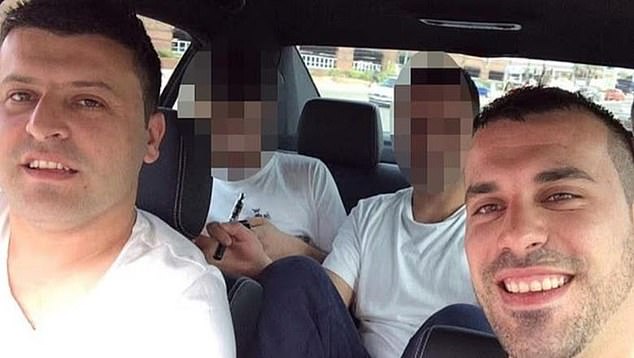
Klevis Hoxhosmani (right) and his brother Artur, were not discreet with their ill-gotten gains and lived a lavish lifestyle


Klevis and Artur were two of four brothers born in the industrial Albanian town of Burrel during the final years of the country’s harsh and isolationist communist regime
The pair appeared in court earlier this month, in Tirana, charged with conspiracy to traffic £335million’s worth of cocaine from Latin America to Britain and the EU.
Prosecutors allege the pair controlled a highly sophisticated pan-European network involving at least 16 operatives whose reach spread into ‘international criminal markets’, with one of the ‘executive branches’ based in Britain.
By hiding the drugs in consignments of legitimate goods, such as boxes of bananas and bags of cocoa beans, it is claimed ‘tons of narcotics were transported to ports in Belgium, the Netherlands or overland routes to France and the UK’ by lorry drivers working for genuine export companies.
The siblings are suspected of laundering money from their operation in property and other high-value investments.
Investigators in Albania, where the pair are remanded in custody awaiting a full trial, have already seized a yacht and a fleet of cars, including a Mercedes-Benz AMG G63 – a luxury SUV which lists for more than £140,000 – plus one Rolex and a Richard Mille watch.
Now, in a Daily Mail investigation, which raises yet more troubling questions about our broken immigration system, we can reveal that the brothers were able to start building their alleged drugs empire after moving to the UK, where – they told friends –they planned to claim asylum.
The pair had established themselves in Dorset, where locals described them as the ‘neighbours from hell’, with one nicknaming Klevis ‘Ali Baba’ because his associates appeared to be 40 thieves.
Klevis has since racked up several convictions, including one for beating up a woman, while Home Office sources say there was an open police investigation into alleged drugs offences against him at the time of his arrest back in Albania.
The emergence of the brothers’ disturbing backstory comes amid reports that the number of cross-border drug-smuggling cases dealt with by Britain’s organised crime police has more than doubled in a single year, putting law enforcement under increasing strain.
Meanwhile, Border Force is on course to seize a record-breaking volume of class A drugs, such as cocaine and heroin, for the second year in a row.
Klevis and Artur, 42, were two of four brothers born in the industrial Albanian town of Burrel during the final years of the country’s harsh and isolated communist regime.
It meant they came of age in the turbulent aftermath of the fall of the dictator Enver Hoxha, when the economy went into a tailspin and law and order broke down.
Two sources that are part of the Albanian community in the UK have told the Daily Mail that, like huge swathes of their contemporaries, the Hoxhosmani brothers decided to leave Albania and try their luck in Britain. Artur came to the UK in around 1999, they said, followed by Klevis some years later.
Home Office sources say there is a record of an asylum claim for Artur, although under a different date of birth from his registered details in Albania, a tactic often used by Albanian claimants to make it harder for the Home Office to make checks.
Details of Klevis’s claim to stay in the UK are not public, but he apparently faced a battle with the Home Office when it tried to appeal a decision by the First-tier Immigration Tribunal to allow him to remain. This was denied by the judge, the Courts Service said.
By 2013, the brothers were living in Bournemouth, where Klevis was director of the Crystal Hand Carwash. He also ran a tyre shop and is still registered as a director of a coffee shop in the town centre.
Electoral roll and other public records suggest they lived an itinerant life in the seaside resort, moving between multiple properties in and just outside the city.
One of their longest stays was on Hill View Road, a suburban street made up of elegant, detached houses leading to a cul-de-sac in the Redhill area of Bournemouth.
One elderly resident recalled how Klevis moved in first with his then wife and their young child. ‘I will never forget that surname,’ he told the Daily Mail following news of the arrests.
‘They were nothing but trouble the pair of them. The property agents spent a lot of time and effort trying to get them kicked out.
‘When they eventually evicted them they left the place in a hell of a mess. It was absolutely filthy. There were holes in the walls, the doors had been wrenched off their hinges and it stank of excrement because they had left dirty nappies all over the place.
‘The police made plenty of visits to the premises while they were there, usually because they had another stupendous domestic row. They both swore at one another like troopers but in English.
‘There was one evening where I heard a kerfuffle on the road outside and looked out my window to see a woman in a dressing gown laying into him.’
In 2014, Klevis Hoxhosmani, then aged 26, appeared before Bournemouth magistrates where he admitted assaulting a woman by beating.
He was given a 29-day community order under the Building Better Relationships Programme and was ordered to pay a fine of £125. He also pleaded guilty to causing £300 worth of damage to an iPhone.
A year earlier he was fined £200 after being convicted in his absence of driving a Mercedes, a breach of his licence.
But the neighbour said there were already fears that far worse had been going on at the property – which he said was known to be under police surveillance at the time.
‘There were always smart cars turning up there at all hours of the day and night with two, three or four blokes onboard,’ he said.
‘On another occasion there was a Lamborghini outside revving its engine.’
For a while, peace was restored when the couple seemed to disappear while still owing around a year’s rent on the property.
But despite their apparent departure, neighbours regularly noticed a light on in the house.
The resident said: ‘Then one night a neighbour saw a man climbing in through a side window and called 999. Police came to the property and arrested the guy and it was Klevis’s brother Artur. He had been squatting there while they weren’t about but they had to let him go because it was still legally let to his family even with all the rent owing.’
The situation came to a head one autumn evening when Klevis heard an ‘almighty crash’ at his front door and found an aluminium pole, similar to extendable handles for brushes used in hand car washes, sticking out of it.
‘Another was thrown at the door the next night. A couple of days after that, someone threw a big lump of an apple against it and on another night a big stone.’
The brothers soon moved on to another part of Bournemouth, much to the relief of the resident.
Albanian special prosecutors now allege that within a few years the Hoxhosmani brothers were operating an international smuggling network that was swamping Britain with cocaine.
Communications intercepted by the investigators allegedly show they were behind a 250kg shipment of cocaine that was seized in France in April 2020 on its way to the UK. Following the raid, Artur exclaimed in a message: ‘F*** the state.’
In other messages the gang refer to the UK as the ‘island’, while Artur also tells alleged accomplices to ‘bring money to England’. In a separate communication Artur is told: ‘I’ve got all the money in England.’
Artur apparently enjoyed enthusiastic backing of his underlings, with one of his workers messaging him: ‘You live life as big as your heart – may you live 100 years, bro, with all the people you love!
‘May God give you whatever your heart desires!’
The messages are key to the case against the Hoxhosmani brothers outlined in a court document by prosecutors, Albania’s Special Structure against Corruption and Organised Crime (Spak).
It alleges they ran an operation that was ‘hierarchical and divided into specialised roles’.
‘At the top of this criminal group were the leaders and financiers who not only ordered and financed drug shipments, but also coordinated routes, points of contact and logistical operations,’ it said.
‘They were the originators, investors and guarantors of the operations, connecting the source of drugs in Latin America with European markets through a sophisticated chain of intermediaries. Most of them lived between the countries of the European Union, the United Kingdom and Dubai.’
The leaders had contacts in Colombia and Ecuador who were responsible for ‘securing, packaging, and the shipping of the drugs to European ports’.
The illicit cargo was smuggled through customs and were hidden in wooden pallets, boxes of bananas, bags of cocoa beans and shipments of timber.
The alleged criminal group also had a string of key connections with corrupt customs officers and port staff in several EU countries which was a ‘crucial factor’ in the success of their drug trafficking. After arriving in Antwerp in Belgium and Rotterdam in the Netherlands, the drugs were transported by land to France and through the Channel Tunnel to the UK, it is claimed.
After arrival a separate distribution network received the illicit packages and delivered them ‘according to local orders’.
‘These were the executive arms of the network in Great Britain and Western Europe.
‘The criminals managed to transfer huge sums of money without any trace or detection by using the ‘Hawala’ system.’
This informal money transfer technique, which uses an international network of brokers who operate on trust, proved a ‘sophisticated method’ to ‘circumvent the traditional banking system’ and ‘hide the origin and destination of drug trafficking proceeds’.
The whole operation was run and controlled through an encrypted messaging app popular among Albanian criminals called ‘Sky ECC’.
The system was similar to ‘EncroChat’, a secret communications service used by organised criminals that ran on modified mobile phones using unique servers that could only communicate with each other.
On this system, the gang hid behind nicknames – including one British operative called ‘Beast’ – which they believed ‘guaranteed anonymity and avoided eavesdropping’.
This was to be a fatal flaw for the gang’s operation. Just as EncroChat was penetrated by police in 2020, leading to the arrest of thousands of criminals – as documented in a recent Channel 4 series – the code for Sky ECC was cracked by detectives in 2022.
Albanian crime busters launched a probe working closely with other European police forces – including two officers from the UK’s National Crime Agency who are understood to be permanently based at Spak’s Tirana headquarters – and began to decipher a huge cache of messages which enabled them to identify alleged ‘serious criminal offences and suspects’.
Communications unearthed included delivery plans, warnings of customs checks and instructions on how to react in the event of seizures.
It culminated in the summer with the arrest of the Hoxhosmani brothers and several alleged accomplices, who now sit in an Albanian jail awaiting trial in front of a judge.
But while the investigators are to be congratulated on the operation which has brought them this far, the Hoxhosmanis’ former neighbours back in Bournemouth – and no doubt many others, too – are wondering how these small-time brothers were allowed to use
the UK as their base to launch themselves from car wash operators to alleged international cocaine-smuggling kingpins.