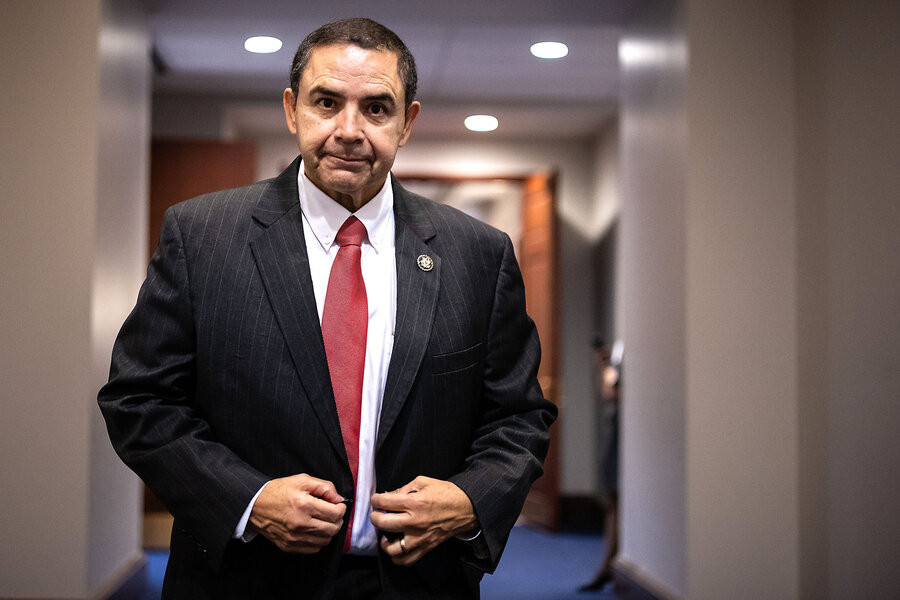
Rep. Henry Cuellar apparently didn’t follow the playbook.
Last week, President Donald Trump, a Republican, sent ripples across Capitol Hill when he unexpectedly pardoned the conservative Texas Democrat and his wife, who were indicted in 2024 on corruption charges. Some observers speculated that a party switch – which could boost Republicans’ chances of holding on to their slim House majority – might be in the offing. Instead, Representative Cuellar promptly turned around and filed to run again in his southern border district … as a Democrat.
On Sunday, President Trump decried Mr. Cuellar’s “lack of LOYALTY” on social media, ending his lengthy post with a flourish of frustration: “Next time, no more Mr. Nice guy!”
Why We Wrote This
Historians say presidential pardons have been used in ways that range from serving the chief executive’s own family interests to uniting a torn nation after a war. When the power is abused, it can pose a direct threat to democracy, say some critics of actions by President Donald Trump.
It’s the latest example of how Mr. Trump has made presidential pardon power a high-profile feature of his second term, far more than in his first. This ramped-up use of clemency reflects Mr. Trump’s wider, more assertive claim to executive power since retaking office. His comments when issuing pardons often reflect sympathy for supporters – as well as Mr. Trump’s own grievance toward the justice system, following his four criminal indictments, one of which resulted in a conviction (which he is appealing).
Critics see a “pay to play” mentality behind some of Mr. Trump’s pardons. The October pardon of billionaire Changpeng Zhao – founder of Binance, the world’s largest cryptocurrency exchange – was followed by an expanded partnership between Binance and the Trump family crypto firm, World Liberty Financial. The White House denies any connection. Massachusetts Sen. Elizabeth Warren, the top Democrat on the Senate Banking Committee, lambasted the pardon as “corruption.”
Some pardons even appear to contradict administration goals. On Dec. 2, Mr. Trump pardoned former Honduran President Juan Orlando Hernández, freeing him from a 45-year prison sentence in the United States for helping drug traffickers transport cocaine to the U.S. The pardon came as the U.S. has ramped up its military campaign against drug trafficking, blowing up boats suspected of transporting drugs in the Caribbean and eastern Pacific.

Still, many of the pardons Mr. Trump has issued this year appear personal, coming after his own legal troubles. Between his first and second terms, Mr. Trump faced multiple major legal cases. At times, he has spoken of others’ entanglements with the justice system in language similar to how he has described his own.
In his Truth Social post on Sunday about the Cuellars, Mr. Trump said he had “felt very good about fighting for a family that was tormented by very sick and deranged people – They were treated sooo BADLY!” Similarly, in the Hernández case, Mr. Trump stated on social media that Mr. Hernández was “treated very harshly and unfairly.”
The former Honduran president, his lawyer, and his wife all actively lobbied for clemency. Trump allies Roger Stone and former Rep. Matt Gaetz also reportedly lobbied on Mr. Hernández’s behalf, though not for pay. Paying lobbyists to get Mr. Trump’s attention in the hopes of receiving a pardon has become big business in Washington.
“Trump seems to have entered into a period of special enthusiasm” for pardons, says Walter Olson, a senior fellow in constitutional studies at the libertarian Cato Institute.
Critics, however, see a power that is being abused in ways that pose a direct threat to democracy. When pardons are granted on the basis of personal sympathy or loyalty, as well as potential quid pro quos, it undermines the integrity of the system – and ultimately, Americans’ faith in the rule of law.
Justin Levitt, a constitutional scholar at Loyola Law School in Los Angeles, says Mr. Trump has been particularly prolific in issuing pardons either for “crimes against the democratic process or crimes involving public corruption, which are very much related to the democratic process.”
The health of the American system itself is at stake, Professor Levitt says. “Democracy depends on knowing that politicians work for the public, not themselves.”
Why the pardon power exists
The presidential pardon power is as old as the republic. The Founding Fathers carried over the practice from the English monarchy, known previously as the “prerogative of mercy.” It was, and is, limited to federal crimes, and in the early days of the United States, when there were few federal laws, it was seldom used. The first presidential pardon came in 1795, when George Washington granted clemency to figures involved in the so-called Whiskey Rebellion over taxes.
Throughout American history, pardons have at times been granted in an effort to promote national reconciliation. Examples include the presidential pardons of ex-Confederates by Abraham Lincoln and Andrew Johnson; the 1974 pardon of Richard Nixon by Gerald Ford; and Jimmy Carter’s 1977 pardon of more than 200,000 evaders of the Vietnam War draft.

During his first term, Mr. Trump issued some 237 pardons and commutations, a low number compared with other modern-era presidents. Less than a year into his second term, he has issued more than 1,600 – the vast majority to people involved in the attack on the U.S. Capitol on Jan. 6, 2021.
The Jan. 6 pardons, issued on Inauguration Day this year and fulfilling an oft-repeated 2024 campaign promise, came as no surprise. They set the tone for an administration that rewards loyalty, and they remain controversial.
But the more recent acts of clemency have also grabbed headlines as, one by one, Mr. Trump pardons public figures and associates, tech and business leaders, celebrities and athletes, and political activists.
In late November, the president commuted the seven-year sentence of private equity executive David Gentile, who was convicted of defrauding investors of $1.6 billion. The grant of clemency also stipulated that he would not have to pay restitution, which had been set at $15.5 million.
In some instances, Mr. Trump’s rationale might not be anything more complicated than commiseration for a colorful public figure embroiled in legal trouble. Take George Santos, the former GOP congressman from New York sentenced in April to 87 months in prison for wire fraud and identity theft, who was freed in October after the president commuted his sentence.
“George Santos was somewhat of a ‘rogue,’ but there are many rogues throughout our Country that aren’t forced to serve seven years in prison,” Mr. Trump wrote on Truth Social explaining the commutation.
Yet, ethics experts say these acts of clemency also send a signal to other elected officials who might be worried about potential legal action against them.
The message is, “if you are involved in any corruption, you could be pardoned during this administration – as long as you stay loyal to the president,” says Kedric Payne, senior director of ethics at the Campaign Legal Center in Washington.
Mr. Payne notes that Mr. Trump has long been an equal-opportunity granter of clemency. On the last day of his first term, the president commuted the 28-year sentence of Kwame Kilpatrick, the Democratic former mayor of Detroit, who was found guilty of multiple criminal counts, including extortion. Mr. Kilpatrick went on to campaign for Mr. Trump in the 2024 election.

Julia Demaree Nikhinson/AP/File
Early in Mr. Trump’s second term, he commuted the sentence of the Democratic former governor of Illinois, Rod Blagojevich, who had served eight years of a 14-year sentence for corruption. Mr. Blagojevich also became a strong Trump ally.
Mr. Trump has also taken care of those who have stayed loyal to him during high-stakes periods. Last month, he pardoned key figures in the effort to challenge his 2020 election loss, including former New York Mayor Rudy Giuliani, former Chief of Staff Mark Meadows, and lawyer Sidney Powell. Late in his first term, Mr. Trump pardoned former aides Steve Bannon, Paul Manafort, and Michael Flynn, and his friend, Mr. Stone.
Past presidents’ controversial pardons
To be sure, Mr. Trump is not the only recent president to issue controversial pardons.
Joe Biden pardoned his son Hunter late in his term, after insisting he wouldn’t. And in the waning hours of his presidency, he preemptively pardoned five other family members, including his brothers, insulating them against potential future charges.
Bill Clinton also pardoned a family member on his way out the door – half-brother Roger Clinton, convicted of cocaine possession and drug trafficking. But President Clinton’s most infamous pardon went to fugitive financier Marc Rich, whose ex-wife had contributed to the Clinton Presidential Center and then-first lady Hillary Clinton’s Senate campaign.
Ultimately, there’s little check on the pardon power. In theory, a president could be impeached for inappropriate pardons – though in the currently divided Congress, impeachment and conviction are well nigh impossible to achieve. Or the U.S. Constitution itself could be amended to eliminate pardon power or add a check, such as a requirement for congressional approval. That’s an even taller order, though.
Mr. Olson, the Cato scholar, notes that the Founding Fathers had “some very definite concerns” about the potential for abuse in the granting of pardons, in that it comes close to absolute power. But they went ahead and embedded the pardon power in Article II, Section 2 of the Constitution. One question that remains untested is whether presidents can pardon themselves.