Festive food, it seems, gets weirder, more ridiculous and less appetising every year.
Among the horrors I’ve come across are gingerbread-infused cheese and prosecco-flavoured crisps… and don’t get me started on the mince pie wrap I’ve seen lurking on supermarket shelves. Whatever happened to good, old-fashioned turkey with all the trimmings followed by plum pudding?
Well, this year’s trendiest ingredient might just be the strangest one yet.
For standing in your house right now, bedecked in baubles and tinsel, is an unlikely – but apparently delicious – festive flavour: your Christmas tree.
Whether you’ve got a 7ft Nordmann Fir or a 3ft potted Blue Spruce, you’re in possession of something that is, in fact, edible. Their
needles, bark and branches make versatile and flavoursome additions to a variety of sweet and savoury dishes, according to food writer Julia Georgallis,
‘Just think of it like a bay leaf or a sprig of rosemary,’ urges Julia, who’s so passionate about the subject that she penned a cookbook, How To Eat Your Christmas Tree, in 2020. ‘There are a lot of plants we can eat that we can’t buy from the supermarket. This doesn’t make them any less worthy, tasty or edible,’ she adds.
Different types of trees, she explains, have subtly different flavours and ‘don’t taste like car air freshener’ – a welcome relief.

Sarah Rainey tries her hand at cooking a selection of festive dishes using christmas trees as a key ingredient
‘Pine is woody and very delicate, it doesn’t have a strong flavour at all.
‘Fir is grassy. And spruce, my favourite, almost has notes of vanilla.’
It may sound unconventional but Julia isn’t the first to make use of her Christmas tree in the kitchen. Indeed, the tradition of cooking with conifers dates back centuries and spans the globe, from Alpine communities making herbal liqueurs to East Asian cultures smoking fish and meat with pine.
And many of this country’s top chefs use it in their seasonal dishes, from pine jelly with meat to spruce honey with cheese. Until recently, Waitrose sold a batch of moreish mince pies topped with pine sugar, devised by the chef Heston Blumenthal.
If that hasn’t whetted your appetite, many believe there are health benefits to eating evergreens, too: such as strengthening your immune system and warding off colds – a real boon at this time of year.
So which bits can you tuck into… and is it simply a case of plucking a few sprigs and putting them in a pot?
Julia urges caution, especially when it comes to the type of tree.
‘In other parts of the world, yews, cedars and cypress can be used as Christmas trees and these are extremely poisonous,’ she says.
‘As with all foraged food you don’t buy in a supermarket, there are precautions you need to take.’
The most important first step is to source an edible tree. If yours is already lit up in the front window, this tip may have come a little late. But you can always check with the supplier, who may need to ask their grower whether or not the tree is safe to eat (a question guaranteed to raise a few eyebrows).
‘Many farmers spray their trees with harmful chemicals or even green paint to make them more Christmassy,’ Julia warns.
If and when you establish that it’s edible, unsprayed and unlikely to send you hurtling to A&E, you’ll need to prepare the needles.
These are sharp, like fish bones, so Julia recommends taking care – or even wearing gloves – when snipping them off with scissors into a large bowl. ‘Wash the branches under cold, running water, making sure that you get rid of bits of mud and dirt,’ she says.
‘You may notice that there are balls of sap, but this is safe to eat, as are the dried buds which might be at the end of some of the branches.’
My tree cleared for consumption, I turn my hand to some of Julia’s recipes. Could eating the Christmas tree become a new family tradition, or is it another festive food fad?
CHRISTMAS-CURED FISH
Smoked fish is a favourite for Christmas breakfast in our house… but I’ve never tried curing my own (let alone with tree offcuts).
This recipe, says Julia, makes a wonderful starter or decadent sandwich filler.
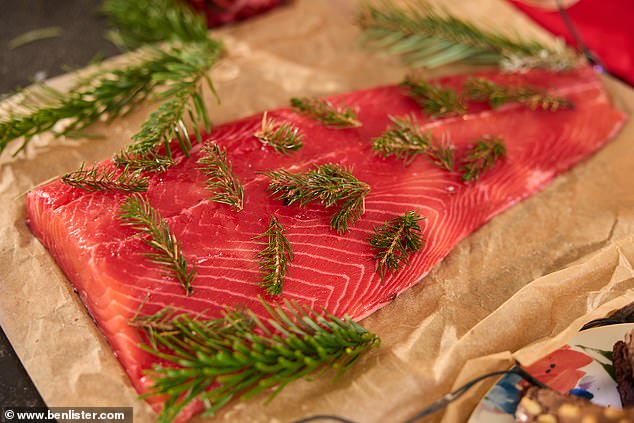
Sarah’s Christmas-cured fish which makes a for a wonderful starter or a decadent sandwich filler
Ingredients: 2kg filleted fish (I’ve chosen a side of salmon), 350g fir or spruce needles, 770g demerara sugar, 500g salt, two small beetroots and the zest of two lemons.
WHAT TO DO: Julia recommends freezing your fish for up to a week to kill bacteria before starting this recipe.
But, with Christmas just around the corner, I don’t have that long.
I stick my supermarket salmon in the freezer for 24 hours and hope for the best.
To make the cure, I mix the remaining ingredients together.
The needles (stripped from my tree, a 6ft Norway Spruce, and washed thoroughly) are sharp and spiky, so I transfer them to a chopping board and dice everything up before continuing.
Next, I lay a large piece of cling film on my kitchen table, sprinkle the cure over it and place the fish on top, packing lots more curing mixture over the top and sides before wrapping it tightly.
It goes in the fridge for another
24 hours, before it’s time to wash off the cure – and serve.
TASTE TEST: The salmon, now bright pink in colour, is delicately-flavoured with citrus, tangy beetroot and a woody flavour that I assume is the spruce.
It’s subtle, but noticeable, giving the fish an earthy depth of flavour that works well with the lemons.
This would make a perfect posh party canape, or give a real kick to my Christmas scrambled eggs.
VERDICT: 5/5 – Fresh, festive and impressive to behold
SPRUCE AND GINGER ICE CREAM
Julia’s favourite recipe from her book is a Christmas tree ice cream made with blue spruce needles – so I hot-foot it to my local garden centre and find a few sprigs.
You can make it with or (in my case) without an ice cream maker, and it’s studded with chunks of stem ginger, which give it a warming, zesty aftertaste.
Ingredients: 300g blue spruce needles (or 400g any other Christmas tree needles); 510ml double cream; 170ml whole milk; 170g caster sugar; eight egg yolks and five pieces of stem ginger, chopped.
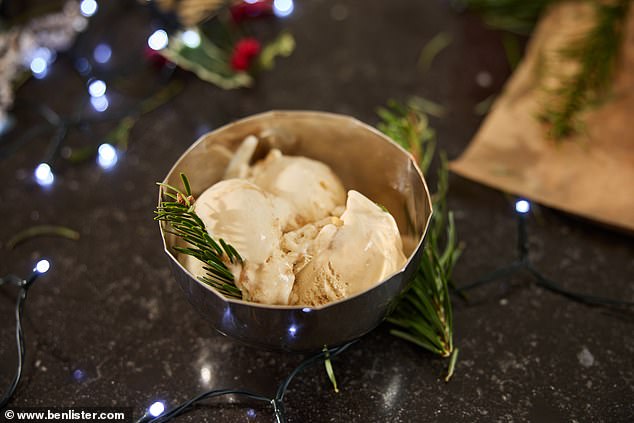
Christmas tree ice cream made with blue spruce needles which Sarah felt lacked the essence of the Christmas tree
WHAT TO DO: I start by whisking the cream, milk, sugar and yolks in a saucepan over a low heat until they’re well-combined, before adding the needles.
The mixture heats gently for 15 minutes, after which time I turn up the heat to medium until it starts to bubble.
I blame my fiery hob, but it catches on the pan and the custard mix ends up slightly charred. Undeterred, I sieve it (to get rid of the needles but keep their flavour) and leave it to cool.
Next, it goes into a tub in the freezer, where I take it out and stir it every hour – quite the hassle – before adding the stem ginger after about two hours and continuing to stir until it’s completely frozen. The whole process takes five hours.
TASTE TEST: So is it worth it? Though the ice cream is velvety-smooth, rich and mellow, I’m not getting much Christmas tree coming through – the overpowering flavour is ginger. Spruce, should taste like vanilla, but mine is bland. Still, the gingery ice cream is delicious, and I pop a few sprigs of spruce on top to make up for it.
VERDICT: 3/5 – A lovely dessert, but lacking in essence of tree
CHRISTMAS PICKLES
Pickling is all the rage these days, as fermented vegetables – preserved in vinegar or brine – have proven benefits for gut health and boosting immunity.
While pickling Christmas trees may be novel, pickled pine cones is a popular Scandinavian dish. It involves preserving green pine cones (usually from Scots Pine) in a sweet and sour brine, then serving them as a snack, pairing them with duck or using them in jam.
Ingredients: A handful of fir, pine or spruce needles, 2 litres of apple cider vinegar, 50g salt, 900g demerara sugar and 700g beetroot, carrots or cucumber, sliced into ribbons. If you have them, you can add a handful of juniper berries.
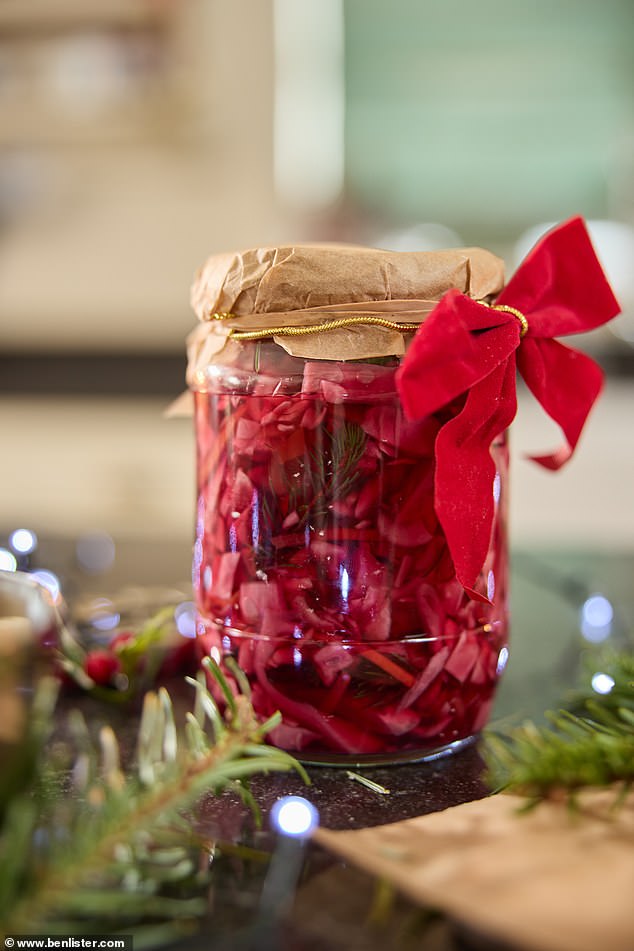
Christmas pickles which Sarah said were vibrant and packed full of flavour
WHAT TO DO: One of the easiest recipes in the book, all you have to do is heat the vinegar, sugar and salt together in a saucepan until just boiling.
You’ll need a sterile, lidded jar. I’m using an old jam jar that I’ve run through the dishwasher on a hot cycle (this will stop the contents from going mouldy).
Arrange the veg ribbons, fir needles (I’m using some from the wreath on my front door, which uses Nordmann Fir branches) and juniper in the bottom of the jar, before pouring on the liquid.
It must be tightly-sealed, cooled and kept in the fridge for at least five days before you can tuck in.
TASTE TEST: I serve my pickles with Christmas cheese, and the contrast between the tangy, salty vegetables and the creamy dairy is mouth-wateringly good.
The pickles are vibrant, packed full of flavour and almost grassy from the needles, although I do have to pick a few spiky bits from my teeth.
VERDICT: 4/5 – Lip-puckeringly sharp, moreish citrus flavour
PINE NUT BROWNIES
Based on a traditional Italian cake, this recipe doesn’t technically involve sprigs from your tree, but it does use pine nuts which is festive enough for me.
‘The oils in the pine nuts make this brownie very moist and fudgey, and the creamy, nutty flavour works well with the chocolate,’ Julia explains.
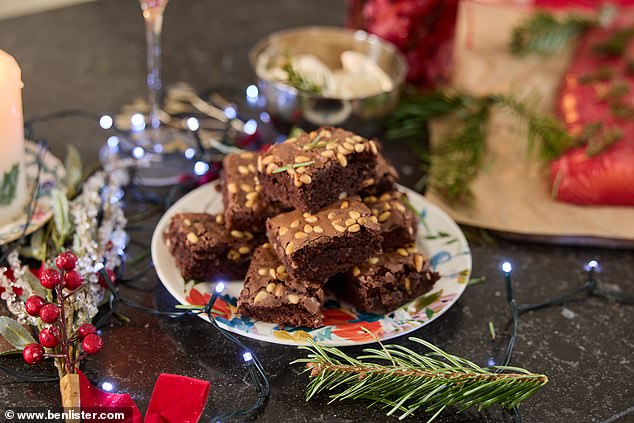
Based on a traditional Italian cake, this pine nut brownie recipe doesn’t technically involve sprigs from your tree
Ingredients: 200g pine nuts (they cost an absolute fortune; the cheapest I can find them is for £7.80 from Tesco), 150g each of dark and milk chocolate, 170g unsalted butter, five eggs; 300g caster sugar, 130g plain flour and two pinches of sea salt.
WHAT TO DO: This recipe uses pine nuts two ways. First, I crush 150g of them in a pestle and mortar, before adding them to the chocolates and butter, and melting it all together.
Next, I whisk the eggs and sugar until the sugar dissolves, and pour this into the melted chocolate mixture. Finally, I stir in the flour and salt, and tip the lot into a 20cm square, lined baking tin.
I sprinkle the remaining pine nuts over the top before baking the brownies at 180C for 20 minutes.
TASTE TEST: Gooey, decadent and moreish, these are good brownies, but distinctly lacking in pine flavour. The nuts on top have turned golden brown, but these just add crunch – and not much more.
I sprinkle a few washed fir needles over the top to ramp up the flavour, but this makes them look like they’re sprouting grass.
VERDICT: 2/5 – A clever twist on a classic, but I can’t taste pine
FIR TREE MIMOSAS
It wouldn’t be Christmas without a cocktail or two.
Ingredients: Tree-based cordial, made by boiling the juice of ten lemons and the zest of four with two litres of water, 700g caster sugar and 400g of fir or spruce needles for two hours before straining it.
The resulting liquid, Julia says, ‘tastes a bit like grapefruit juice’.
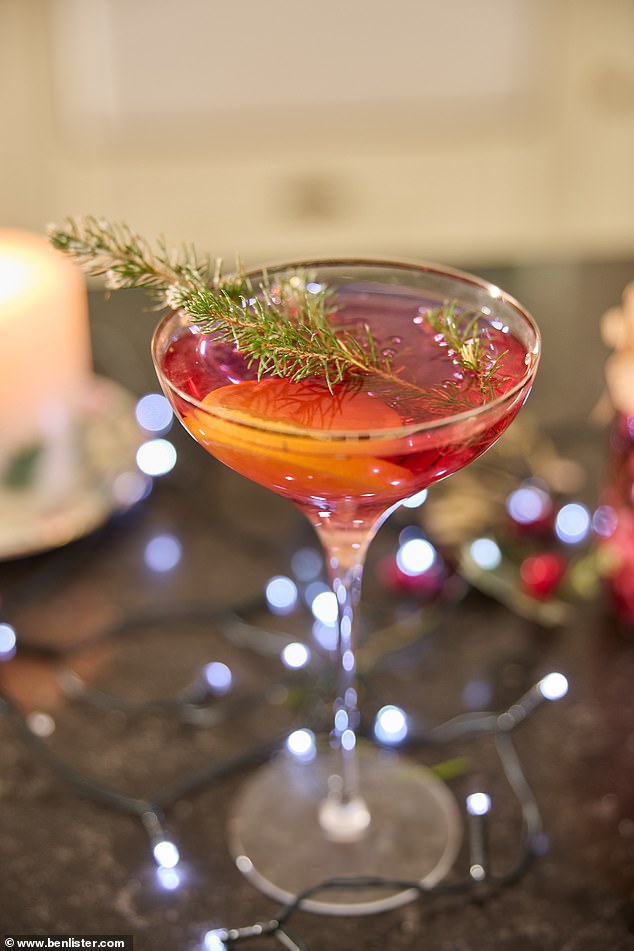
This festive alcoholic cocktail includes fir tree-based cordial, made by boiling the juice of ten lemons and the zest of four with two litres of water, 700g caster sugar and 400g of fir or spruce needles for two hours before straining it
WHAT TO DO: Having whipped up some cordial, I turn to Julia’s recipe for mimosas – my favourite cocktail.
I pour 70ml of the red-orange liquid into a cocktail shaker, along with 140ml prosecco and a few ice cubes, and shake it rapidly for a minute. If you don’t have a shaker, a lidded jar will do.
Decanted into my fanciest glass and topped with a slice of lemon, it looks festive and fabulous.
TASTE TEST: Fizzy, tart and dangerously drinkable, this is my kind of cocktail. The cordial adds a wonderfully bitter-sweet flavour, which sparkles on my tongue. Next up, Christmas tree sours…
VERDICT: 5/5 – Booze, bubbles and a dash of tree – so what’s not to like?
How To Eat Your Christmas Tree by Julia Georgallis, Quadrille Publishing from Amazon for £11.98