It was just a few blocks away from Mexico City’s towering art deco Monument to the Revolution that, 71 years ago, another historic revolution was hatched.
Starting in the summer of 1955, a young Fidel Castro and Ernesto “Che” Guevara hunkered down together in a two-story, working-class apartment building to plan their overthrow of the Cuban dictator Fulgencio Batista.
Mexicans share stories about how the men practiced rowing in a lake in the verdant Chapultepec Park or took turns shooting in a town just outside the capital. Both were briefly imprisoned in Mexico City for possessing illegal firearms. Then, in November 1956, the men set off from the Mexican coast with 80 other revolutionaries on the yacht the Granma, heading back to Cuba, where they would change the course of the island’s history for generations to come.
Why We Wrote This
Mexico’s diplomatic support to Cuba has long boosted the communist island. It also helps Mexico assert its independence from the United States.
That set the foundation for Cuba’s longest uninterrupted diplomatic relationship in Latin America. Mexico is referred to, even by Fidel Castro, as an inspiration of the Cuban Revolution, and long prided itself on the fact that its revolution, at the start of the 20th century, inspired Cuba’s decades later. Across the ideological spectrum of governments that have led the country since it became a democracy in 2000, Mexico has remained a relatively steadfast friend to Cuba.
But, as the United States ratchets up pressure on Latin American governments under President Donald Trump’s new foreign policy approach, which views the region as part of its sphere of influence, Cuba has become something of a thorn in the side of U.S.-Mexico relations. Following the U.S. military capture of Venezuela’s authoritarian leader, Nicolás Maduro, in January, the Trump administration turned its attention toward the communist island that was for years propped up economically by Venezuelan oil.
But last year, it was Mexico that sent the most oil to Cuba, and Mexican President Claudia Sheinbaum Pardo bristled at a U.S. executive order issued on Jan. 29 that threatened foreign nations with tariffs if they send Cuba desperately needed petroleum shipments. She had announced the day before that Mexico was temporarily pausing oil shipments to Cuba, and that it was a “sovereign decision” not made under pressure from the United States.

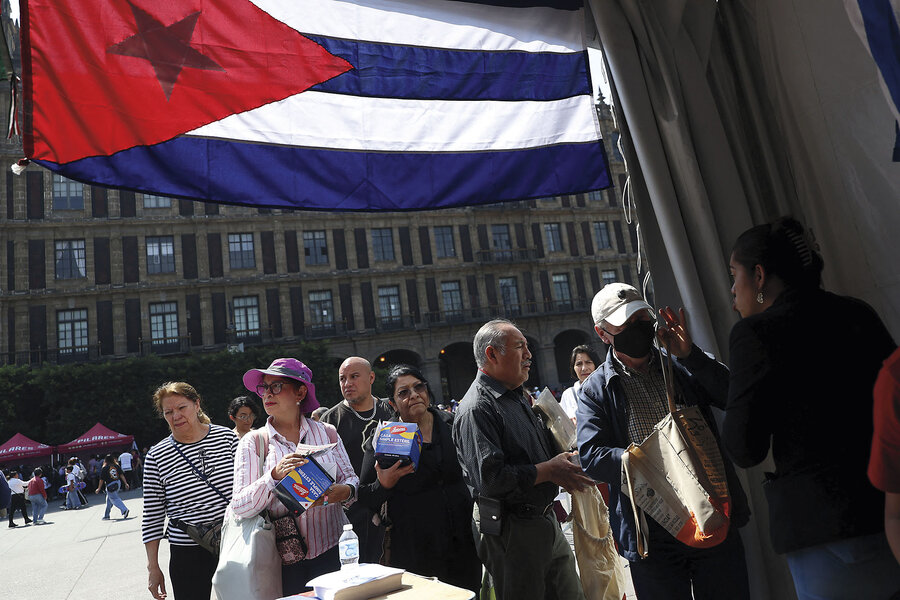
The U.S. can’t “strangle people like this,” she said later, at a Feb. 9 news conference, adding that Mexico will continue to support Cuba. Her government sent two ships carrying some 814 tons of food and basic supplies to Havana the same week. On Feb. 25, the U.S. Treasury Department said it would authorize limited amounts of Venezuelan oil, which Washington now controls, to be sold to Cuba’s private sector.
“Cuba is a special relationship for Mexico,” says Pía Taracena Gout, who teaches international relations at the Ibero-American University in Mexico City. For many decades under the semi-authoritarian Institutional Revolutionary Party (PRI), which ruled from 1929 to 2000, Mexico was able to showcase its fading revolutionary chops by pointing to its relationship with Cuba. And by supporting Cuba at the United Nations General Assembly every year since 1992, calling for an end to the U.S. embargo officially in place since 1962, Mexico signaled to the world – and perhaps most important its powerful northern neighbor – that sovereignty and nonintervention are central to its worldview.
Cuba allows Mexico to “show its autonomy from the United States,” says Dr. Taracena.
Revolution to revolution
Mexico was one of the first countries in the world to carry out a postcolonial revolution, overthrowing a 30-year dictatorship in the early 1900s and ushering in social, agrarian, and political reforms. When Cuba’s revolution ignited in 1959, before Fidel Castro turned it into the communist project it would become, the revolution was immensely popular among Mexicans. Many saw themselves reflected in the Caribbean island’s achievements, and even questioned whether their own government had gone far enough in distributing land and wealth.
“Cuba was always kind of a mirror for Mexico to look at and reflect on, ‘What are we doing in our own country? Is it enough?’” says Renata Keller, a history professor at the University of Nevada, Reno, and author of a book on Mexico-Cuba-U.S. relations during the Cold War.
By the time Fidel Castro and his brother Raúl came down from the Sierra Maestra mountains victorious in their fight for Cuban independence, Mexico’s leadership had moved away from its revolutionary apex in the 1930s. But the increasingly conservative PRI was able to maintain what is sometimes called its “perfect dictatorship” in part by functioning as an umbrella party that included the far left. Supporting Cuba was an easy way to do that.

The Cuba-Mexico relationship evolved over the years, but pragmatism was a constant. In 1961, Mexico was at the forefront of protesting the failed U.S. Bay of Pigs invasion at the U.N., and it was the only Organization of American States member in 1964 to reject a U.S.-led initiative to break diplomatic ties with Havana.
But at the same time that Mexico publicly defended Cuba, it shared intelligence with the U.S. government, facilitated by still maintaining an embassy in Havana.
Cuba-Mexico relations started to stumble under center-right President Vicente Fox, who was the first democratically elected leader after the PRI lost power. Mr. Fox traveled to Cuba in 2002 and met with dissidents, angering the Cuban government. A month later, he famously rushed Fidel Castro out of an Extraordinary Summit of the Americas meeting before U.S. President George W. Bush arrived, and the same year, he joined the majority at the U.N. to condemn Cuba’s human rights record.
Leftist politicians and many in the Mexican public were up in arms over the perceived violation of Mexico’s foreign policy standards of nonintervention – and its historic relationship with Cuba.
But future conservative leaders seemed to learn from Mr. Fox’s experience. Subsequent conservative presidents made official visits to the island to meet with then-President Raúl Castro, and forgave an estimated 70% of Cuba’s debt to Mexico in 2013.
“Mexico will always try to seek a relationship with Cuba,” says Dr. Taracena. “Perhaps those that aren’t ideologically aligned with the left have opened the door to more listening to Cuban dissidents, but in reality, Mexico’s role has to be a mediator in the conflict with the United States – especially now that Donald Trump’s pressure is so strong.”
Careful balance
Ms. Sheinbaum has been referred to as “the Trump whisperer” for her ability to negotiate with the U.S. president in a second term that has kept Mexico central to U.S. goals around halting immigration and drug trafficking in the region.
She has avoided the enactment of sky-high tariffs through negotiations, despite multiple threats from Mr. Trump, and the U.S. president has declared her “brave” and a “wonderful and highly intelligent leader.”
But he might be missing the nuance in Mexico’s historic – sometimes “performative” – relationship with Cuba, and how much it benefits the United States, says Dr. Keller.
The island is in a downward economic spiral as international airlines cancel flights to cities across Cuba, hotels close due to electricity and food shortages, and government workers are furloughed. An estimated 2.7 million people have left Cuba since 2020, amid a multiyear recession.