The recent unrest in Minnesota has reminded me of the words of an anguished mother from nearly a decade ago: “You could be next.”
That was Valerie Castile’s response in 2017 when a Minnesota jury found the police officer, who killed her son Philando during a routine traffic stop, not guilty.
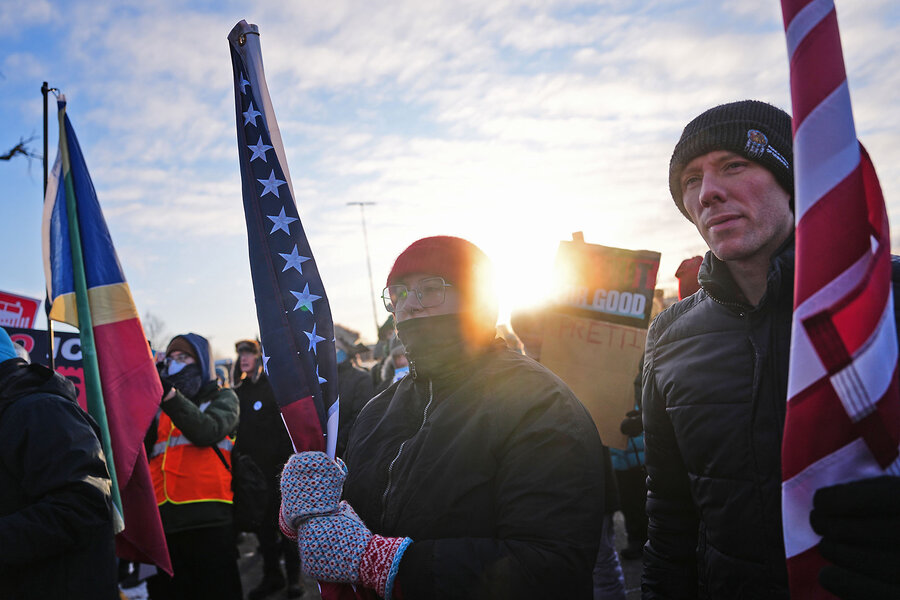
In recent weeks, in the state where George Floyd and Mr. Castile died in fatal encounters with law enforcement, civil protests ended in tragedy when federal agents killed two U.S. citizens, Renee Good and Alex Pretti. Their deaths are echoes of a uniquely American narrative. In 1967, at the height of the Civil Rights Movement, riots erupted in the predominantly Jewish and Black communities of north Minneapolis. Police brutality was a factor then, too.
Why We Wrote This
The United States has a long history of civil rights protests. Cultural commentator Ken Makin identifies a through line of resistance, from 1960s Mississippi to 2020s Minnesota. The wrestling between civil rights advocates and their opponents is baked into American life, he writes, affecting people, policies, and policing.
Name a city that has seen recent protests: Portland, Oregon; Washington, D.C.; Chicago; Los Angeles. Too often, the First Amendment freedoms of expression and assembly have been met with repression by law enforcement. Minneapolis begs a question: Do we choose to repair society’s wrongs? Or repeat them?

Painfully, the answer remains the latter. Five years ago, officials called for “racial healing” to calm the unrest provoked by Mr. Floyd’s death, which occurred literally under the knee of law enforcement. The Minneapolis shooting victims were white, but race is a motive in the deployment of federal officers on American streets to round up people ethnically rooted in countries the Trump administration disparages.
Buzzwords alone are not a salve, nor are they functional policy. The policy gains of the 1960s are fleeting and fragile. The historian Ibram X. Kendi noted recently that President Andrew Johnson vetoed the first Civil Rights Act in 1866, which Congress then overrode, granting citizenship to Black Americans. This section of Mr. Johnson’s veto jumped out at me:
In all our history, in all our experience as a people living under Federal and State law, no such system as that contemplated by the details of this bill has ever before been proposed or adopted. They establish for the security of the colored race safeguards which go infinitely beyond any that the General Government has ever provided for the white race.
That was 160 years ago. President Johnson regarded equality for Africans in America, which by proxy has often proved to be rights for all, as excessive and providing an unfair advantage. In a January 2026 interview, President Donald Trump was asked about the Civil Rights Act of 1964, which secured equal access to education and employment for Black Americans. He said those protections resulted in white people being “very badly treated.”
I can only describe the human costs of the Civil Rights Movement as monumental, and that goes beyond the lives lost. The trauma of a generation who grew up with the assassinations of Martin Luther King Jr., Medgar Evers, and Malcolm X, among many others, is ever present. The wrestling between civil rights advocates and their opponents is baked into American life – from its people, to its policy, and yes, its policing.
In Minneapolis today, parents are afraid to send their children to school because of the presence of federal law enforcement officers armed with military-grade hardware in their streets. Others have kept their children home in acts of protests. They did the same in 2021, ahead of the trial of the police officer who killed George Floyd.
Civil disobedience has its own through line in American history. Sometimes, in order to repair, you have to repeat what works.