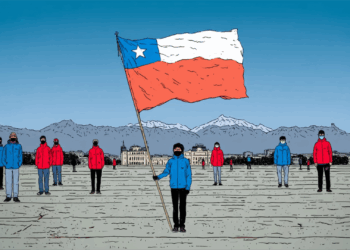
“Too far from God, too close to the United States.” These words were famously said by Mexican President Porfirio Diaz to define his nation’s relationship with its northern neighbour. Sadly, he didn’t actually say this; in fact, a Mexican journalist made it up. But now, in 2026, this phrase has a far wider resonance. The Monroe Doctrine was one thing, but now Europe’s old empires are becoming American.
Josep Pedrerol is the king of Spanish late-night television. The host of the world’s leading late-night football show, he normally begins with a monologue summing up Real Madrid or Barcelona’s fortunes. On Monday night, however, he opened with a different tone. From the studio north of Madrid, he delivered a message of solidarity to Mexico after violence followed the killing of CJNG leader El Mencho. This might seem odd, but it happened in a Spain which is becoming more and more Latin American.
Pedrerol’s show, “El Chiringuito de Jugones,” is broadcast live in Latin America and the United States; such is its dominance over Hispanic footballing culture. Despite this televisual colonisation, Spain itself is rapidly becoming more South American. Huge migration in the last ten years has changed the face of Spain’s urban centres. More 25–39-year-olds in Barcelona were born abroad than in Spain, and Madrid has over 1 million Latin American-born residents.
The capital has been transformed, with its outer neighbourhoods filled with poor immigrants working in hospitality, while its centre is the preserve of rich émigrés fleeing from left-wing governments. The neighbourhood opposite the El Prado Museum is already 40% Latin American, and demand is booming. This transformation is not incidental; Madrid’s conservative mayor wants it to overtake “Miami” as the capital of the Latino world.
This comparison to the heart of American “Latino” culture betrays a wider picture. As Spain is becoming more Latin American, so is the United States. 20 per cent of the U.S. population is Hispanic, with this number constantly growing due to immigration. Spain does not collect similar data, but 9% of its population was born in Latin America to begin with, and more are due to arrive. Spain is the European country most similar to America in terms of demographics, and this will become clearer and clearer as time goes on. Tony Blair may have dreamed of Britain being the bridge between the United States and Europe, but Spain is far better positioned.
For instance, when Secretary of State Marco Rubio spoke to Spanish centre-right leader Alberto Nunez Feijoo, the conversation was in Spanish. While Feijoo has been criticised from the left for not being able to represent Spain on the world stage due to his weak English, he is much more comfortable with the Hispano-hablante Rubio. An American turn towards a “21st-century Monroe Doctrine,” inaugurated by some after the kidnapping of Nicolas Maduro, will leave Spain far more tightly bound to the US.
The Spanish have a concept called Hispanidad, which translates literally as Spanishness. It developed as an answer to the country’s 19th-century ills from the reactionary thinker Ramiro de Maeztu. It was an attempt to unite Spain and its then-disparate possessions around an eternal community bound together by former rulers and religion. It discarded racial thinking in favour of a historico-philosophical guiding spirit. Although Spain had lost the most valuable parts of its empire, Hispanidad would still allow it to have genuine power in the world as the totem of a civilisation. This was, as it sounds, ambitious and Hispanidad remained little more than 1920s journal filler. However, despite ultimately falling out of use in the Civil War it was revived first by Franco as a Spanish version of Columbus Day and in modernity as a celebration of diversity.
Both Spain and Britain, through language and people, cannot be separated from this civilisational dark matter which pulls us west
Maeztu’s first dream of Hispanidad is actually far more applicable to modern “Americanness.” From finance through social media and even language, the eternal community of America is inescapable in Britain as its reggaeton tuned variant is in Spain. It is a hard-to-define mélange of history, diversity, commerce, and language which dominates the cannibalistic stateless spaces of the world: the high seas, trading floors, and algorithms which shape our lives. Both Spain and Britain, through language and people, cannot be separated from this civilisational dark matter which pulls us west.
The United Kingdom is often said to be caught in the middle between Europe and America, especially post-Brexit. Admittedly, it is far harder to be Britain than Spain. Pedro Sanchez can say what he wants about the world, refuse to pay for NATO, and everyone will shrug their shoulders because it’s just Spain. Despite this, walking past the queue to the Latin “Discoteca” in “Holborn” gives me pause for thought. As a mix of young Spaniards and South American students wait to listen to Puerto Rico’s own Bad Bunny, I don’t think we are alone in our Atlantic conundrum.
Nowadays we all face that Mexican dilemma, “too far from God and too close to the United States”.