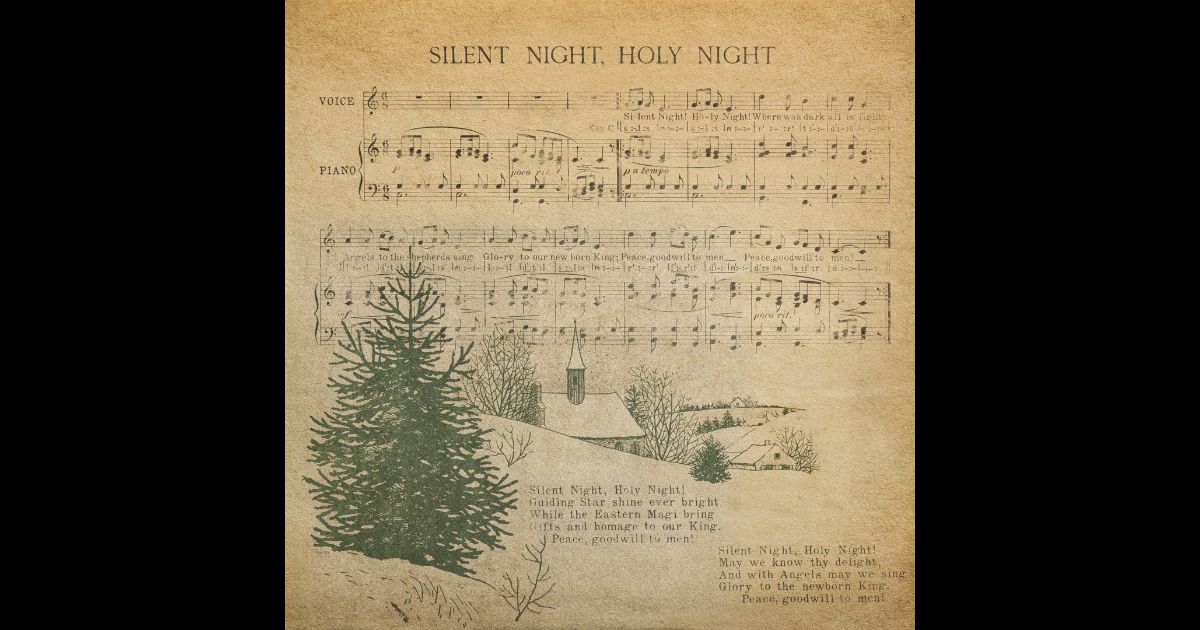
It’s one of the most identifiable songs of this or any modern Christmas. And, if it wasn’t for war, water, and mice, you’d likely never know it in the form it’s in.
It all began in 1816, a time of turmoil in Europe. The Napoleonic Wars had just ended, with Bonaparte himself being exiled to the distant Atlantic island of St. Helena. Any hope that Europe would return to normal was thwarted by an unusually dark summer, literally; as The Washington Post now points out, most blame the gloomy weather on a volcanic eruption in Indonesia which caused massive famine thousands of miles away.
In Oberndorf, Austria, however, there was one young priest who drew some inspiration from the hard times. Oberndorf was especially hard hit, with many of the residents working on the salt barges that ran along the Salzach River.
There lived a youthful Catholic priest by the name of Joseph Mohr. He’d composed a Christmas poem that autumn, titled “Stille Nacht, Heilige Nacht.” For those of you who don’t speak Deutsche, that translates to “Silent Night, Holy Night.”
“Two years later, Father Mohr enlisted a friend, Franz Xaver Gruber, a local schoolteacher and musician, to come up with a melody for the poem that could be played for Christmas on the guitar,” The Washington Post reported.
Wait, you say — the guitar? Yes, the usual piece of instrumentation for holy music, the church organ, had fallen into disrepair thanks to mice and/or water.
Gruber, amazingly, took only one day to compose a melody for the song, about a curly-haired Jesus being born.
And unbelievably, that simple guitar piece has survived two centuries and change now — probably all the better for the understated guitar, not the original choice of instrumentation, emphasizing the vocals with a soft harmony.
Even modern versions that don’t retain the guitar instrumentation, like Bing Crosby’s legendary rendition, still keep a relatively low-key background:
If you can imagine the bombast of a church organ doing this song justice, you have a better musical imagination than I do.
“It’s such a part of the general soundscape of Christmas,” Sarah Eyerly, assistant professor of musicology and director of the early music program at Florida State University’s College of Music, told The Washington Post in 2018.
“Often times when songs are composed by people in times of great stress, there’s something quite human about them,” she added.
“And that often resonates with people outside of that particular geographic location, or culture or time period.”
And while the original German version was translated into English dozens of times (to say nothing of the hundreds of other languages it’s been ported to), the most well-known is an 1850s translation that continues to be the usual version of the standard sung around the tree with the yule log burning.
Also, while Crosby’s is the most famous recording, everyone from the Mormon Tabernacle Choir to rap and heavy metal bands have tried their hands at it.
So, rest assured that you can find the version of “Silent Night” that fits you — even if we still prefer the original version, bequeathed to us by water, mice, and/or geopolitical hardship.
Not only does the song hearken to the Christmases of our year, but it should also hearken us back to the fact that Christians found solace even in the darkest of times. It’s something to remember when you sing the classic of classics this Christmastide: As Einstein said, “God does not play dice with the universe.”

Advertise with The Western Journal and reach millions of highly engaged readers, while supporting our work. Advertise Today.