Britain’s political debate is now debating migration, sovereignty and law enforcement on terms that would have been unthinkable a decade ago
I am far more optimistic than many on the right. Many fear that Britain is doomed by birth rates, economic stagnacy, institutional dysfunction, mass migration and multiculturalism. According to many who blackpill, it’s either already too late, or anything but a Restore government in 2029 will lead inexorably to the extinction of England.
Such people fear that Reform UK, and Nigel Farage in particular, are too weak, glib and accommodationist. They point, for example, to Farage’s interview in September 2024 in which he described mass deportations as “politically impossible”.
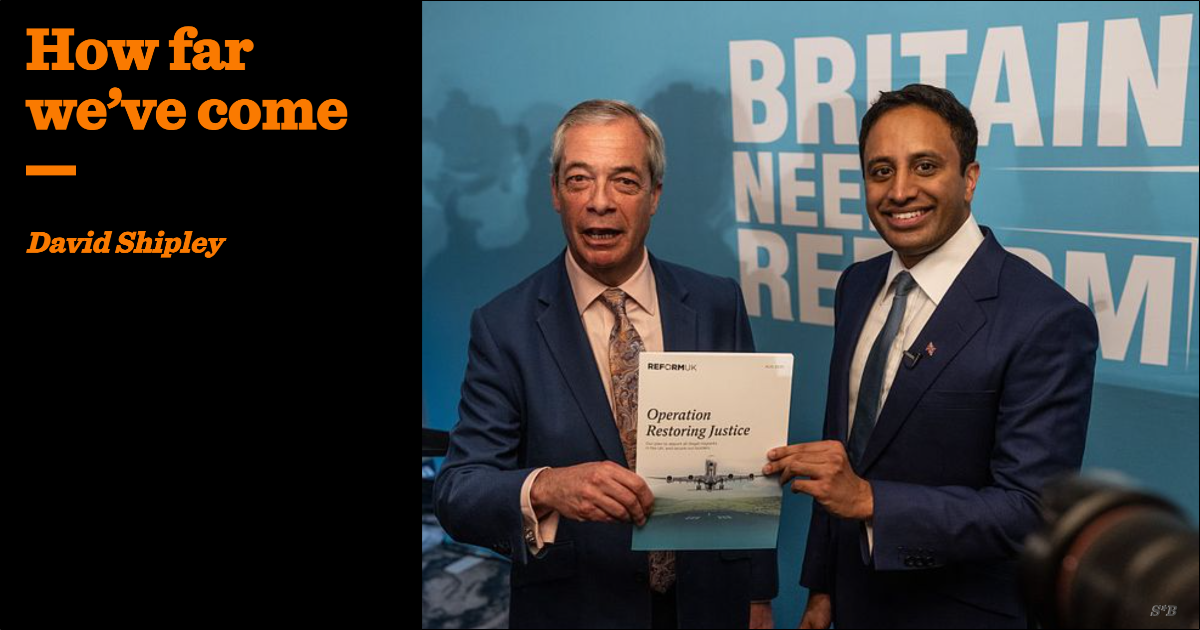
To such friends, I say: look how far we have come. On Monday morning Zia Yusuf promised to “end and reverse” the recent “invasion” of migrants, describing it as a “national emergency”. Yusuf was launching Reform’s plan for immigration, policing and national security. At the centre of this is the “Illegal Migration Mass Deportation Act”, which will create a statutory obligation to deport illegal migrants — and, I understand, will make all migration cases non-justiciable. Immigration would become an administrative matter for government ministers and the civil service. This is radical, wise and welcome, as are the commitments to leave ECHR and repeal the Human Rights Act. Under Reform, no more immigration tribunals, no more costly delays to deportations, and no more immigration lawyers and human rights lawyers making fortunes at our expense.
The mass deportation effort will be led by a new agency, UK Deportation Command, chartering five flights a day, deporting “up to 280,000 annually”. The party also has other plans to stop the flow of illegal migration to our shores. Those who arrive here illegally will “never be granted asylum”. There will be a “Polanski Law”, making aiding and abetting illegal migration a strict liability offence, punishable by up to two years in prison.
Alongside these responses to illegal migration, Reform plans to abolish Indefinite Leave to Remain, replacing it with renewable five year work and spousal visas with “higher salary thresholds and strict English tests”, immediately cease Universal Credit payments to all foreign nationals (currently running at £1bn a month).
These changes are significants. Ending ILR, cutting benefits and raising salary requirements will cause many unproductive or otherwise undercommitted migrants to decide that Britain is no longer the country for them. Even more effective levers would be to remove the statutory right to be housed, and tax remittances.
Reform are also announcing policies which directly challenge creeping Islamisation. The IRGC and the Muslim Brotherhood will be proscribed. All churches will be granted listed status, preventing their conversion to mosques. Prevent will be overhauled, refocusing it on Islamist threats with the goal that it be “proportionate to MI5’s caseload”. Diversity training will be “stripped” from Prevent, perhaps meaning no more investigations into Brits who believe that mass migration threatens our culture and way of life.
There is also some detail on broader law-and-order matters: more prisons, a “vast expansion of Stop and Search”, and removing “DEI mandates and the policing of legal speech” from our police forces.
This is a tremendous set of policies. It’s not perfect of course, and I would hope to see Reform go further on historic asylum grants and passports which should not have been issued. Similarly, the “red list” of visa banned nations should be expanded, and should apply whether or not those nations comply with our deportations of their citizens. But politics is the business of the possible, not the perfect. What matters is winning elections, and getting most of what you want — not remaining ideologically “perfect” in endless defeat.
To be here, three years out from the General Election, with the party that leads the polls promising such radical changes, is cheering. Granted, the fact that a party promises something does not mean that it will be done. (Every PM in the last three decades has been elected after promising to lower immigration.) But this is at least a set of policies to hold Reform to — and a sign of how aware British people have become of our dysfunctional circumstances.
So to those who are tempted to blackpill, to succumb to despair, look at where we are. Since the last election the political ground around migration has moved more than it has in my entire life. Victory is not inevitable, but it is ours for the taking.