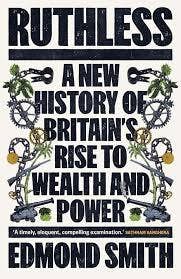
The character and analysis of Britain’s economic transformation is a matter of obvious interest not least to those seeking explanations for growth. These questions have also become significant to the culture wars” dimension of British history, and, in particular, there has been a tendency in a school of exposition to link Britain’s prominent role in the Atlantic slave trade and in New World slavery with an explanation of this transformation. Edmond Smith falls squarely into this tradition, that of a hostility to slavery, capitalism and empire, writing in Ruthless (p.340): “No small part of Britain’s economy was tied to the labour of enslaved people … During Britain’s rise to wealth and power in the eighteenth century, the lives of millions of people were spent in the name of profit”.
And so on throughout the book. “Exploitation” is the key means of development, as in: “Across Britain and its empire, finding ways to maximise the exploitation of land by changing what it could do was a key feature of the nation’s rise to wealth and power” (p. 260).
The argument is offered clearly and with energy, but the book suffers from a number of conceptual, methodological and empirical elements which, hopefully, Smith, Professor of Economic Cultures at Manchester, can engage with in future work. Among the most significant is an inadequate grasp of the relationship between his period of study and developments before and after. In particular, industrialisation was more a matter of the following century, when, of course, the slave trade was far less present.
There is also a weak comparative discussion of the comparisons and contrasts between Britain and other industrialising states (such as Russia) and those which were not industrialising, such as the slave-rich Portuguese Empire. The slave trade and slavery were clearly significant to the industrialisation of the eighteenth century, but less so to that of the nineteenth, which underlines the problems posed by the issue of what is being examined.
The contribution of the New World to the European economy rested to a great extent on the bullion that came in as a result, and the liquidity it produced. For Britain, the benefit from major development of gold production in Portuguese-ruled Brazil in the eighteenth century deserves consideration alongside discussion of Caribbean sugar. In addition to commercial strength, political stability and the continuity of a parliament funded national debt, this resource helped the British government to borrow at a low rate of interest. As a result of its exploitation of bullion resources, the West acquired an important comparative advantage, one increasingly deployed in Britain. China received bullion for its tea and ceramics, but access to this bullion ensured that Britain was able to insert itself into the non-Western world.
More generally, quests for profit, control and transformation were scarcely new or specific to Britain. The creation of capitalistic, liberal economies did (and does) not require imperial might, but it rests (and rested) in social and political circumstances and developments that are specific and particular. Britain’s Industrial Revolution should not be detached from these. It is an aspect of the country’s “total” history in the eighteenth and nineteenth centuries, and this should not be limited to the elements forefronted by Smith.