Britain’s bloodiest day starts with a wave of a hand in a shadowy bunker in the catacombs deep beneath Tehran. Iran’s wounded supreme leader, Ayatollah Mojtaba Khamenei, has not been seen in public since he took charge after his father was killed exactly a month ago today. But a major strike on a Western capital would require his authorisation. So, with a fanatical cry of ‘Allahu Akhbar,’ the worst destruction our islands have suffered since World War II is underway.
The Ayatollah’s command comes at 10.53am Tehran time (three and a half hours ahead of GMT), after the nightly American and Israeli bombing has lulled. Two Khorramshahr-4 ballistic projectiles – the very ones that were recently fired at our base in Diego Garcia, suggesting for the first time that they could potentially also reach British shores – trundle out of their underground ‘missile cities’ beneath the central Iranian town of Isfahan on a motorised transporter erector launcher and are raised to vertical position.
Based on a North Korean design, the monstrous missiles are almost as tall (20 metres) as the Angel of the North statue in Gateshead, weigh the same as two London buses and are painted yellow and black, like wasps.
At that range, they can carry 86 stone of explosives, possibly including up to 80 ‘cluster munitions’: smaller bombs that scatter as they descend, increasing the carnage. Iran has dozens of such projectiles, which it adapted from Pyongyang, which, in turn, based its design on Soviet submarine missiles.
In broad daylight, time is of the essence. As Iran maintains the Khorramshahr-4s in a state of readiness, it takes just 12 minutes for them to be filled with a mixture of fuel and oxidiser by a crew wearing Hazmat protective gear. Then the pumps are disconnected, the targeting data is confirmed, the personnel withdraw to a safe distance, and amid an orange-white fireball and a roiling plume of exhaust, the missiles are launched.
It takes three minutes for the projectiles to exit the Earth’s atmosphere. After that, they travel in space at hypersonic speeds of up to ‘Mach 16’, more than 12,000mph. At such a velocity, it takes them under 20 minutes to cover the 4,000 miles to Britain (a passenger jet takes about six hours). They re-enter the atmosphere at about 10,000mph and drop to their targets at 08:01am GMT. Like comets, they descend in silence, faster than the speed of sound. The noise of the impact is described from several miles away as a roaring explosion and a low-frequency, concussive blast with a pressure wave that hits individuals in the chest. Time from command to strike: 38 minutes.
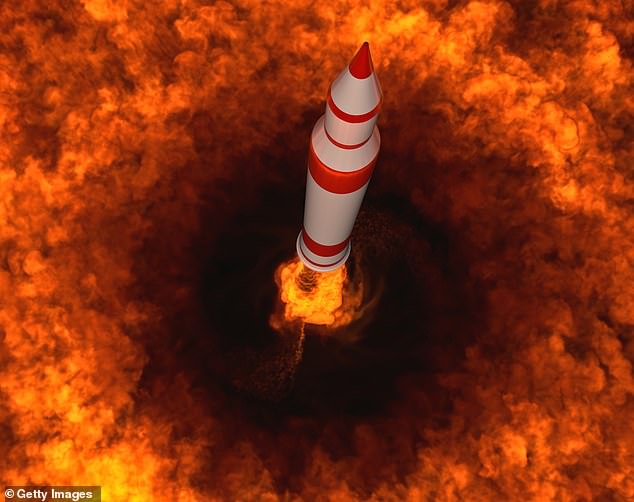
Such a doomsday scenario may seem unrealistic. Every element of this nightmare, however, is both plausible and precedented
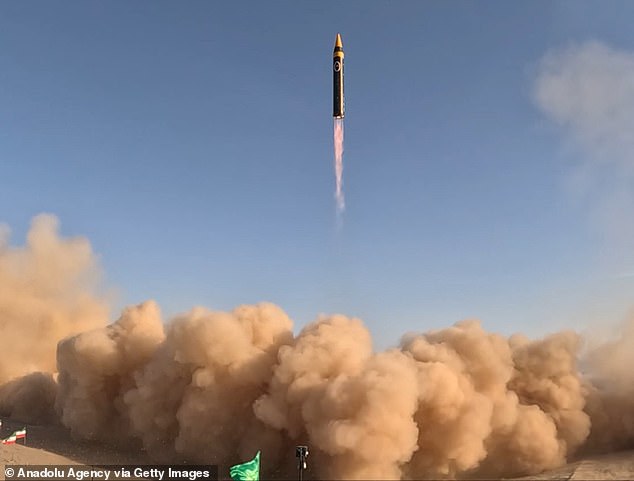
Two Khorramshahr-4 ballistic projectiles – the very ones that were recently fired at our base in Diego Garcia – trundle out of their underground ‘missile cities’
If even a remote part of the Scottish Highlands were hit, it would cause national panic. Tehran’s target of choice, however, is Heathrow, the busiest airport in Europe, selected to cause carnage, stretch our emergency services and paralyse our infrastructure and economy.
Britain has no exo-atmospheric interceptors, like Israel’s Arrow 3 or America’s SM-3s, which – on a good day – can spectacularly destroy missiles like the Khorramshahr-4 while they are still in space. We have no high-altitude terminal defences, like the United States’ Terminal High Altitude Area Defence system, which can catch them towards the end of their flightpath. We don’t even have lower-tier defences like Washington’s Patriot PAC-3s, which may offer a last-ditch attempt to avert disaster in the final moments of descent.
Instead, all we have are six Type 45 destroyer warships. Combined with satellite early warning and radar, if one Type 45 was stationed off the Lincolnshire coast and another at Portsmouth, they could have an effective range that could extend to hundreds of miles. Despite their fearsome capabilities, however, these are optimised for aircraft, cruise missiles and complex air attack environments, not leviathans of the skies like the Khorramshahr-4. To make matters worse, our only serviceable destroyer, HMS Dragon, is 2,500 miles away in the eastern Mediterranean. The remaining five are in various stages of refurbishment in dry dock, leaving our skies entirely undefended.
As the missile emerges from the clouds above Heathrow, RAF Boulmer, the Northumberland base that houses Britain’s Control and Reporting Centre, has received an alert from Nato’s early-warning system. But the American defences on the European continent have been unable to protect us. Nor does Britain maintain any air-raid sirens.
Ten seconds later – just as the order is given to scramble our Quick Reaction Alert Typhoons at RAF Coningsby in Lincolnshire – the missile hits.
At that time in the morning, one flight is leaving every three minutes from Terminal 5 alone, with up to 20,000 people shopping, dining and relaxing in lounges. The first missile lands squarely on the home of British Airways, causing an unprecedented mass casualty event. Up to 150,000 people are inside Heathrow, including passengers and airport staff, at peak times. A single ballistic missile strike on a densely populated area can easily kill 3,000 and injure perhaps 10 times that number. Amid the screams, dismemberment and death, the scenes are apocalyptic: Britain’s 9/11.
Two minutes later, at 8.03am, the second missile descends at hypersonic speed on a prime military target, Northwood Headquarters, which oversees the Army, Royal Navy and RAF, as well as our cyber and space operations and some Special Forces coordination. This one is carrying a cluster munition warhead, which causes multiple explosions across the Hertfordshire complex, killing and mutilating thousands of our most senior officers, and degrading our command-and-control. With our military defences and civilian responders alike in a state of disarray, the stage is set for the next dreadful phase of Iran’s plan.
It’s not like we weren’t warned. Last Friday, General Abolfazl Shekarchi, the regime’s military spokesman, threatened the West on state television: ‘From now on, based on the information we have about you, even parks, recreational areas and tourist destinations anywhere in the world will no longer be safe for you.’
Thus, at 8.24am, while mobile phones across the country blare out the government’s Emergency Alert that was tested last year – aside from older models, those with poor signal, those who had opted out of notifications and some on smaller networks – a range of terror atrocities is launched in Britain. These take the form of varying degrees of sophistication.
The Ukrainians carried out Operation Spiderweb deep inside Russia in 2025. Dozens of small First Person View (FPV) drones were smuggled into the country piece by piece and hidden inside wooden structures on trucks. When they were near the targets, the roofs opened remotely and they were guided to strike Russian airbases. Taking lessons from this, a lorry driven by Iranian operatives stops in the Park Royal Estate, the largest industrial estate in London.
At precisely 08:33am, it launches a swarm of FPVs 12 miles towards the heart of the capital.
Police jammers prevent such low-flying drones, which are operated remotely using headsets, from entering the Government Security Zone, a group of critical buildings in Westminster. But most civilian targets are vulnerable. With so many resources tied up with the unfolding disasters elsewhere, counter-terror powers to extend the no-fly zone are rolled out only patchily.
Moreover, as they are designed to block drones running the latest software, hundreds of the deadly devices have freedom of airspace.
After about 13 minutes’ flight time, these low-flying, remotely operated FPVs, each carrying 7lb of explosives equivalent to 20 hand grenades, start plummeting into crowds in the heart of rush-hour London causing carnage, spreading panic and sparking a manhunt for the operators.
Even this is not the end of the mullahs’ plans. At a Jewish school in Golders Green, northwest London, about 100 children have gathered nervously in the playground as teachers send them home. Then the bomb goes off.
Hezbollah, Iran’s proxy Lebanese terror group, planted a bomb in Buenos Aires that killed 85 people in 1994. Five years later, after a tip-off from Mossad, British security services uncovered Hezbollah’s bombmaking factory in north London, containing enough ammonium nitrate to produce 11 such atrocities. Forty-one Jewish schoolchildren and five teachers are murdered in what becomes known as the Golders Green Bombing, with 35 others suffering life-changing injuries.
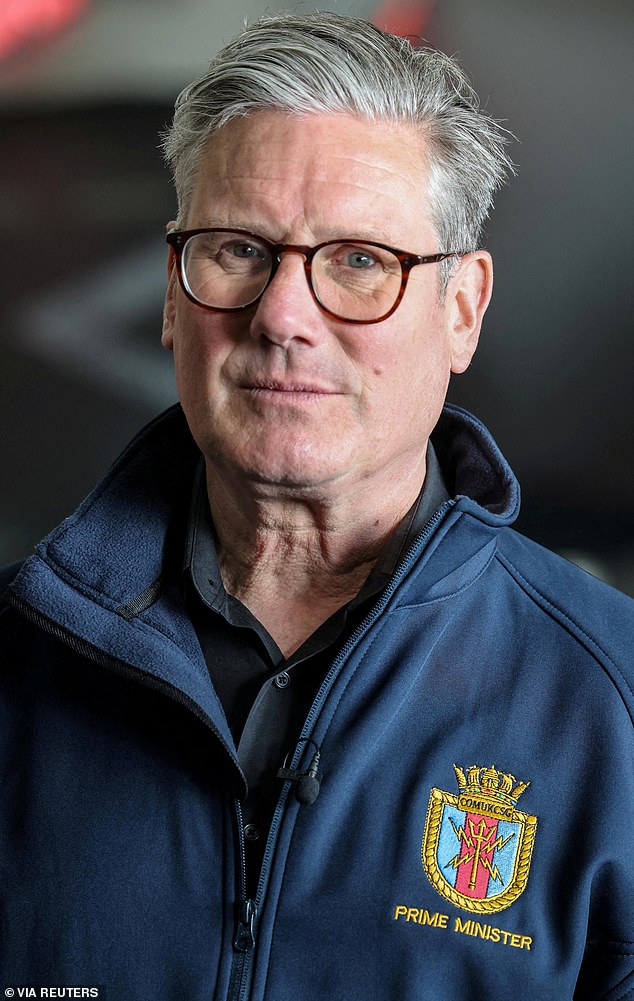
Security experts have argued that Keir Starmer’s continual display of weakness is emboldening Tehran to attack us
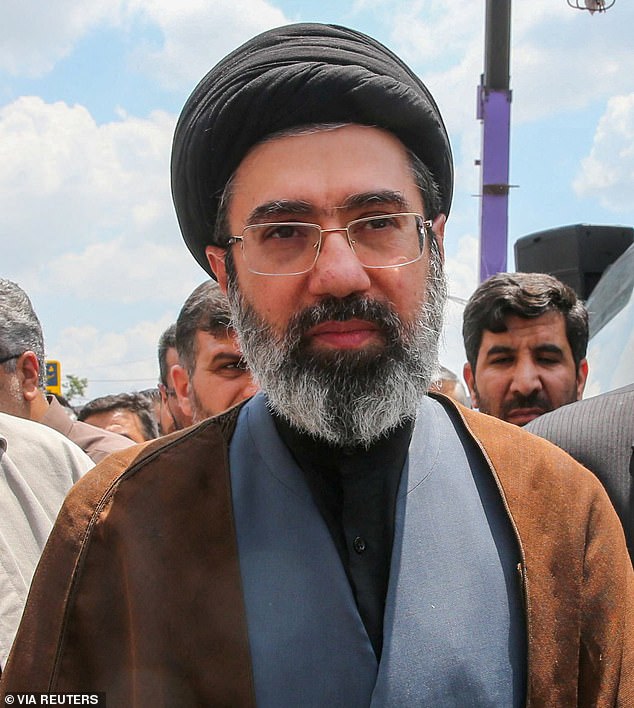
Iran ’s wounded supreme leader, Ayatollah Mojtaba Khamenei, has not been seen in public since he took charge after his father was killed
But still the horrors are not over.
By 8.50am, the entire country is in a state of incredulous panic. Elite SAS units have been helicoptered in from Hereford, counterterror firearms officers have been stood up and our at-readiness brigade, either 2 PARA or 3 PARA, has been deployed. Typhoons are in the air, enforcing a no-fly zone as all commercial airliners are grounded. After tweeting, ‘We will never allow hate to divide us,’ the Prime Minister convenes a Cobra meeting.
Then at 9.07am, the assassinations start to begin.
MI5 chief Sir Ken McCullum has warned that his officers tracked as many as 20 ‘lethal Iran-backed plots’ in Britain in one recent year alone, strongly suggesting that the mullahs have established deep covert networks and proxies operating under our noses. In 2023, the Jewish Chronicle revealed that Tehran was ‘mapping prominent Jews for an assassination campaign that will be triggered if Israel attacks’, a story later confirmed by the security services. A year later, an Iranian dissident journalist, Pouria Zeraati, was stabbed by Romanian suspects in an attack believed to have been orchestrated by Iran.
At 9.15am, more than 50 highly trained Iranian terrorists and hired eastern European gangsters begin knife, gun and car attacks. Six anti-Iranian British MPs are targeted, as well as four Israeli and two US diplomats, a senior rabbi and two British newspaper journalists who were staunch critics of the regime.
The Prime Minister and the Cabinet are rushed to safety in the top-secret Pindar Crisis Command Centre 200ft beneath the Ministry of Defence in Whitehall.
As videos of these acts of violence appear on the internet, official Iranian social media accounts, which have millions of followers, proclaim a Salman Rushdie-style fatwa, calling for sympathisers to add to the havoc with lone-wolf attacks. The wolves oblige.
At 10.15am, a nurse leaving St Thomas’s Hospital after a night shift is stabbed to death on Westminster Bridge; an hour later, a man attacks eight people with two kitchen knives in the Bullring in Birmingham, killing three, before passers-by – including several Muslims – restrain him until armed counterterror police arrive.
At 11.46am, a knife-man screaming, ‘Allahu Akbar!’ is shot dead by police on Buchanan Street in central Glasgow. At 11.50am, Operation Plato, the multi-agency response to an ongoing marauding terror attack, is declared nationwide, triggering a large-scale mobilisation of all police forces in the country. The Army begins patrolling the streets in major cities.
By the afternoon, Britain resembles a military state. After the Home Secretary advises people to stay in their homes, only soldiers and police can be seen outside and the economy grinds to a halt. As the day rolls on, there is a handful of further stabbings and an arson attack on a synagogue in Manchester; a car ramming outside the Royal Liverpool University Hospital leaves a police officer with life-threatening injuries. The death toll is estimated at 7,209, eclipsing the 2,977 killed on 9/11.
At 9pm, as Britain’s day of carnage draws to a close, a visibly shaken Prime Minister finally addresses the nation via video-link from his bunker. ‘I would like to confirm that Britain was not involved in any offensive military action against Iran,’ he says. ‘That will continue to be the case. We must continue to find ways to de-escalate the situation and work towards a negotiated solution to these terrible attacks.’
In the days that followed, Britain is reeling. The only glimmer of positive news is that on the Bloodiest Day, as it has become known, MI5 arrested a 41-year-old Iranian who was attempting to blow up the SS Richard Montgomery, a Second World War shipwreck in the Thames off Sheerness in Kent, which is laden with 1,400 tons of explosives, including fragmentation bombs, incendiary devices and white phosphorous devices.
Last year, aircraft were banned from flying over the wreck amid fears that hostile nations were plotting to attack it, destroying flood defences in North Kent and South Essex and triggering a mini-tsunami. This arrest saved hundreds of lives. Nonetheless, two weeks after the atrocities, the final death toll is announced: 6,203, including 1,437 children.
The Prime Minister announces that a public inquiry into the security failures on Britain’s Bloodiest Day, including the ineffectiveness of Nato’s early warning system; it is expected to conclude no later than 2032. Rachel Reeves announces that defence spending will be raised to 3.3 per cent of GDP by 2045, but it later emerges this will include ‘infrastructure resilience spending’ on things like housebuilding and rural broadband. Jeremy Corbyn leads a pro-Iranian march in London. Amid fears of reprisals against Britain’s Muslim community, anti-Islamophobia legislation is rushed through Parliament. A conspiracy theory suggesting Mossad was behind the atrocities gathers popularity online, and the media debate focuses on whether Britain should cut ties with Israel.
Such a doomsday scenario may seem unrealistic. Every element of this nightmare, however, is both plausible and precedented, and if even one aspect of it materialised, the country would be thrown into crisis. Moreover, security experts have argued that Keir Starmer’s continual display of weakness is emboldening Tehran to attack us.
‘There was no British retaliation to the drone strike on our base in Cyprus,’ former security minister Tom Tugendhat told me. ‘Iran has always seen Britain as a powerful adversary, but we have been advertising ourselves as the softest target in Europe.’
But why would they attack little old us, you might ask? What has Britain ever done to aggravate the mullahs? The answer is simple: they are filled with a pathological hatred for our freedoms and we have allowed ourselves to become the weakest country in the West. Given how Tehran has been pushing our boundaries with strikes we might do better to ask: why would Iran not attack us?
- The Brink podcast, presented by Jake Wallis Simons and former parachute regiment officer Andrew Fox, is available now