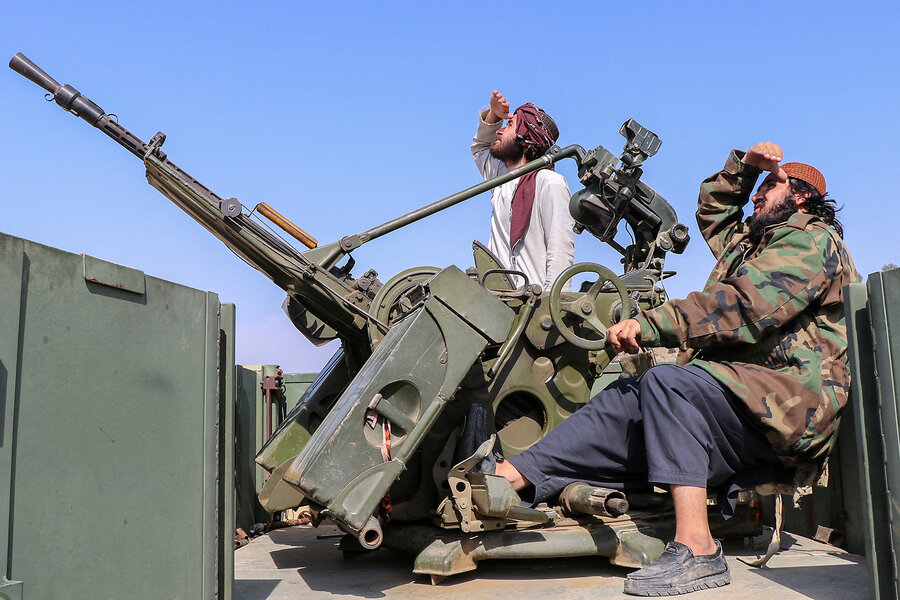
Pakistan launched airstrikes on Afghanistan and claimed to have killed hundreds of Afghan Taliban fighters on Friday in a major escalation between the two former allies.
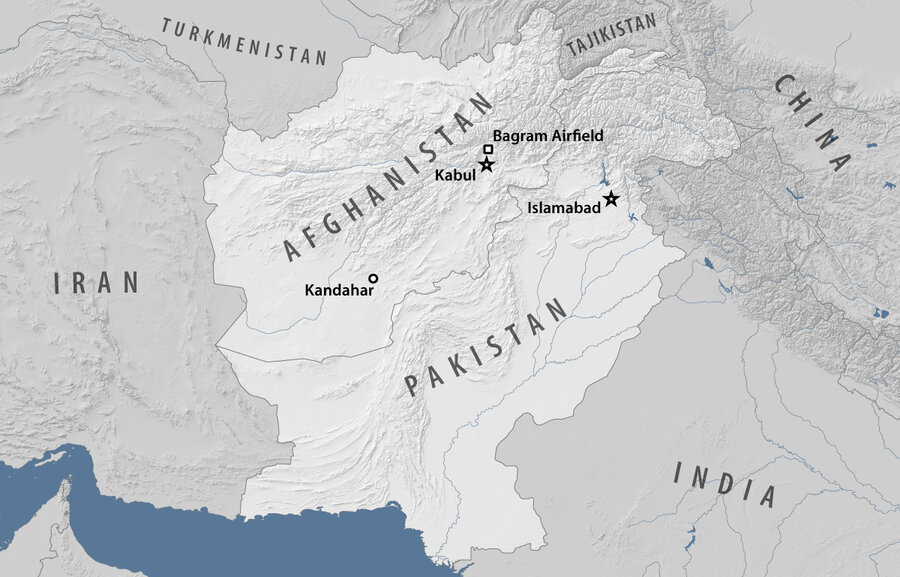
As well as attacking Afghanistan’s capital, Kabul, Pakistan also hit the city of Kandahar, home to Afghan Taliban Supreme Leader, Haibatullah Akhunzada. The attacks came hours after the Afghan Taliban claimed it had carried out a large-scale military operation against Pakistani targets on Thursday, capturing 19 Pakistani military posts and killing 55 Pakistani soldiers.
Pakistan’s Minister for Defense Khawaja Asif declared today that Pakistan’s “cup of patience had overflowed” after a spate of recent terror attacks on Pakistani soil. “Now it is open war between us and you,” he wrote in an open message to Afghan leaders on X, formerly Twitter.
Why We Wrote This
Tensions between former allies Pakistan and Afghanistan have yet again come to a head, with Pakistan’s defense minister saying the neighbors are now in “open war.” Islamabad and Kabul have been able to smooth over tensions before, but the rift is only growing.
The flare-up follows a similar round of deadly skirmishes in early October that ended with a ceasefire mediated by Turkey and Qatar.
Pakistan was once a close ally of the Afghan Taliban and instrumental to the group’s creation. When the Taliban took over Afghanistan in 2021, Pakistan’s then Prime Minister, Imran Khan, welcomed the development, saying that the Afghan people had “broken the shackles of slavery” from the West.
But relations between Pakistan and the Afghan Taliban quickly began to fray as the former began to experience a sharp tick in terrorist attacks along the Durand Line – the porous border between the two Muslim neighbors. Islamabad accuses Kabul of providing a safe haven to militant groups like the Tehreek-e-Taliban Pakistan (TTP) and the Baloch Liberation Army (BLA). Kabul has consistently denied the accusations.
In recent months, the government of Pakistan has also sought to paint the Taliban administration as illegitimate. While addressing a press conference earlier today, Pakistan’s Information Minister, Attaullah Tarar accused the Afghan Taliban of repressing the people of Afghanistan. “They try to subdue women, minorities, and children and they have usurped the basic rights of the citizens of Afghanistan. Hence I will term it an illegitimate regime,” he said.
As Pakistan-Afghan ties have deteriorated, Pakistan-U.S. relations have enjoyed something of a renaissance. Experts of the region have speculated that the U.S. may back Pakistan in launching a regime change operation in Kabul. U.S. President Donald Trump has made no secret of his desire to retake Bagram airbase, controlled by the U.S. until 2021. It is currently under the Taliban’s control. The Taliban have so far rejected his demands.
Islamabad is also wary of the growing cooperation between its archrival India and Afghanistan.
In October, during the last round of skirmishes between Afghanistan and Pakistan, Taliban Foreign Minister Amir Khan Muttaqi made a high-profile visit to New Delhi and drew the ire of Islamabad when he signed onto a statement referring to the disputed territory of Jammu and Kashmir as part of India. The status of the Himalayan region, which is claimed by both India and Pakistan in full, has been the principal driver of conflicts between the two nuclear-armed neighbors.
The failure of Pakistan and Afghanistan to find common ground despite several rounds of talks threatens regional stability, and has upended life along Pakistan’s northwestern border.
In the immediate line of fire are Afghan refugees who fled to Pakistan during the Soviet Afghan war of the 1980s and in the civil war that followed the Soviet withdrawal. As the relationship between Pakistan and the Afghan Taliban deteriorated, Pakistan launched a massive deportation drive, sending more than one million refugees back to Afghanistan. Taliban officials accused Pakistan on Friday of striking at least one camp where deportees were being housed.