A dispute over a Corsican village cross has become a proxy conflict in an existential war over French identity
Occasionally, when working in journalism, you come across a story which appears to have produced such a confusingly large response that you’re left scratching your head at the apparent inconsequentiality of its proximate origin. Somewhere in the order of the equation, cause and effect appear to have got out of sync.
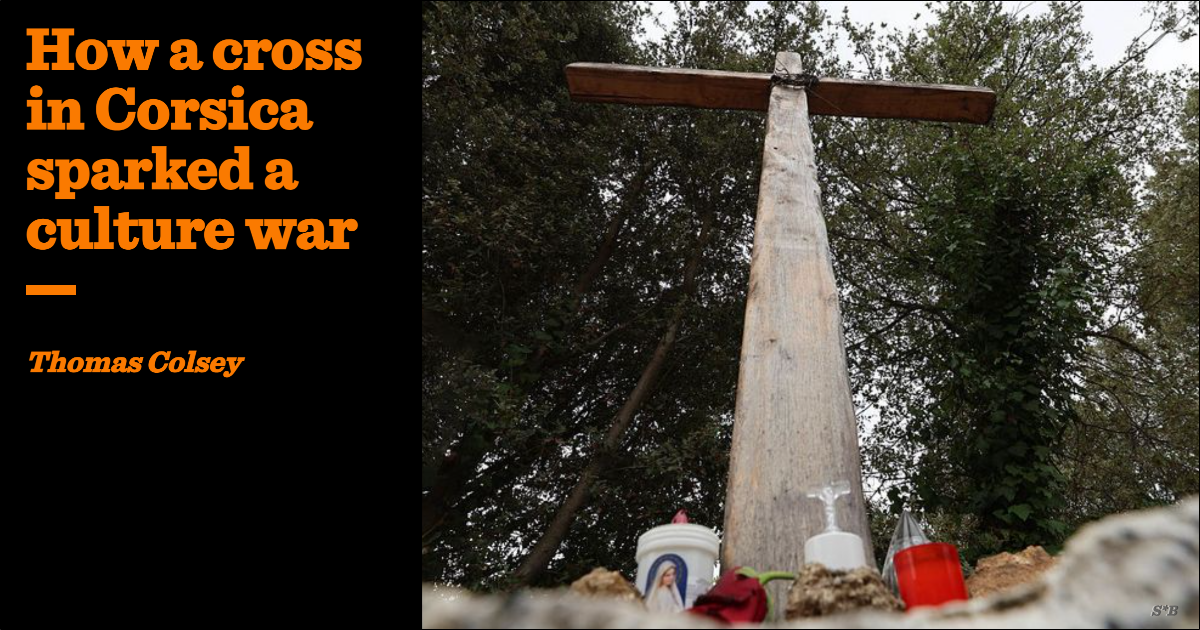
So it is with the story of how a quiet residential complaint about a small wooden cross by a lone retiree, in a village of no more than 60 inhabitants, led to involvement from the courts, regional political parties, national political parties, and the local cardinal-bishop.
Should you have found yourself, on a late mediterranean holiday, passing through ordinarily sleepy Quasquara — a hillside commune perched on the island Napoleon Bonaparte hailed from — in the last month, you would have seen in vivid detail that this controversy is unfolding with a significance far beyond its parochial origins. Traversing its sloping country lanes, you would be met with banners displaying remarkably strong Christian nationalist sentiment: “Erasing the cross is erasing Corsica” and (addressing the complainant) “Go home; the cross belongs here”.
Although this has been hitting regional headlines in Corsica and national headlines (and even television) in France for some time now, it has somehow escaped the Anglophone press. So you’d be forgiven for not being familiar. Allow me to set the scene.
It all began when, in 2023, Marie-Noëlle Franck-Guiderdoni, an octogenarian not originally from Quasquara and no stranger to local controversy, complained that a wooden cross erected a year earlier contravened a 1905 law. The law, already controversial, was the product of France’s laïcité at its most aggressively secular, a period when monasteries were forcibly closed. It prohibits “erecting or affixing any religious sign or emblem on public monuments or in any public place whatsoever”.
Locals already knew Franck-Guiderdoni for her objections to church bells, a municipal noticeboard, and for her long-standing feud with the village mayor, Paul-Antoine Bertolazzi, after losing a local election in 2012.
Bertolazzi rejected the complaint, arguing that the cross replaced an older one that had fallen into disrepair and was therefore protected by exemptions in the 1905 law: “Monuments built before 1905 can be preserved… restorations of ancient monuments are not considered new installations.”
Even so, the cross began attracting attention. In 2024, the Ghjuventù Indipendentista (“the Independentist Youth), a long-standing nationalist student organisation, rallied beside it, declaring Corsica “deeply imbued with Christianity for centuries” and condemning the proposed removal as “erasing a symbol rooted in our history”. Social media and regional press coverage pushed the story into the national spotlight.
After two years of refusals to remove it, on 10 October the regional administrative court ruled against Bertolazzi, declaring the cross illegal because it had not been placed precisely where the older one stood and on public land. The state ordered its dismantling, relocation to private land, or privatisation of the plot on which it stands.
Things kicked off. A petition defending the cross amassed over 42,000 signatures within days. Banners appeared; students in Sartène, Corte and Bastia marched with placards reading “Terra corsa, terra christiani”. With widespread Corsican public support for the cross seemingly undisputed in the regional and national press, one resident noted that “an entire region is rallying behind a symbol”.
Politicians entered the fray. The mayor of Ajaccio – the capital of Corsica – pledged “total support”. Femu a Corsica, the island’s largest and governing party, denounced the ruling as “a rigid, conflictual secularism” imported from the mainland and “foreign to our traditions”.
Then the national right intervened. Marine Le Pen and Jordan Bardella’s Rassemblement National and Éric Ciotti’s Union des droites, understanding its profound symbolic potential in the battle for the soul of France, announced their 2026 municipal elections alliance at the site of the cross and created a fund to buy the land.
Observing the escalating conflict, Cardinal François Bustillo from Ajaccio declined to support the demonstrators. “The cross should not be a cause of division,” he said. “We serve the cross, we do not use it.”
For me, this story exposes most of the fault lines for Europe’s major existential battles in the 21st century in one fell swoop — each independent but interrelated.
Firstly, one manner it does this is internal to Europe’s oldest and most enduring institution: the Catholic Church. The cardinal’s evasive sophistry is explained by the cataclysmic change of approach by Catholic prelates and popes in the wake of the Second Vatican Council in the 1960s. Whereas before, the Church once proudly encouraged Christian nationalism, it pivoted to instead emphasising religious liberty as a fundamental human right (nebulously defined). This was interpreted as a celebration of pluralism and within decades confessional Catholic states across Europe vanished in what many felt to be a needless own goal.
Yet, there are caveats. Something the protestors sense and understand.
Despite whatever Bustillo asserts, the cross has a long history in the Catholic Church as a symbol behind which her besieged children and nations rally. Pope St John Paul II, a Polish patriot, knew this well and leaned into a healthy religious nationalism to make a dual resistance to both the encroachment of the foreign Russian hand and the boot of the secular Soviet state. Indeed, history reveals that without such responses to protect the established people, religion, and culture against a threatening “other”, Catholic Iberia and Austria might have been, like formerly Latin and Christian North Africa, erased.
Even Pope Francis, who chose Corsica for his final papal visit in 2024, recognised this tension in a manner eerily prescient for Quasquara. He praised the island’s “dynamic secularism” — a model where the state does not enforce religious homogeneity yet where Catholic symbols and festivals still colourfully and centrally animate civic life — yet still warned that French laïcité retains “a coloration too strongly inherited from the Enlightenment” that demotes religion to a “subculture”.
The French left reacted furiously, feeling one of their own had betrayed them. But Francis’ comment exposed the next profound and unresolved existential crisis which Quasquara also leads us to: the two schizophrenic notions of France.
A not insignificant portion of the French right never embraced la République following the Revolution of 1789 and retains explicitly monarchist, ancien-régime sympathies. For them, France’s soul rests in a rooted people and its ancient title as la fille aînée de l’Église — heir to a once-flourishing civilisation of Gothic architecture, monastic hospitals, confident Renaissance art, study and innovation, all animated by a fierce, inextricable Catholicism. The competing vision sees France instead as the progenitor of Enlightenment statecraft, secular, modernist, rationalist, sexually “liberated”, and subversively experimental. These two Frances do not synthesise; they simply coexist.
Then there is Corsica. It never fully embraced the secular idea. Between 82 and 90 percent of Corsicans still identify as Catholic (compared with 47 percent of mainland French). Corsica’s national anthem is a Marian hymn. Ostentatious Holy Week processions remain civic events. And while only around 12 percent of Corsicans favour full independence, more than half already support increased autonomy. The attack upon the Quasquara cross resurrected dormant resentment owing to longstanding differences with Paris,
The island’s identity is neither simply French nor wholly separatist: more of a hybrid, but decisively Christian in its grammar and resilience. Yet culturally and religiously, its people retain sympathies to the alternate conception of France — and by extension the alternate civilisational identity of Europe — to the one of the 1905 law and its proponents.
But in Corsica as elsewhere, this cultural foundation has been increasingly shaken by external forces. In 2022, weeks of violent unrest gripped the island following the prison killing of Yvan Colonna, a popular nationalist figure convicted of perpetrating an assassination, by an African migrant inmate for “insulting” Muhammad. Seventy-five police officers and twenty-five civilians were injured; the Ajaccio courthouse was torched; twelve thousand protestors assembled in Corte. And, perhaps revealing that these things are not unconnected, in 2025, days before the Quasquara ruling, protests erupted again after a 19-year-old Corsican was murdered by an illegal migrant.
Europeans are asked to dismantle and erase their history, religion, identity
The cross’ removal appeared to be too visceral an image for what many in Corsica and beyond feel is happening across the board: Europeans are asked to dismantle and erase their history, religion, identity in the name of formless cosmopolitan universalism, while new arrivals have no intention of doing the same.
Religion, politics, identity, history, demographics, ancestry: all of these things are independent of one another but frequently intertwine. One such place each intersects, dramatically, is at Quasquara.
Corsicans understood that their inheritance was built and left behind by a particular people deeply animated by a conviction that the God whom the cross represents supported, fortified, and guided their lives. The thought of the cross being forcibly removed, at a time of broader existential angst, forced them to confront whether they were so sure such a conviction’s symbolic or actual power was redundant that they would be willing to permit its erasure.
Beyond this, the protesters refused to recognise the legitimacy of a 1905 law which demanded the dismantling of one of their sacred and culturally-prized symbols, the same way many simultaneously refuse to welcome the burgeoning presence of foreigners that this same state introduces.
Quasquara is an omen and a preview
This opens yet further fundamental questions: who really is ultimately authoritative? Secular law – or something else? Something higher? What sort of civilisational, political, philosophical future do we want for our regions, nations, continent respectively?
Quasquara is an omen and a preview. Europe will face these same conflicts and questions repeatedly in the coming decades. The fire that the cross has sparked could continue to blaze.