The Houthis raised the stakes in the Middle East conflict on Saturday with a threat to cripple the global economy by blocking a second vital oil shipping route.
In a significant escalation to the month-long war, Iran‘s proxy group in Yemen issued its warning after launching a missile attack on ‘sensitive’ Israeli military sites.
Risking a further surge in oil and gas prices, the group’s military leaders said they are considering closing a Red Sea oil route used as an alternative to the Strait of Hormuz, which Iran has effectively shut down.
Known as the ‘Gate of Tears’ in Arabic, the Bab al-Mandeb Strait is an 18-mile-wide waterway connecting the Red Sea with the Gulf of Aden. Crucially, it controls sea traffic toward the Suez Canal.
If both routes are compromised, the impact would extend far beyond the region, hitting supply chains, energy markets and shipping costs worldwide.
Ten per cent of global seaborne trade passes through the Red Sea, including a fifth of the world’s container traffic and car shipments and 10 per cent of crude oil.
Mohamad Elmasry, a professor at the Doha Institute for Graduate Studies, described the Houthis entering the US-Israeli war on Iran as ‘very significant’.
An armed political and religious group, they declare themselves to be part of the Iranian-led ‘axis of resistance’ against Israel, the US and the wider West – along with armed groups such as Hamas and Lebanon’s Hezbollah movement.

Houthi leader Abdul-Malik al-Houthi announced earlier this month that his terrorist organization is prepared to get involved in the ongoing conflict raging across the Middle East. The terrorist leader is pictured on a poster during a parade in Yemen in solidarity with Gaza in 2024
Mr Elmasry said: ‘We have seen over the past two and a half years that the Houthis have significant power. If they decided to move to shut down the Bab al-Mandeb Strait, the Red Sea and, ultimately, the Suez Canal, we would have two major choke points [closed] along with the Strait of Hormuz.’
As the conflict entered its fifth week:
- Around 24 American troops were injured in an Iranian strike on a military base in Saudi Arabia
- Hundreds of thousands of families are planning UK staycations instead of jetting abroad due to the crisis
- A foiled bomb attack on the Bank of America’s Paris headquarters yesterday was linked to the Iranian proxy group which also claimed responsibility for the arson attack on Jewish charity ambulances in North London last week
- A former oil company executive said that ministers should consider enforcing driving restrictions in Britain amid an impending fuel supply crisis
- Donald Trump is said to have privately floated renaming the Strait of Hormuz the ‘Strait of America’ or even after himself
- A Israeli missile strike killed three journalists in Lebanon
The Strait of Hormuz and Bab al-Mandeb Strait – which separates Yemen on the Arabian Peninsula from Djibouti and Eritrea on the Horn of Africa – are far apart geographically but closely linked operationally.
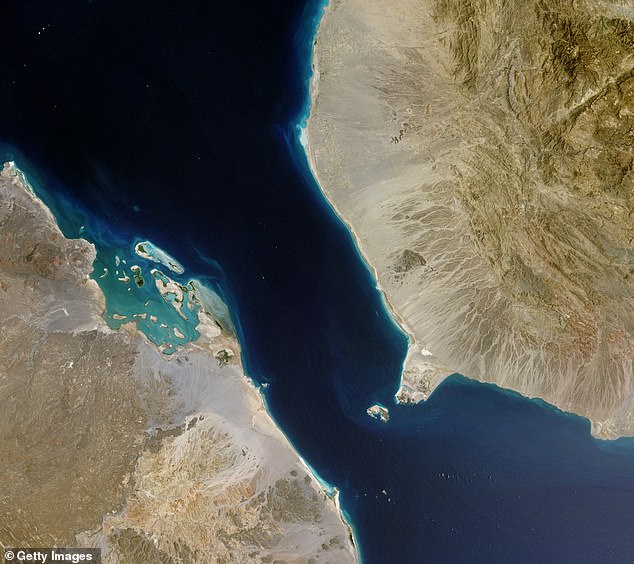
Known as the ‘Gate of Tears’ in Arabic, the Bab al-Mandeb Strait is an 18-mile-wide waterway connecting the Red Sea with the Gulf of Aden. Crucially, it controls sea traffic toward the Suez Canal

Iran has disrupted shipping in the Strait of Hormuz, through which about 20 percent of the world’s oil passes, in a bid to pressure the US to end the war. It is a strategy the Houthis have used in the Red Sea in the past. Houthi soldiers are pictured boarding a commercial vessel
If Hormuz is hit, oil struggles to leave the Gulf. If Bab al-Mandeb is blocked, it struggles to reach Europe and if both are hit the route breaks end to end.
The Houthis have held Yemen’s capital Sanaa since 2014 and, so far, have stayed out of the US-Israeli war on Iran.
The group’s attacks on ships during the Israel-Hamas war caused chaos in the Red Sea, through which billions of pounds of goods pass each year.
Between 2023 and 2025, Houthi rebels attacked more than 100 merchant vessels with missiles and drones, sinking two ships and killing four sailors.
During this time, ships transiting through the Suez Canal fell from 26,000 to 12,700.
Mohammed Mansour, the Houthis’ deputy information minister, said on Saturday: ‘We are conducting this battle in stages, and closing the Bab al-Mandeb Strait is among our options.’
Ibrahim Jalal, a senior researcher on Yemen and the Gulf, said the threat to shipping around Yemen is ‘very alarming, especially when it’s compounded by a coordinated multi-strait blockade’.
He told Al Jazeera: ‘This is exactly the theatre that Iran has been preparing for from what we have seen in the past few years with the Houthis.’
Meanwhile Iran has claimed to have destroyed a Ukrainian anti-drone system depot in the United Arab Emirates. The announcement came after Volodymyr Zelensky, the Ukrainian President, said the UAE and Ukraine had agreed to ‘cooperate in the field of security and defence’.
Ukraine has pitched itself as a partner to states across the Gulf, as well as to Europe and the US, to deter Iranian-made drones.
However, Iran has said it regards Kyiv as a ‘legitimate target’ due to the support for its allies.
Dr Burcu Ozcelik, a senior fellow at Royal United Services Institute, wrote on X: ‘The Houthi factor was always a question of when, not if. They remain a significant lever for Iran, but they will make their own calculations on how far to take escalation.
‘The more serious threshold would be renewed disruption in the Red Sea, with wider international consequences – and possibly pressure on the UK and other states to join the counter-Houthi effort alongside the US.’
Brigadier-General Yahya Saree, the Houthis military spokesman, said air strikes would continue until ‘the aggression against all fronts of the resistance ceases’.