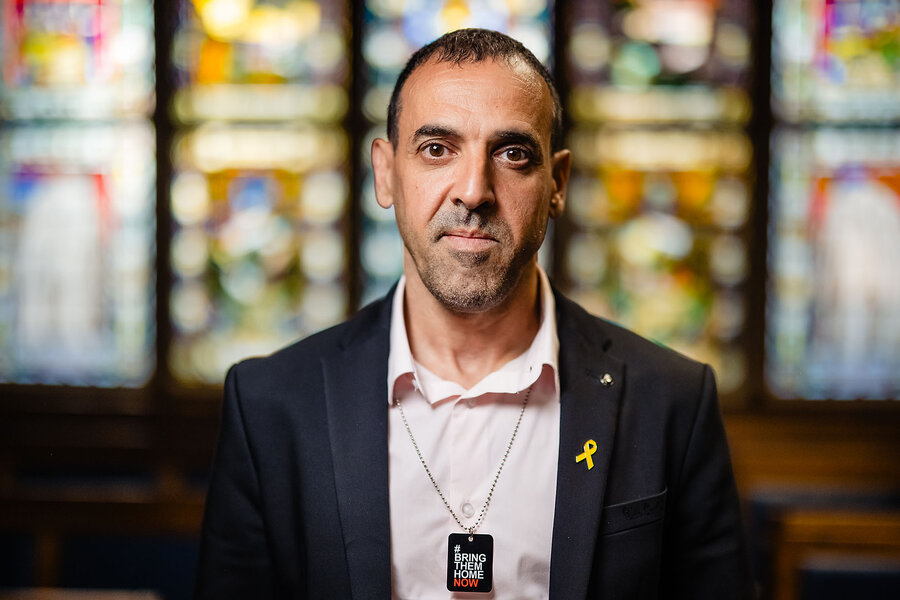
When a group of Hamas terrorists dragged Eli Sharabi from his home on Kibbutz Be’eri on Oct. 7, 2023, he yelled “I’ll come back!” in the direction of his wife and two daughters.
After being held in Gaza for 491 days, he did come back. And now, he has written the searing “Hostage” as a record of his ordeal.
Readers know from the outset what Sharabi didn’t learn until his release on Feb. 8, 2025: His wife, Lianne; 16-year-old Noiya; and 13-year-old Yahel were murdered in their home after Sharabi was abducted. The book’s dedication page features a photo of their smiling faces, alongside a photo of the author’s brother Yossi, who was killed in captivity.
Why We Wrote This
Countless people have endured horrific suffering after more than two years of war in Gaza. It is gratifying that one good and hopeful man has had his life returned to him, our critic writes, as completely changed as it must be.
One wonders whether Sharabi would have endured had he known of these losses. As he tells it, from the moment he is driven from Israel into Gaza by the euphoric terrorists, he remains laser-focused on one thing: surviving and returning to his loved ones. Lianne was raised in England, and she and the girls had dual British-Israeli citizenship. Lianne screamed “British passport!” when the five terrorists stormed in and the men demanded their documents. The belief that Hamas might be reluctant to harm British citizens provides Sharabi a measure of reassurance over the next 16 months.

“Hostage” is a frank account of Sharabi’s time in captivity; it is both difficult to read and difficult to put down. The author, 51 when he was kidnapped, faces steadily deteriorating circumstances. Initially, he is hidden in a home with another hostage, a terrified Thai worker named Khun. Despite being shackled, the two men are relatively comfortable and well-fed. Because Sharabi speaks Arabic, in addition to Hebrew and English, he slowly gets to know his two Hamas guards and the males of the household. They spend hours talking and playing cards. He is relieved above all that he has not been taken down to Hamas’s network of tunnels, whose reputation is of “a bottomless underworld with no light, no air, and no return.”
On his 51st day in Gaza, Sharabi’s situation changes drastically: He is forced deep underground into the tunnels. He is so frightened of what awaits him that he considers resisting, knowing that doing so will lead to his death. “There is always a choice,” he writes.
The author is brought to a room that eventually holds six other Israeli hostages, all younger men who had been abducted from the Nova music festival. They share their harrowing stories and trade information, trying to grasp the enormity of the situation. On their third morning together, a guard appears and tells three of them – Hersh Goldberg-Polin, Almog Sarusi, and Ori Danino – to gather their things: They are being released. Sharabi writes that he was “deeply jealous” but happy for them. Only much later does he learn that they were executed in the tunnels.

Abdel Kareem Hana/AP/File
Sharabi remains with the other three, Alon Ohel, Or Levy, and Eliya Cohen. The tunnel has electricity and running water, and they receive two meals a day. They understand that the terrorists want to keep them alive because they are, in the author’s words, Hamas’s “bargaining chips.” After 40 days, however, Israeli airstrikes aboveground force them to move to a different tunnel. Here, the rooms are smaller, and there is no power or water.
“Difficult days lie ahead,” Sharabi writes with considerable understatement. As the war rages above them, food and supplies become scarce. They are are surrounded by raw sewage and ravaged by hunger, sometimes given only one stale piece of pita for the day. Colonies of worms begin to multiply around them and infest their meager belongings. Sharabi describes them as “living in suffocating proximity to fear, longing, darkness, despair, bathed in that ubiquitous stench.”
When their captors are in a group, the author observes, “they become meaner and humiliate us more,” taunting them and forcing them to wait before being allowed to relieve themselves. As individuals, they occasionally offer small kindnesses, like giving the famished hostages a wedge of a clementine. But, one day, a guard receives a phone call with bad news; he flies into a rage and attacks Sharabi, repeatedly punching and kicking him. For a month, Sharabi is in intense pain, barely able to sit up.
Through it all, Sharabi demonstrates an extraordinary resilience, which helps him cope with unimaginable anxiety and deprivation. As the oldest, he assumes an almost paternal role, particularly with Ohel, with whom he becomes close. Sharabi’s professional background is in management, helping him mediate the conflicts that inevitably arise among hostages confined together for months in a cramped space, scared and starving. He fights their dehumanization, emphasizing that, despite their dire circumstances, there are still some things that they can control. Remarkably, he insists that each night they name at least one good thing that happened that day. Perhaps a despised guard didn’t enter their room, or a kinder guard gave them tea.
It’s wrenching to read about how Sharabi’s love for his family keeps him going. He passes some of the endless time telling Ohel detailed stories about his wife and children. “I’ve got to believe they’re all right so I can hold on for them, so I can survive for them,” he writes.
But he understands that his wife and children might be dead – that he must prepare himself for that possibility and focus on surviving for his own sake, too. “I want to live,” he recalls thinking. “I love life. I crave it. I want to breathe life, to walk free, to return to the open skies, to go back home, to work, to purpose.”
Countless people in the region have endured horrific suffering after more than two years of war. Still, it is gratifying that one good and hopeful man has had his life returned to him, as completely changed as it must be.