This Sunday, with Honduras one week into its vote-count deadlock, Juan Orlando Hernández—aka J.O.H.—revived his suspended socials by posting two jovial Facetime screenshots. Checking in with his wife and two daughters from New York in 2022, the disgraced former president of Honduras looks serene in the first screenshot. In the second, he beams through a disheveled beard and glasses upon his release from prison for drug trafficking, this past Sunday. He is visibly still savoring President Donald Trump’s pardon-via-X the week before.
His whereabouts still unknown, J.O.H. was soon the subject of a new arrest warrant back home from a lame-duck attorney general, issued on domestic corruption charges. The election has altered his fate, but in what direction is still unclear—as is the future of Honduras itself.
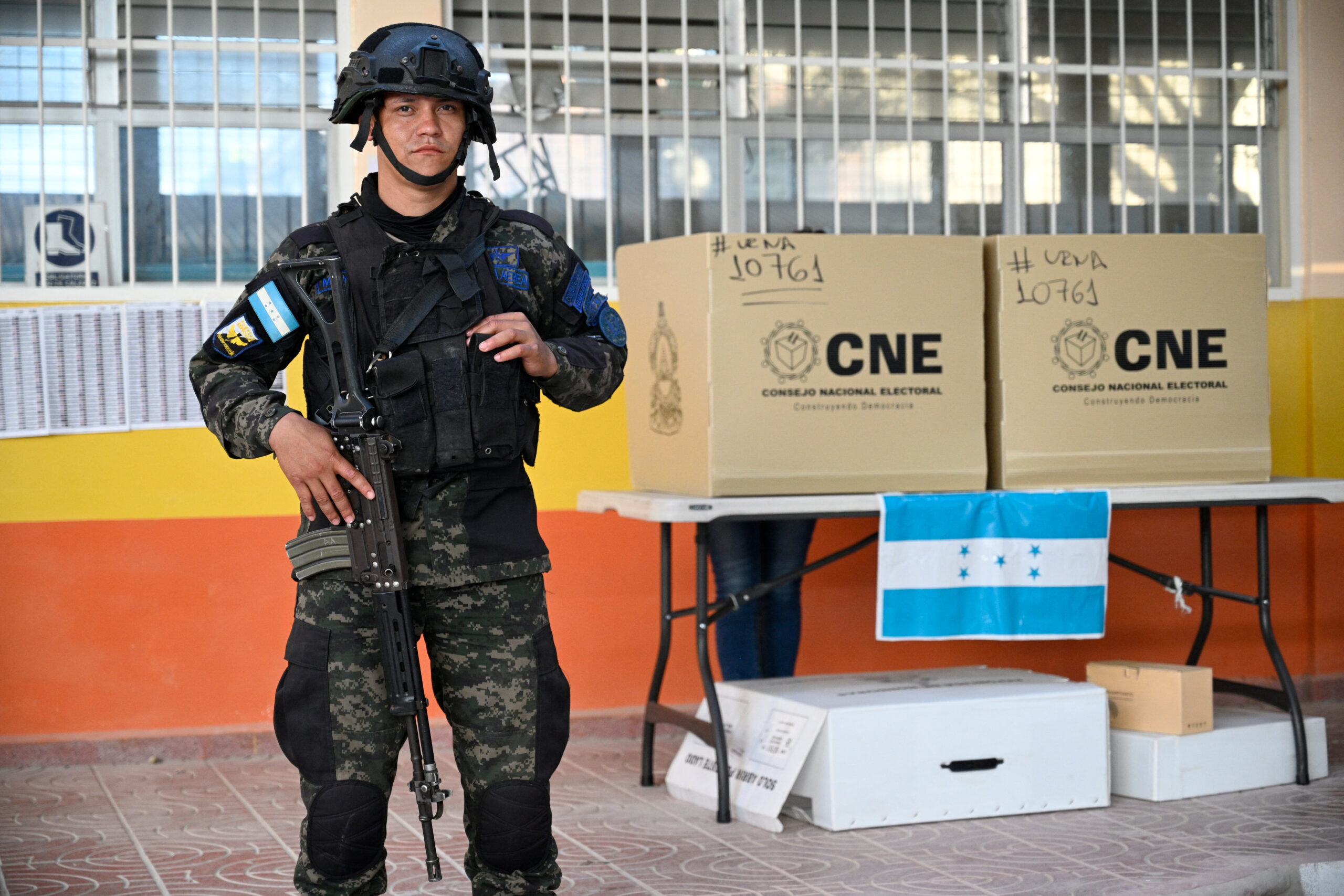
At Vicente Cáceres elementary in Tegucigalpa’s teeming Colonia Kennedy, Humvee-loads of military police peer through balaclavas as gaggles of monitors and the press fill the gym where the National Electoral Commission (CNE), is late for its opener. It’s barely daybreak, and Honduras is on a razor’s edge. Routine get-out-the-vote calls are missing their becalming effect. The eve blew the campaign’s death toll past 20. Candidates have nobody to report threats to. In a state of 10 million with a landmass the size of Virginia, the mighty observer-to-voter ratio will feel puny as the results are inevitably contested. By 7 a.m., this nerve center of polling stations stiffens up a notch.
Cossette López-Osorio just alleged that security risks required her to sit out the CNE, where she holds the opposition National Party’s seat in a party-appointed triad. Amidst trickery and intimidation within CNE itself, Cosette has emerged a rising star from the campaign. She may have wanted to avoid conveying approval of a crooked election process.
Election outcomes in Honduras haven’t been trusted in a long time, not since “Mel” Zelaya called a premature win in 2005, with polls barely closed. No race has escaped challenge since the hard-left strongman took “21st century socialism” to a nation that was spared its preceding variant. Zelaya was ousted by the military in 2009 for running roughshod over Congress and the Supreme Court over constitutional term limits. He cried that he was the victim of a “coup,” duping the world into not seeing him as the perpetrator of one. Zelaya came unofficially back to power in 2017 via his wife, the outgoing Xiomara Castro, who on day one greenlit the extradition of her predecessor—the National Party’s aforementioned Juan Orlando Hernández—on contested drug charges in the Southern District of New York.
Trust has been in freefall ever since. Some rigging attempt is, as of election day, a foregone conclusion, at a scale that could entrench the dismally unpopular power couple through LIBRE’s candidate, Rixi Moncada, a stodgy teacher-turned-finance minister on the back foot, not least for sparing some Castro-praise for Cuba’s late despot. Spirited hearings were held at the U.S. House and the Organization of American States. Both sent vast observer teams, though they were no match for the regional left’s specialty of dealing out vests and credentials to an army of activists routinely called on to thumbs-up sham races—including, most recently, Venezuela’s.
The campaign’s harasser-in-chief was LIBRE’s man at the CNE, Marlon Ochoa, an Oxford MPhil who fuses dapper looks with selfie-documented pyromancy against Tegucigalpa’s U.S. embassy. Cossette’s daughter has been doxed, and deep fake voice-notes have been circulated in an attempt to tarnish his rivals. Ochoa has deadlocked the CNE, torpedoing the procurement of briefcase deliveries to polling stations, which this time carried a mistrusted biometric scanner. Vital early results would be transmitted through a tool, TREP, manned by a Colombian provider that LIBRE was lone to back, and later lone to disown—the antics of an endangered incumbent desperate to deflect allegations of a fraud plot by chalking it on its rivals.
LIBRE-trained and instructed “shock groups,” another Venezuelan import, were pent-up at the leash. Should havoc (relajo) be wreaked at polling stations—ballots stolen, burnt, or otherwise endangered—Army Chief of Staff Gen. Roosevelt Hernández, another Zelaya-Castro loyalist, had ordered his men to stand down and let it rip. These “colectivos” already stormed CNE plenaries through the year’s two campaign seasons (the race was preceded by primaries). The Congress itself remains hijacked by LIBRE’s minority—47 vs. 81—which sent the chamber into recess while setting up a special commission under its thumb and keeping the keys to the building for itself.
Meanwhile, crime soars beyond politics. In part a result of gang movements that have taken place since El Salvador’s law-and-order reset, the crime wave has tanked LIBRE’s popularity (which is also saddled with the sinking economy). Homicides are not down by enough to compensate for ubiquitous extortion, and Hondurans refusing to pay might end up chopped into small bits, stuffed into nylon bags, and left on a street curb. The executors are often young acolytes recruited at schools and universities. In a testament to the miseries of “21st century socialism,” a loo break at Vicente Cáceres exposes one to loyalty oaths sworn to various “maras,” the regional term for gangs, sharing wall space with deceptive state paeans to national hero Francisco Morazán. “Refundar educando,” a new school curriculum, is the educational leg of LIBRE’s plan to “re-found” Honduras. Along with such campaign slogans as “democratizing the economy,” Hondurans have reason to feel a larger 20-year socialist project is on the ballot, and they’re taking the race as a plebiscite.
The result is, as of this writing, tied up in a nail-biter, but one thing is clear: Honduras voted against a re-founding into socialism. Both the conservative National Party’s candidate, Nasry—a.k.a. “Tito”—Asfura, and Salvador Nasralla of the centrist-leaning though non-descript Liberal Party, are edging to claim victory as their respective fiefdoms alternate to feed the CNE’s national tally, and as suspicious blackouts give way to hand-wringing and outcry. Rixi, who’d even led some polls, lingers a distant third below the 20% mark, many of her candidates alienated or otherwise distanced. Zelaya has cried out gringo interference—and LIBRE has kicked into full-on election denialism this week—but even he is working to cut his clan’s losses by keeping Rixi at arm’s length.
Asfura holds a narrow lead in this “technical tie,” but has pledged not to call an early win. The National Party hopes its rural fiefdoms, latecomers to the tally, will flip the race just as they’ve reliably outdone Nasralla’s urban leads thus far. The race is down to Honduras’ two legacy players, but the National Party’s superior party machine is making a difference past election-day. All parties play a role in the tallying of votes, yet National Party’s army of volunteers can collect ballots (“actas”) at a scale that allows it to crosscheck CNE tallies, amounting to a TREP of its own. Tegucigalpa, lost after Asfura’s mayorship, was resoundingly retaken. This doesn’t mean Nasralla’s outsider aura, however illusory—he has run for president four times to Asfura’s two—won’t help his chances. Many a European chancellery wishes a third way out of National Party-LIBRE, even as the claim to be elbowed out by a duopoly is mimicked by all three parties, and Nasralla’s role as Xiomara’s kingmaker—not least enabling her 2017 “win” and becoming her VP—is too easily forgotten. The Liberal Party’s Anna Paola Hall, who holds the CNE’s rotating Presidency, has disowned Nasralla’s fraud claims about an engineered blackout alleged to put Asfura on the lead, but more outlandish allegations are making it into the global headlines with less scrutiny.
Asfura’s rise holds lessons, still, whatever the outcome. He received a bombshell endorsement from Trump on Friday, followed by a trickier post on X: a pledge to pardon J.O.H., who was barely one year of the way to serving a 45-year jail term in Hazleton, West Virginia. It came with Trump’s cries of DOJ lawfare, an assessment shared even by some of J.O.H.’s enemies. Extradited by his rivals from a statelet where foreign drug empires inevitably hold sway, J.O.H. was harmed by an out-of-context quote, politically-tainted testimony, and the foul record of his own brother who is himself serving a life sentence. One version has it that J.O.H. merely failed to cooperate with a DEA mission out of Colombia, resulting in two long-time moles shot dead—and real narcos on the run—as they landed in Honduras. Mel Zelaya, meanwhile, is in cahoots with Venezuelan drug traffickers, and the construction of secret landing sites for planes smuggling cocaine is suspected to have resumed under Xiomara. His brother Carlos was caught in a “narco-video” being happily bribed as he urged: “half for the comandante.” Perhaps more so than Mel, J.O.H now has a shot at a free man’s life: he should be spared LIBRE’s harsher retribution the moment his new arrest warrant goes the way of Johel Zelaya, the outgoing attorney general who issued it. Nasralla, however—suspected of negotiating with Mel to keep the National Party from returning to power—has pledged a Honduran trial for J.O.H., should he win the presidency.
Though not its first judicialized race, this was Honduras’ most transnational one yet. Children in cages, families apart, and law-abiding migrants in detention centers or deportation planes remain Trump-era torments for Hondurans, both at home and in America. Yet, to the confusion of the press, Trump’s endorsement wasn’t a liability in this corner of Central America. Asfura spoke in the language of hard bilateral interest, eschewing high-flown humanitarian pieties. He pledged the same low U.S. tariffs that Guatemala and El Salvador face, along with an extension of Temporary Protected Status for Honduran nationals to live and work in America. The root causes of migration, in turn, would be tackled to Honduras’ benefit: investment in maquila factories, call centers, primary exports, and banking. With remittances contributing 30 percent of GDP, their handling in cash feeds the infamous “trap,” whereby successive Honduran governments had lost the incentive to keep people home.
It was a markedly geopolitical race, too. Xiomara had ghosted Taiwan for no tangible benefit in Chinese investment. Hondurans went to the polls amidst gathering clouds over Venezuela, with even some F-35s rumored to be lined-up in Soto Cano, a major U.S. military installation in Honduras and Central America’s only U.S. base. Rixi’s loss weakens Maduro’s ailing regime no less than the latter’s downfall would have strengthened Tito, who is boosted by the region’s rightward tide.
Several stresses came to a head in this crucible of a race. The juncture in which Zelaya’s clan saw its power slip holds lessons for the region’s left-wing Bolivarian attempts to synthesize the formalities of popular rule with fundamentally undemocratic impulses. These hybrid regimes can’t remain hybrid indefinitely. Honduras was on a unidirectional ratchet, but didn’t break out of the chrysalis on time to make socialism prevail over democracy. Arbitrariness was widespread—violence, cronyism, fraud, persecution—but the trappings of electoral competition were still allowed their sphere. Xiomara, to be sure, had staked a middle-ground to court international investment, and her pretense of cooperating with global agendas earned Honduras millions in aid and sustained revisionist claims about 2009. Yet even combined with egalitarian promises and help from the anti-U.S. axis, they clearly weren’t enough.
Had Rixi won fraudulently—the only kind of win within her reach—the uproar would have called for quelling by the military and colectivos, in turn sowing authoritarian remorse at granting elections in the first place. The irrationality of not dispensing with democratic niceties would have been, ex post, too evident. Even if such chances to defeat would-be tyrants at the ballot box, just on time, won’t always be repeated elsewhere, this one is emboldening. Yet, as their Cuban patrons have endlessly instructed, the mirror lesson from Zelaya’s lost bet—to kick into higher gear before the window of opportunity closes—is being drawn by authoritarians up and down the region.
Subscribe Today
Get daily emails in your inbox
Asfura himself also has lessons for perceptive observers. A grandfatherly figure donning baggy denims and landscaper boots, he has tended Honduras as a garden, harping on about honesty and work and opportunity in a gravelly, earnest voice. His tech clumsiness was even endearing, not alienating, to youths: he turned “la racha” from a digital term-of-art into a viral sensation having barely understood its meaning (a TikTok streak in which he was asked to appear). Embodying the strenuous ethos of a developing country bent on overcoming, he stressed investment and infrastructure and jobs as articles of faith, somewhat formulaic but never scripted. He has eschewed jabs at opponents, to the point where the boisterous politics of his main endorser, and the electoral mud fight waged by his opponents, reveal some degree of naivety—a deficit of cunning—to be the flipside of his strengths.
Asfura’s likely win confirms that all leadership is local. In a country of dirt roads and never-ending construction sites, Tegucigalpa’s bridges and paved surfaces crystallize the former mayor’s ethos of service. He remains, at some level, an archetype of the Honduran everyman: self-made, not overly literate, of Palestinian descent but removed from the largely Arab “10 families” of oligarchs that LIBRE has waged economic war on (and that Nasralla seems desperate to join). As a construction tycoon, Asfura knuckled down after Hurricane Mitch, in 1998, from which his nickname—“Papi a la orden,” uttered when delivering aid or equipment in stricken areas—sprang. The phrase connotes alert fathership and has struck a chord with vulnerable Hondurans. Amidst the heady recount, Trump has followed up with a third message urging transparency and respect for Papi’s victory. Had his sympathy had a basis in familiarity, this would be it: Memes of the two donning safety helmets have gone viral, while local journalists have stressed that Papi “is a tractor man, not an office man,” and that like Trump, he “smells of concrete.”
In its lighter, narcissistic form, politics is the art in which Nasralla may have a better claim to the Trumpian filiation. A former beauty pageant anchor and sports pundit, bluster runs as a thread through his career. He has claimed Trump’s first X post was an unapproved comms job, that the White House actually likes him more, that his phone has blown up with advance congratulations, and that multi-billion USD investments are waiting to pour into Honduras at the snap of his presidential fingers. Asfura is an unlikelier populist, if one at all; measured, ever cautious not to appear a snake oil salesman, with only his future efforts to tout. He has urged respect for “institutionality,” reckoned with America’s power over the region, and never spoken of character detached from deeds. Our populist era hasn’t supplanted the stark realities of life and leadership, just cast a different light over them.