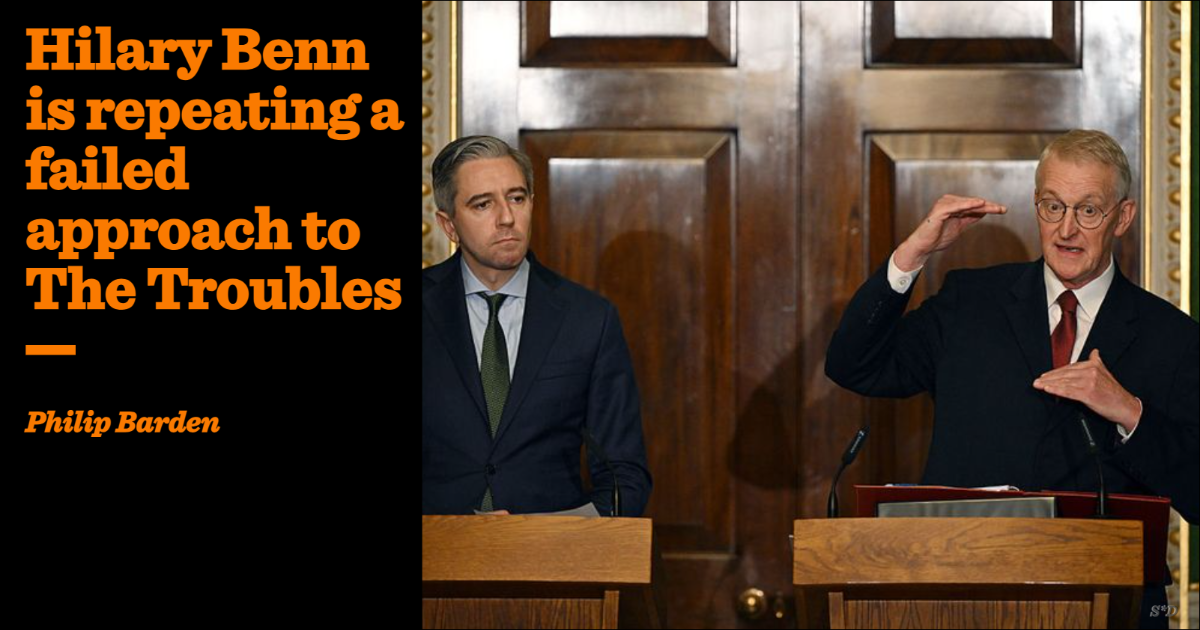
The Secretary of State for Northern Ireland, Hilary Benn, has set out his proposals to deal with legacy issues. His laudable objective is to get to the truth. Easily said, but after 30 years of failure we can safely say in the court and coroner’s system that it is hard to achieve, and I can explain why.
First, we should reflect on those killed. 3,600 people died in nearly 30 years. Over 1,800 were civilians, 1,719 were British military and RUC so approximately the same number as civilians. Less than 100 were terrorists on active service. Some civilians may have been engaged in terror, but over 90 per cent of those killed were at the hands of terrorists. 10 per cent were killed by the military and police.
Second, we should consider how we get to the truth of 90 per cent of terrorist killings. In the search for the truth the terrorists rarely make an appearance. They slipped into the shadows years ago and their paymasters and associated political parties do not tell what they know. So getting to the truth in 90 per cent of cases is near impossible.
There is an interesting legal dilemma in this. The MoD, as part of the Government, has to hand over records and trace and make witnesses available. Sinn Fein as the political wing of the IRA, and in Government as the lead party in NI, does no such thing. Instead, whatever secrets Sinn Fein has it keeps and the same applies to loyalist parties connected to paramilitaries. This cannot be morally right. If these entities won’t co-operate then the process will always be biased against the army and RUC. That breeds resentment which, in turn, leads to a lack of co-operation.
The shame of the peace process is that this silence and non-co-operation has been allowed to continue, whilst these same entities demand investigations and answers. Until this issue is addressed, the truth in most cases won’t come out. There either is a level investigative field or not, and those frustrating the process should not be permitted to participate in it. You are either in the process or not.
Otherwise, the perception is that the target of inquests is the military and RUC killings, as they kept records and co-operate with the process. Hence the anger of veterans.
There are many individuals who are known to have been associated with terrorism and they refuse to say what they know. There is no incentive for them to tell the truth, such as a truth and justice reconciliation process.
The security services have files on many people that could be opened up, including covert recordings a plenty. But these also remain secret and so the truth does not come out.
If we want the truth, really want it, then compel co-operation and make all records available. But it seems no one wants this. So what do they want? In my view the search for the truth is too often driven by people with an agenda well beyond what the actual truth is. They want their truth, not the truth.
The new process is really the same old tried and tested process that has failed over 30 years because the court system is adversarial and not about a search for the truth — that is more the territory of public enquiries with their extended powers. The court system apportions blame.
Hilary Benn has made it clear there will be no more public inquiries. He stated that the purpose was to provide answers for families who have waited too long and deliver fairness including protections for veterans to whom the Government owes a duty of care. He rightly expressed concern at the passage of time and so the age of many witnesses now. He didn’t mention, however, that many witnesses are now deceased and evidence has been lost. Which again inhibits the search for the truth.
So what are we returning to? The 30 or so outstanding inquests will continue and I would estimate they will take three to five years to conclude. The new legacy body will investigate other cases. One legal right that will apply is that those who are subject to investigation will have a right not to answer any questions which may incriminate them. This privilege applies not only where the person believes an answer will incriminate them, but where someone else may assert the answer is incriminatory. It is a very wide privilege. For example, where a person has fired a weapon, they may be accused by someone of murder, so they can refuse to answer questions relating to the weapon and the shooting.
Why would you refuse to answer questions? Because you don’t want to spend the next five or more years of your life involved in litigation, which takes over your life, which is what has happened to people who have cooperated in the search for the truth.
Take the case of Joe McCann, an Official IRA leader in West Belfast who murdered 15 soldiers. He was shot in 1972 by several soldiers during an arrest operation. In about 2007 the then Labour government set up the Historic Enquiries Team to find the truth of legacy cases. Two of the soldiers were approached with a plea from the McCann family asking for the truth and stating they did not want retribution. The soldiers wanted to help the family find closure and so co-operated and said what they knew. What happened next?
Defence lawyers will ensure their clients don’t engage in the process so as not to create any admissible evidence
They were prosecuted. We advised the prosecution service that such an act breached the law. Nevertheless the case was brought and run to trial where the soldiers were acquitted and the case thrown out on the same basis that we had said the case should not be brought. This took up over five years of their lives and deeply affected them and their families. Dennis Hutchings faced a process that lasted seven years and he died in trial just before he would have been acquitted.
The recent coroner’s inquest of Mr Bradley, where the family denied he was an IRA gun runner, is another important example. After a lengthy process involving undercover agents risking all to tell what they knew, it was proven that Mr Bradley was lawfully killed when he swung a rifle toward the soldier who had shouted a warning to him. The family appealed the coroner’s decision. It doesn’t just end. It is about more than the truth.
The finding in Coagh is another good example. In 1991, three terrorists in a car, two armed with Armalite rifles, were carrying out a planned drive by murder of a civilian waiting to go to work. They were shot and killed by the military. The Inquest started in 2021, evidence was heard in 2023 and the decision issued in 2024 upholding that the terrorists were lawfully killed. The soldier who shot the driver was offered the privilege not to answer questions and he declined that offer and gave a full account of how the driver was an integral part of the terrorist unit as he was driving a mobile fire platform.
The family of the driver challenged the decision by judicial review and on 8 October 2025 that was dismissed. This encapsulates the time this all takes and the impact on lives is considerable.
The protections for veterans are a statement of what is available already. Anonymity and screening can be applied for and there are clear grounds on which they are granted and, in every case after Dennis Hutchings’ naming by the PSNI on his arrest, soldiers have had anonymity. Evidence can usually be given remotely.
The health of veterans is one area that could be dramatically improved. Take the case of the soldier who had very bad PTSD. He had hallucinations. Agoraphobia. Anger outbursts and no coping mechanisms. Two of the country’s leading forensic psychiatrists also stated he was not fit to give evidence. These reports were passed to the families of the next of kin who obtained a report from a psychiatrist, who is less qualified and would never even have seen the patient. Yet he advised the veteran was fit to give evidence.
There was then a hearing with the medical practitioners being cross examined and the coroner (who is not medically qualified) finding the veteran was well enough to give evidence. He chose not to because of the clear medical advice that his health would be damaged if he did. He was then pursued, initially sentenced to a term of imprisonment before a £5,000 fine. Civilians in Northern Ireland who have not answered subpoenas are not treated as harshly, despite being medically well.
If the government is serious in wishing to protect veterans then where veterans have medical conditions those must be respected, upheld, and the evidence they give must be in accordance with the medical advice. Lawyers should not judge medical advice, they should follow it.
Further, the entire legal system is adversarial. Defence lawyers will ensure their clients don’t engage in the process so as not to create any admissible evidence as, in many of these cases, if you do not participate there is no admissible evidence.
So whilst I fully support the search for truth I would like it to be done in a fair and open way, ensuring those in Northern Ireland who know the secrets tell them and until then the process will continue to be focused on the military and one eyed. The political parties in Northern Ireland who are associated with the paramilitaries are allowed to avoid telling what they know, and that is wrong. There is at the heart of this matter a lack of candour and that is the real problem.
Until that is resolved, there is no reason to expect any more of this new framework than its predecessors. It will lead to Inquests and Investigations which will target the military and police, and damage lives already impacted by service in NI. Unless the government takes a different approach, the truth will lie buried with the paramilitaries, and the secret files and recordings of the security services.