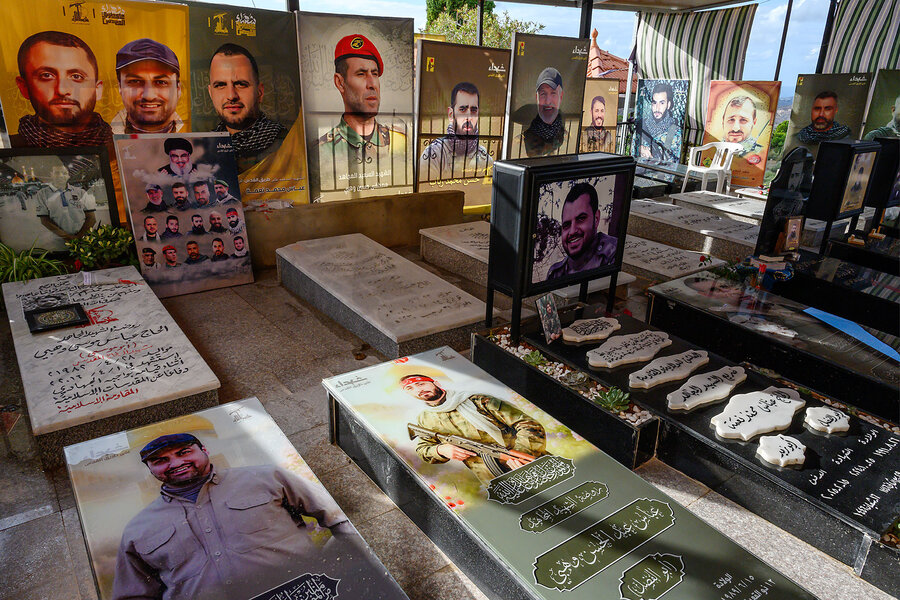
The Hezbollah martyrs’ cemetery is perched high on the edge of the hilltop hamlet of Mahrouna, with commanding views across the tree-lined hills and ravines of southern Lebanon toward the border of Hezbollah’s perennial enemy, Israel.
There is no sadness in the voice of Yehya Naameh Khalil, only pride, as he speaks about his son who is buried here – a Hezbollah unit commander called Hassan, with chiseled features and a steely-eyed look, who died in an Israeli strike in May 2024.
The Monitor observed that exact Israeli strike, and the funeral the next day, when the Hezbollah officer was buried with full military honors.
Why We Wrote This
Hezbollah has been weakened by Israel and is under pressure to disarm. But its Shiite supporters express pride in their sacrifice and look forward to revenge. And for the militia, says one analyst, keeping its arms is “existential.”
“You only have to look at his face, to know what kind of person he was,” says Mr. Khalil, who says his son was respected in the village as a problem-solver to all.
Echoing his funeral eulogy, the father – a lean man with short gray hair and three traditional silver Shiite rings, one set with turquoise – says he is “honored” by his son’s status as a martyr, killed on what this family considers to be a divine path.
“I thank God for that gift,” he says.
The experience and beliefs of this family of Hezbollah supporters offer rare insight into what continues to drive the Shiite militia’s true believers, and why they are certain that – despite repeated and deep Israeli blows – Hezbollah’s war against Israel will not end.

Scott Peterson/Getty Images/The Christian Science Monitor
There is also pride here that Mahrouna is known as the “Mother of Martyrs,” for producing more killed Hezbollah fighters per capita than any other community in Lebanon.
“We used to have one martyr every three or four years, but now they come in batches of five or six at a time,” says Mr. Khalil, referring to the two dozen graves festooned with portraits, banners, and devotional ribbons. “This village belongs to the [Hezbollah] Resistance.”
Continued pressure from Israel
In solidarity with its ally Hamas, Iran-backed Hezbollah began firing rockets into northern Israel in October 2023. The Hezbollah-Israel exchanges escalated until Israel launched a determined offensive in the fall of 2024 that wiped out Hezbollah’s top leadership, killed or wounded thousands of fighters, and targeted the group’s vast missile arsenal with thousands of airstrikes.
Despite a ceasefire since November 2024, Israel has continued near-daily strikes against Hezbollah targets, which Israel says is self defense to prevent Hezbollah – long the most potent arm of Iran’s regional “Axis of Resistance” alliance – from rebuilding its fighting capacity.
A drone attack in Beirut in late November, for example, killed Hezbollah’s top military commander, Haytham Ali Tabatabai. And days after the Monitor’s recent visit to Mahrouna, Israel issued a warning that it would strike a specific building in the hamlet, told residents to keep 300 meters away, and destroyed it.
The Israel Defense Forces Arabic-language spokesperson, Col. Avichay Adraee, posted video of the Mahrouna strike with the words: “This is how the terrorist Hezbollah operates in your villages and stores its futile rockets in your homes and puts you in danger.”
The U.S.-mediated ceasefire requires Hezbollah to give up its weapons and the Lebanese Army to deploy throughout the country, even in Shiite areas of southern and eastern Lebanon, which Hezbollah has ruled for decades.
That disarmament has largely been achieved south of the Litani River to the border with Israel. But Hezbollah says it will not disarm further until Israel stops its strikes; until Israel withdraws from five outposts it still occupies inside Lebanon – also a ceasefire requirement; and after Lebanese engage in a “strategic dialogue” about the future.

Scott Peterson/Getty Images/The Christian Science Monitor
Hezbollah has “been weakened for sure … and their deterrence posture is gone,” says Nicholas Blanford, a Beirut-based expert with the Atlantic Council. “But they remain powerful domestically, as an organization, so they can stand up to the government and say, ‘We are not disarming.’ More importantly, they still pose a threat to Israel.”
“The Israelis talk about 70% to 75% of Hezbollah’s missile arsenal having been destroyed … but I think Hezbollah retains the capability to inflict a lot of damage on Israel,” says Mr. Blanford, author of “Warriors of God: Inside Hezbollah’s Thirty-Year Struggle Against Israel.”
Among Hezbollah’s rank and file, expectations are high of imminent revenge for Israel’s ceasefire strikes, at least. But, so far, Hezbollah has not struck back.
Dependence on Iran
“Their strategic patience is deeper than I would have thought six months ago. But in a way it makes sense, because their options are not great,” says Mr. Blanford. “They are able to rebuild, reorganize, and rearm, despite the blows they’re taking. That’s evident. And the problem they face is that, if they do retaliate … the Israelis are just going to come back massively.”
“It sounds easy to say, ‘Why don’t you just put down your weapons and become a political party?’” adds Mr. Blanford. “But for Hezbollah, the weapons are the party. The ‘resistance priority,’ as they call it, is the beating heart of Hezbollah. And if you take away the weapons, the rest will collapse.”
Hezbollah’s dependence on Iranian support and logistics explains the group’s position, he says.
“If Hezbollah were to voluntarily say, ‘Here are our weapons, we’re going into politics,’ the Iranians would say, ‘OK, then we’re going to stop sending millions of dollars to you, because you are of no use to us anymore.’
“Hezbollah has some of its own revenue, but it’s not going to be enough to sustain the massive social welfare apparatus they have,” Mr. Blanford adds. “Maybe they can keep a hospital here, a school there, a few guys in parliament and a few seats in government. That could end in the next election,” he adds, if the Lebanese people conclude that a disarmed and defunded Hezbollah is of little use.
“It’s existential for them, and they won’t disarm,” he says, short of a direct order from Iran.

Scott Peterson/Getty Images/The Christian Science Monitor
Hezbollah’s leadership compares its fight against Israel with the 7th-century Shiite legend of Imam Hussein, who chose to perish in battle in Karbala, in present-day Iraq, rather than surrender.
“We will not allow the disarmament of the Resistance, and we will wage a Karbala-style confrontation,” Hezbollah Secretary-General Naim Qassem said in late September, describing a “jihadist recovery” that meant Hezbollah was “ready to defend against the Israeli enemy at any time.”
“Victory is coming”
One veteran Hezbollah operative in Beirut, who fought in Syria and gives the name Ali, offers a sober view of Hezbollah’s current standing, but remains unbowed.
“The Israelis feel they are winning. Are they are going to keep bombing? Yes. And we have to admit we did lose a lot, too,” he says.
“Israel has high tech of all kinds, and sadly we have a lot of traitors among us,” says the gray-bearded technician, who carries a Hezbollah radio and wears a dog tag around his neck. “We are sifting [people] right now. There are a lot who stole money and ran away.”
Yet retaliation against Israel, he says, is just a matter of time.
“If we shoot back now, our main concern is: Where are our people going to go, for safety?” Ali explains. “It’s going to take a little time to prepare ourselves, to find a safe haven for our people, [but] patience has a limit with us.”
“Everything has an end,” he says, of Israel’s current dominance. “Victory is coming.”
Similar confidence radiates in Mahrouna, where the mosque and at least 1 in 10 houses has been destroyed by Israeli strikes.
“The south suffered a lot from the Israelis and their occupation,” says Mr. Khalil, the slain commander’s father. “Almost every house in the south has wounded or martyrs. How can we give up our arms, and let these criminals come and kill us?”
“If you walk through this village now, you will not see anything but resistance fighters,” agrees Mohammed Yehya Naameh, the younger brother of commander Hassan. “Someone just killed my brother; do you think I will give him my neck?”
“Israel says ‘Hezbollah is finished,’ but we’re still here. We’re still strong,” adds Mr. Khalil. “If it is true what they claim, that we are done, then why do they keep hitting us every day?”