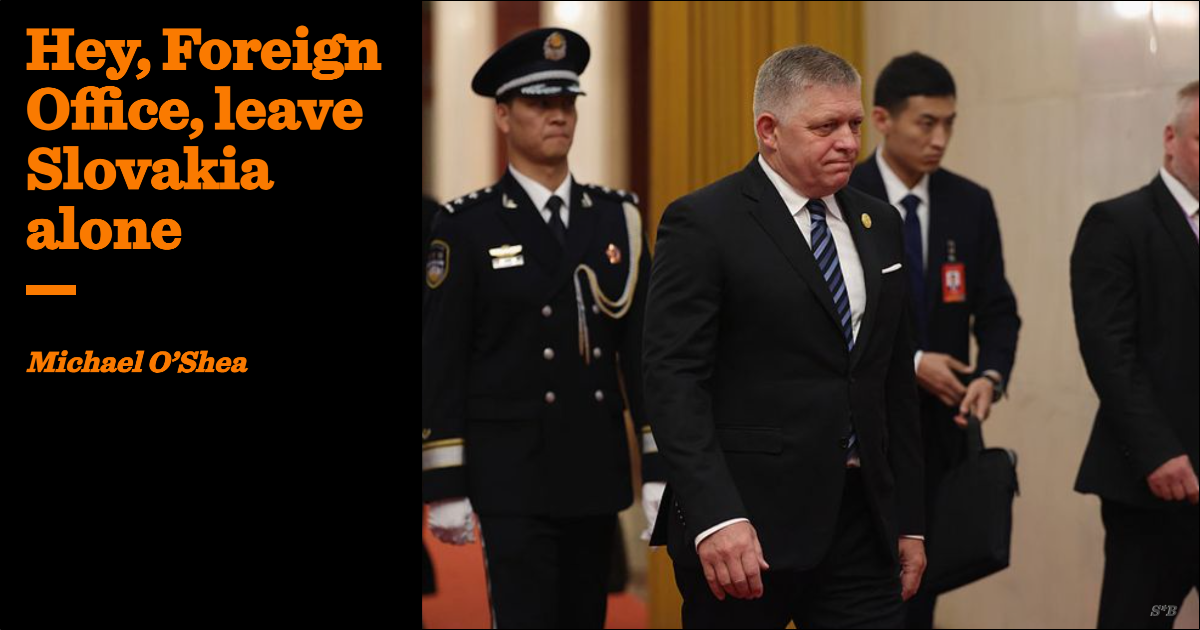
Late last month, the Slovakian parliament passed a constitutional amendment that enshrines recognition of only two sexes, strengthens parental rights in schools, bans surrogacy, and confirms the primacy of Slovakian law over competing EU dictates. The three-fifths parliamentary threshold required a momentary alliance of strange bedfellows, but this is not unusual in Slovakia, where political camps have never ossified along a neat left-right axis.
In this idiosyncratic political landscape, journalists struggle to characterize Prime Minister Robert Fico and often settle for something like “left-wing nationalist.” The Party of European Socialists in the European Parliament just expelled Fico’s Smer-SD party for, effectively, an insufficiently martial foreign policy. More bizarrely, the UK Foreign Office under a Conservative government was recently caught interfering in elections to benefit a left-liberal party in this fellow NATO member state. It is a perfect illustration of the most significant fault line in European politics separating liberals from postliberals, and a foreign-policy apparatus operating solely to benefit the former.
In an episode known as “Zincgate” in Slovakia, the British government financed influencers to sway the 2023 Slovakian parliamentary elections to the detriment of Fico, who ultimately formed a government with a narrow majority.
The independent outlet Declassified UK has conducted an ongoing three-year investigation that revealed the Foreign Office paid Zinc Network Ltd nearly £10 million to “counter disinformation in 22 countries across Central, Eastern and Southern Europe, and in the Baltics.” Influencers signed nondisclosure agreements, and content was subject to approval by the Foreign Office. Thus far, only pre-election projects in Slovakia have been publicly documented.
Independent outlet Marker broke the story in Slovakia, and conservative daily Postoj later confirmed Zinc subsidised the nonprofit MEMO 98 with over €63,000, while the Foreign Office directly disbursed another €35,000 in support of the related CHCEM TU ZOSTAŤ (I want to stay here) campaign. Most of the funds channelled through Zinc financed an election calculator intended to help undecided voters cast their ballots.
Both MEMO 98 and CHCEM TU ZOSTAŤ adhere to legal definitions of non-partisanship. Yet, Slovaks recognise the “98” in MEMO’s name refers to the 1998 Slovakian parliamentary elections, in which a well-funded and -coordinated NGO ecosystem unseated the government of populist Vladimír Mečiar. Central figures of the CHCEM TU ZOSTAŤ campaign included activist Veronika Cifrová Ostrihoňová, who went on to become a MEP for the left-wing opposition Progressive Slovakia (PS) party; former technocratic Prime Minister Ľudovít Ódor, who also subsequently joined PS; and former Prime Minister Iveta Radičová, who led a government between earlier stints of current Prime Minister Robert Fico. A glance at the campaign website leaves little doubt about its leanings, and primary organizers include the Open Society Foundation, among other NGOs with impeccable liberal credentials.
“The main faces of the Chcem tu zostať campaign…as well as many other artists and public figures…who joined the campaign are clearly associated with a specific political camp, which is currently in opposition,” noted journalist Jozef Majchrák in Postoj, “Several of them are associated with its progressive wing.”
Zinc Network, for its part, features an image of a UK anti-immigration rally on its website to illustrate its work in “Countering extremism and radicalisation”. Former employees told Declassified their work amounted to “state propaganda” and that relationships with influencers were “extremely exploitative.”
British officials have protested their innocence. The Foreign Office asserted: “This activity was aimed at encouraging young people to participate in the democratic process in their countries by participating in elections, regardless of their political affiliation or support.” Another Foreign Office spokesman explained that “the UK will always promote truth and democratic values … We are working with partner governments to resist and refute disinformation spread by those who seek to undermine the British people and our allies.” Ambassador Nigel Baker told liberal daily Denník N, “It is both sad and ridiculous that my first summons came from an ally.”
The protestations of non-partisanship and NATO allyship are disingenuous. Exit polls confirmed the conventional wisdom that Progressive Slovakia and other left-liberal parties dominated among young voters, a reality that has prevailed since the instructive 1998 campaign. In this era of campaign analytics, elections are won with precise targeting: young, single, female first-time voters, for example. Then, European institutional behaviour toward Slovakia and neighbours in the region — Hungary, Romania, and pre-2023 Poland, to name a few — confirms that adherence to liberal dogma supersedes EU or NATO membership.
Numerous Slovak observers have noted the Foreign Office ran a hybrid campaign in secret, targeted only a reliably left-liberal demographic, and has thus far refused to proffer a list of influencers to the Slovakian government. Politicians and journalists from Washington to Bucharest have assured us this is dangerous Russian behaviour.
The idea that Slovakia needs foreign voter-participation efforts is also nonsense. President Peter Pellegrini (elected separately from the 2023 government) noted:
Voter turnout in Slovakia has been steadily increasing in the last four parliamentary elections: from 59.1% in 2012, to 59.8% in 2016, to 65.8% in 2020, to 68.5% in 2023. It therefore does not seem necessary for a foreign country to explain to people in Slovakia why it is important to vote. In contrast, voter turnout in the 2024 parliamentary elections in the United Kingdom was 59.7%, a 7.6% decrease compared to the previous elections. So isn’t promoting voter turnout more of a challenge for British governments on their home turf?
Nor should this episode be dismissed because Robert Fico managed to triumph and resume the PM role. Numbers from pollster Focus and the Open Society Foundation’s annual report suggest voters aged 18 to 25 voted at approximately the same rate as the overall population, after showing willingness to vote of just over 50 percent prior to the Foreign Office-funded campaigns. This resulted in Fico’s Smer-SD party building a razor-thin parliamentary majority, the stability of which is constantly debated.
This matters in the quest to battle the foreign-government and NGO leviathan, a topic that was a focus in Bratislava long before Zincgate. The government was forced to dilute a law on NGO-funding transparency after certain coalition partners balked in the face of opposition and international pressure. The government ultimately passed the revised law, which international media called “pro-Russian” and “Russian-inspired,” though it is based on Germany’s Lobbying Act. The UK, France, Luxembourg, and the Netherlands sent delegations to the Slovak Constitutional Court to urge that the law be declared unconstitutional.
So long as legitimate democracy exists in Slovakia, voters will think for themselves
This politicking is a better advertisement for Prime Minister Fico than anything campaign money can buy. Despite his extensive political baggage and the constant international posturing, this self-declared proud socialist and man of the Left offers the best assurances against trans-ing of kids, Bratislavastan, and other liberal horrors. He promises an alternative to the financial and existential crisis of endless war on the eastern border. This the European governing class is not willing to tolerate.
“First govern your own self!” implores Slovakia’s national poet, Pavol Országh Hviezdoslav, in his masterpiece the Bloody Sonnets. It is fitting advice for a liberal British ruling class that has saddled its country with financial ruin, cultural catastrophe, and a demographic transformation that is nothing short of criminal. So long as legitimate democracy exists in Slovakia, voters will think for themselves.