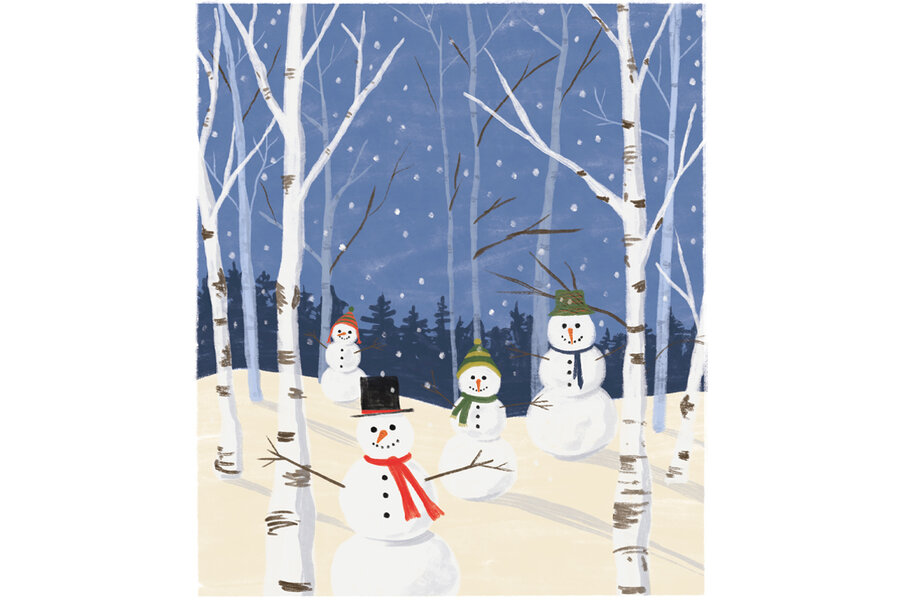
Kids, and kids at heart, race out to make a snowman after a winter storm blankets the ground. Just as every snowflake is unique, each snowman’s size and accessories are limited only by its creator’s imagination.
Indeed, snowmen of all sorts have dotted front yards and public spaces for centuries. Yet they were not always the “jolly happy” figures immortalized in the song and animated television special “Frosty the Snowman.” From political statements to forms of resistance, snowmen have played unexpected roles in history.
To help round out the backstory on our frozen friends, we interviewed a snowman scholar (a jovial fellow with a sparkle in his voice) and even dug up a formula for building the best-looking, three-tiered winter icon.
Why We Wrote This
From political statements to forms of resistance, snowmen have played unexpected roles in history. We round out the record on the rotund winter icons.
Q: Where did snowmen come from?
Although many people assume that snowmen have been around as long as we have, American snowman expert Bob Eckstein set out to learn who, in fact, made the first snowman. Of course, direct physical evidence of all previous snowmen “is long melted,” Mr. Eckstein quips. So he scoured museums, libraries, and other archives, and interviewed historians from all over the globe. His seven-year quest is described in his book “The History of the Snowman.”
Mr. Eckstein says that researchers and historians have told him that Taoist texts exist from seventh-century China that show Buddha’s followers were given the “blessing” to make snow figures of the religious teacher. But Mr. Eckstein found the first known depiction of a snowman – a satirical cartoon figure, drawn in the margins, that he says mocks Judaism and Christianity – in “The Book of Hours.” This volume of prayers dates to 1380 and is held at the Royal Library in The Hague.
Nearly 200 years later, in a winter festival known as the Miracle of 1511, people in Brussels lined the streets with more than 100 lewd and satirical snow figures to protest against the Holy Roman Empire. Mr. Eckstein describes it as “an early form of political commentary,” a Woodstock-like event held by illiterate residents who felt otherwise powerless against their rulers.
“At that point, you couldn’t read and you had no voice or platform in the sense of a newspaper or anything,” he says. “But you can make something on your street corner.”
Snowmen also have played a cameo in violent events. Mr. Eckstein confirms accounts from folklore that say, in 1690, two Dutch guards assigned to the gates of Fort Schenectady in eastern New York decided they wanted to take a break to go to the local pub in their Dutch settlement. They made replicas of themselves out of snow and left their post. While they were away, Native Americans and French troops attacked the fort, killing 60 people, according to a 2010 Schenectady County Historical Society newsletter.
The French used snow figures as a symbol of resistance in the Franco-Prussian War. During the frigid Siege of Paris in 1870, artist Alexandre Falguière crafted a 9-foot-tall snow sculpture of a naked woman on top of a cannon – a creation that became a beacon of hope during the conflict.
In the latter part of the 19th century, Mr. Eckstein’s research found, snowmen started to appear on trading cards in the United States. Starting in the 1920s and ’30s, they also were used in ads for everything from Cadillacs to Mobil oil.
Q: How did snowmen become popular figures for the holiday season?
In 1950, songwriter Steve Nelson and lyricist Walter “Jack” Rollins created a tune about “a jolly happy soul / With a corncob pipe and a button nose / And two eyes made out of coal.” In 1969, Arthur Rankin Jr. and Jules Bass based their animated Christmas TV special, “Frosty the Snowman,” on the song.
The popularity of snowmen has only snowballed from there, and Frosty has been a beloved symbol of the season ever since. As the song cheerily says, “Thumpety thump thump / Thumpety thump thump / Look at Frosty go!”
Q: What’s the best way to build a snowman?
In 2016, James Hind, a British mathematician from Nottingham Trent University, created a formula for building the perfect classic snowman, formed from three giant balls of snow decreasing in size from the bottom up. His complex equation, which attracted a flurry of media coverage, including in USA Today and the Daily Mail in London, breaks down the sizes that make the most aesthetically pleasing figure with a strong foundation.
First, build the three balls from freshly fallen snow, aiming for a total height of about 5 feet, 3 inches. In line with the golden ratio, the snowman’s bottom ball should be 31.4 inches in diameter, followed by the middle section at 19.6 inches, and the head at 11.8 inches.
Next, gather three rocks or other round objects for buttons. Place each one an equal distance apart on the middle ball. Then find two sticks to form a pair of spindly arms. On the face, the carrot nose should be 1.6 inches long, and the objects forming the eyes should be no more than 1.9 inches apart.
Finally, open your closet and have fun accessorizing. Bundle up your snow creation with a hat, scarf, and gloves.
Of course, be mindful that Old Man Winter – and every snowman – is ephemeral. We suggest snapping a selfie so that your new snow-packed pal is frozen in time forever.