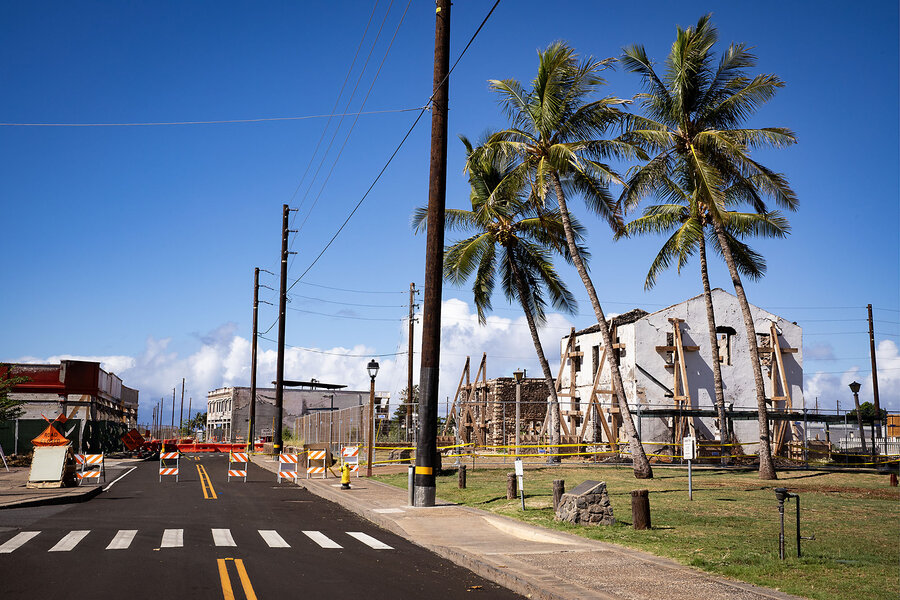
The historic district of Lahaina remains mostly cordoned off to visitors two years after the deadliest wildfire in the United States in more than a century. Fencing, signs, and orange blockades keep curious passersby at bay.
Next month, some activity will return when two piers are expected to reopen at the harbor. County officials say 18 vessels will resume tours and whale watches, bringing some business and jobs back to the area.
But for this island community, the push for progress is tempered by growing calls for a thoughtful, culturally sensitive recovery. The 2023 blaze that killed more than 100 people in Lahaina also leveled centuries of history.
Why We Wrote This
After the deadliest fire in 100 years of U.S. history, houses are rising from the ground once again in Hawaii. But the people of Lahaina are trying to do more than rebuild buildings – they are also trying to rebuild their culture.
Lahaina sits on sacred cultural grounds. It was once the capital of the Hawaiian Kingdom. Restoring that history, say residents and county leaders, will allow the area to reclaim its identity, benefiting generations to come.
“We’ve got to go slow,” says Ke’eaumoku Kapu, executive director of Nā ‘Aikāne o Maui, Inc. The nonprofit has been overseeing cultural monitoring of the fire clean-up. “And whatever happens here should set the standard of what happens throughout the town.”
That aspiration isn’t without challenges. County leaders and cultural advocates alike say thoughtful recovery is hinged on education and community buy-in, not to mention warding off investors hoping to scoop up property.
Cultural restoration also includes bringing back the very people who call Lahaina home. The wildfire physically separated the community’s ohana, or family, dispersing residents near and far. Outside the historic district, houses are rising from the ground once again.

Melanie Stetson Freeman/Staff
Maui County operates a rebuild dashboard that tracks metrics such as building permit status (342 being processed; 527 issued; and 89 completed for residential and non-residential buildings as of early November). Last month, the county announced that the final truckloads of wildfire debris had been moved to a permanent disposal site, clearing the way for roadway and other restoration projects to begin.
“We could rebuild the entire town and rebuild every single structure, but if we’ve lost our people, then … those metrics don’t matter,” says John Smith, Maui County’s recovery administrator.
Center of the Hawaiian Kingdom
Tourists likely knew Front Street as the waterfront roadway filled with shops, art galleries, and restaurants. The fire consumed it. Now, cultural advocates are on a mission to restore what visitors may not have realized: the area’s historical significance.
In the early 1800s, long before Lahaina emerged as a vacationers’ paradise, King Kamehameha declared it the capital of the Hawaiian Kingdom. A cadre of royal buildings materialized near the harbor, where multiple fishponds existed. But then Christian missionaries, whaling operations, and sugar plantations arrived and erased certain aspects of cultural history. Thirsty sugar crops also diverted water from Maui’s streams.
Gone were the town’s Hawaiian names for streets, replaced by English surnames such as Shaw and Dickenson. The fishponds disappeared as well, filled in for purposes such as a baseball field.

Melanie Stetson Freeman/Staff
The fire took even more. It destroyed the Nā ‘Aikāne Cultural Center, home to original signed manuscripts, land awards, historical documents, and artifacts. In the aftermath, Mr. Kapu sees an opportunity to recast a vision of Lahaina that honors its past.
“Let’s just bring back the integrity of our town,” he says while standing next to a map of the Lahaina Royal Complex and cultural sites. “Our children are losing their sense of place.”
In July, Maui County officials launched a two-year, $1 million master planning process for the Complex. The project, with community feedback involved, is expected to include restoration of coastal wetlands and historical sites.
Mr. Kapu pointed out some of those sites on a recent tour of the fire-ravaged sacred space. A damaged courthouse sits near the harbor. A short walk away is a barren plot of overgrown land where a 17-acre pond called Loko o Mokuhinia existed more than a century ago. In the middle was Moku’ula, a manmade island that housed King Kamehameha III’s palace.
Even longtime residents weren’t necessarily aware of the area’s history. Earle Kukahiko, a Lahaina resident who worked for the county for 33 years, says the fire inadvertently provided an educational opportunity, including for himself.
“For me growing up, that was a park,” he says, referring to Loko o Mukuhinia. “I played ball there.”

Melanie Stetson Freeman/Staff
But Mr. Kukahiko says he has seen minds slowly change as more residents learn about Lahaina’s history. A few months ago, at a community meeting, he watched a group of women back off advocating for rebuilding King Kamehameha III Elementary School in the same location after they heard iwi kupuna, or ancestral remains, were discovered at the site. Instead, the school will be rebuilt roughly a half mile north of its original footprint.
That kind of thought shift is crucial, Mr. Kukahiko says, as Lahaina attempts to braid its past and future in this post-fire era.
“You see what a little bit of education does,” he says.
“Place of peaceful recovery”
Up a hill from the shoreline sits a tiny-home community known as Ka La’i Ola. The Hawaiian name, a gift, means “the place of peaceful recovery.”
That’s what it seeks to be for more than 900 Lahaina residents displaced by the wildfire. The modular homes, ranging in size from one to three bedrooms, are providing interim housing for up to five years. It’s not quite temporary but not long term either.

Melanie Stetson Freeman/Staff
The community is the product of a public-private partnership that has brought together the state, the Hawaii Community Foundation, and HomeAid Hawai’i, among other partners, in a bid to provide fire survivors stability while they navigate next steps. Roughly 90% of Lahaina residents affected by the fire were renters.
Cesar Martinez and his family were among them. Now, he’s working for the nonprofit HomeAid Hawai’i and living at Ka La’i Ola with his girlfriend and three children. They spent more than a year going from “hotel to hotel to condo,” he says, before moving into a three-bedroom modular home.
“There’s kids knocking at our door. There’s kids riding bicycles down the street,” he says, describing a renewed sense of home. “So they have [a] more community feel and a lot of friendships here.”
That sense of community reverberates from a pop-up Halloween festival situated within walking distance of Ka La’i Ola. Ukulele music greets costume-clad children, some clutching their parents’ hands as they arrive. Food trucks, an inflatable bounce house, and – of course – candy await.

Melanie Stetson Freeman/Staff
Anthony M. La Puente II, a longtime Lahaina resident who lives in the interim housing development, attended the festival with family friends. Two years ago, he was shopping at Safeway when they called to warn him about the fire so he could get to safety. There were no other sirens or alarms.
“It’s the people of Lahaina that is Lahaina,” he says from under a white canopy tent that is filling with families. He wants their voices to be heard as recovery efforts continue.
But intentional design helps. The community features garden beds and communal barbecue areas where neighbors can gather. A ti leaf plant brightens every corner of a pod containing these tiny homes. In Hawaiian culture, the tropical shrub symbolizes protection.
“When you look around, you’ll see that it’s landscaped,” says Joseph Campos, deputy director of Hawaii’s Department of Human Services. “There are native plants here, so all to just help people find some sense of normalcy.”
Normalcy doesn’t mean forever, though. The goal is for Lahaina wildfire survivors to re-establish permanent housing.
County officials have launched a program dubbed Ho’okumu Hou that offers three housing assistance programs. Two provide financial help for homeowners rebuilding. The third program is for renters who want to become first-time homeowners – a feat notoriously difficult in this high-cost-of-living state.

Melanie Stetson Freeman/Staff
Mr. Smith, who is shepherding recovery efforts, says the county received roughly 2,800 applications for the first-time homeowners grant. The program, which offers assistance up to $600,000, will help aspiring homeowners cover closing costs or bring down the cost of their mortgage payment.
“It is moving through the process,” he says. “We’re going to help a couple hundred people become homeowners.”
Mr. Martinez and his family hope to make that transition.
“We’re taking the classes. We’re signing up for anything possible,” he says, a note of optimism in his voice. “At the end of five years for Ka La’i Ola, we’re going to be able to purchase a home.”
Ohana spirit at work
On a breezy Saturday morning, Mr. Kukahiko – or “Uncle Earle,” as he is known – sits under a canopy strung from a makeshift bathroom. Nearby is a tool shed.
He calls the temporary dwellings, which he built where his daughter’s house once stood, his sanctuary. Mr. Kukahiko and his wife lived next door. The wildfire razed their homes, along with many of their neighbors’. Like so many others, the family now lives at Ka La’i Ola.
But you can find him here most days watering plants and holding conversations with community members.

Melanie Stetson Freeman/Staff
“I’m here most of the time just for peace of mind,” he says.
While Mr. Kukahiko is quick to label his family fortunate, he doesn’t gloss over the reality of a nonlinear recovery. Displaced residents remain wary, wondering who is telling the truth and if the influx of disaster relief money is going to the intended purpose. They also have to beware of scams. Someone tried using his daughter’s name, he says, for wildfire-related benefits.
But there are other reasons to remain optimistic. Good Samaritans helped rebuild a neighbor’s house. And a local contractor whom Mr. Kukahiko coached in youth baseball has promised to rebuild his home. The handshake agreement is a nod to the ohana spirit that underpins Lahaina recovery efforts.
“That’s our people,” he says. “That’s what we do here.”