HEAVY rainstorms battered an island and left it transformed by an eerie blood-red phenomenon.
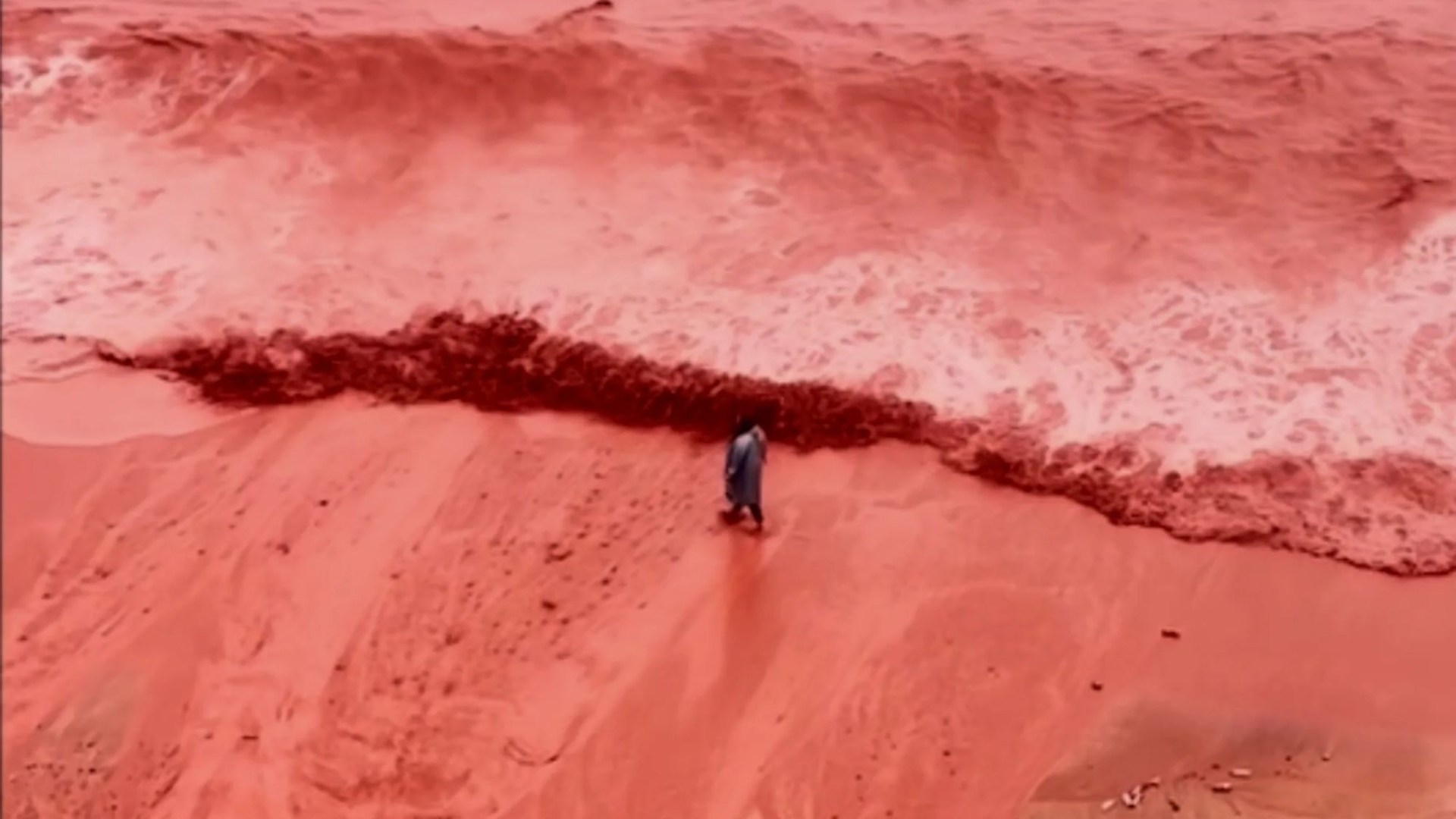
Hormuz Island off Iran in the Persian Gulf turned deep crimson when the pouring rain flowed over cliffs and into the ocean.
The bizarre “blood rain” paralleled similar depictions of red water in the Bible, which have historically been interpreted as signs of the End Time.
Luckily, the Middle Eastern island’s red sea is a natural phenomenon which has led the sands to be dubbed “Red Beach.”
The jaw-dropping red-tinted downpour is said to be attributed to the Iranian island’s iron-oxide-rich crimson soil.
“Golak,” as the soil is know to locals, runs red as soon as it comes into contact with nearby water.
Hormuz experienced the picturesque deep red scene earlier this week with the heavy rainfall pulling the golak downhills and into the ocean.
As the Gulf island appeared to be soaked in crimson on Tuesday 16 , it drew major attention online.
While some people were in awe of the rare sight others sparked concern.
The Iranian Island, home to a few thousand residents, is sometimes called “Rainbow Island.”
It earnt its nickname from the colourful mineral soils which create an even more intense red-hue in areas where erosion is vigorous.
Hematite, is the common iron-oxide mineral that specifically creates the haunting colour – its also responsible for Mars’ famous red landscape.
It naturally appears red in its powdered form as it absorbs shorter wavelengths of green and blue light and reflects longer red wavelengths.
This scattering and absorption effect tints the water crimson when the particles mix with the rain and seas during major weather events.
The Island’s unique chemical makeup formed over millions of years and contains layers of shale, clay, volcanic rocks, and over 70 minerals.
Researchers from NASA’s Earth Observatory said: “The island is a salt dome, a teardrop-shaped mound of rock salt, gypsum, anhydrite and other evaporites that has risen upward through overlying layers of rock.
“Rock salt or halite is weak and buoyant, so it loses its brittleness and flows more like a liquid when under high pressure.”
Some social media users have likened the unbelievable sight to the first of the 10 plagues of god.
God is said to have begun plaguing the Egyptians in the biblical narrative of Exodus by turning the Nile River to blood.
Island visitors have documented the bizarre phenomenon; a few have claimed the red soil stains everything it touches.
The small Island isn’t the only place in the world to have experienced “blood rain.”
Back in August, the Sea of Galilee in Israel ominously turned red, leaving locals panicking and warning of “a bad omen.”
The sea of red was eventually attributed by Israel’s environmental ministry to a bloom of green algae in the freshwater lake.
It turned red when the natural pigment built up under constant sunlight.
There were no reported health risks to swimming in the affected area, despite the unwelcoming red tinge.
The strange phenomenon in Israel was caused by Botryococcus braunii, which is found in many similar freshwater bodies worldwide.