The changing demographic makeup of every neighbourhood in England and Wales has today been laid bare in a series of extraordinarily detailed maps.
Powered by data from the 2001, 2011, and 2021 Censuses, our interactive graphics show how the British population has been transformed over the last two decades amid record levels of immigration.
Simply type in your postcode to see how your neighbourhood has changed, based on factors such as national identity and country of birth.
The data reveals that in 2001, only 0.6% of areas had a foreign-born population of more than 50%, but this has now risen seven-fold to 4.2% in 2021.
When it came to areas where the majority of people did not speak English as their main language, the data shows it has fallen from 0.37% in 2011 to 0.13% in 2021.
There was no question about national identity or English language in the 2001 Census, making comparison that far back impossible.
Our map, which allows you to zoom into street level, plots these changes in all 34,000 lower super output areas (LSOA) in England – tiny pockets of the country made up of around 1,000 and 3,000 people.
Experts argue the numbers reveal certain pockets of the country have changed so drastically due to sky-high immigration that they are no longer recognisable to those living there.
Alp Mehmet, of Migration Watch, said: ‘Many parts of the country now have a majority ethnic-minority population, some of them even mono-ethnic.
‘What a pity the Prime Minister retracted his May comment that we were becoming “an island of strangers”. He was right. It will certainly happen unless immigration is drastically reduced.
‘Migration is now the sole driver of our population increase – 755,000 people (the size of Leeds) in the year to mid-2024.
‘At the current scale, integration is impossible. Indeed, what are new arrivals expected to integrate with?
‘We are simply stoking tensions that threaten future cohesion. We must quickly come to our senses if there is to be any chance of avoiding disaster.’
One of the most high-profile neighbourhoods to undergo significant demographic change in recent decades was the Handsworth neighbourhood in inner-city Birmingham.
It rose to national attention in October after Conservative shadow justice minister Robert Jenrick was secretly recorded branding the area a ‘slum’ and complaining of ‘not seeing another white face’.
He remarked that it was ‘one of the worst-integrated places’ he’d ever seen, where residents were living ‘parallel lives’.
The claims, which he has since doubled down on, sparked controversy, with some declaring the statement as ‘racist’ while others rallied behind him.
The data shows that some parts of the Handsworth neighbourhood had 36% of residents not using English as a main language.
Some pockets of Handsworth had 36% of residents not identifying with any UK national identity (such as English, Scottish, British).
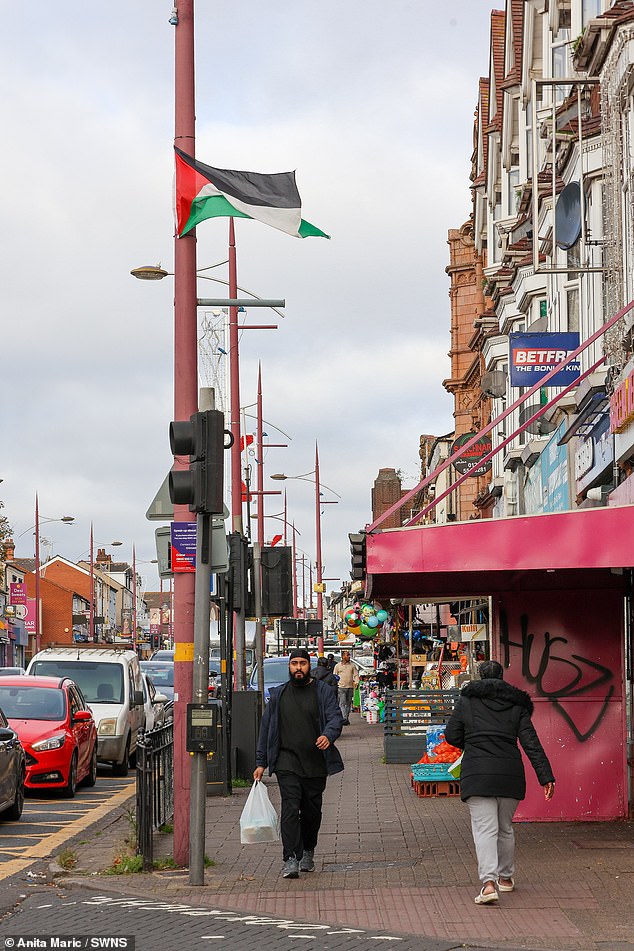
When the Daily Mail visited Handsworth in October, a Palestinian flag was seen flying on its the main street, Soho Road
As well as Handsworth, another area which has seen significant demographic transformation in recent decades is Leicester.
The former textiles capital, which has a long history of welcoming those emigrating from across the world, dominates the rankings of areas where people speak the least amount of English.
The 2011 data shows it has 15 out of the top 20 neighbourhoods in the country with the fewest number of residents speaking it as a main language, with rates reaching highs of 68%.
And in 2021 this trend continued, with it having 16 out of the top 20 neighbourhoods, with rates spiralling to highs of 70%.
Leicester was named one of the UK’s first ‘super-diverse’ cities in 2022 after it was found that more than half its residents were from minority ethnic backgrounds.
A resident called Emma, not her real name, told the Daily Mail in October how she felt unsafe as one of the few white women in the area.
She had lived in the area for almost 25 years but said it had ‘gone downhill’ over the past decade and felt the area had become ‘segregated’.
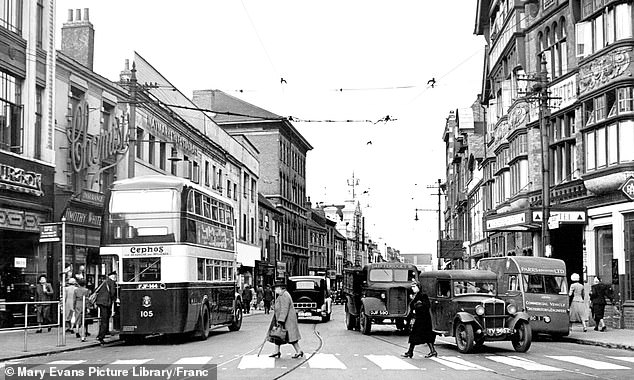
Leicester’s Haymarket in the 1950s. Over the past few decades, the city has been transformed by mass migration
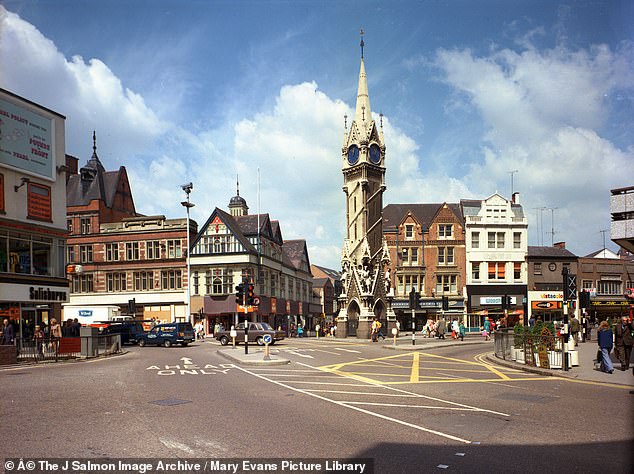
The city’s Clock Tower in 1975. Leicester has seen its demographics change significantly since
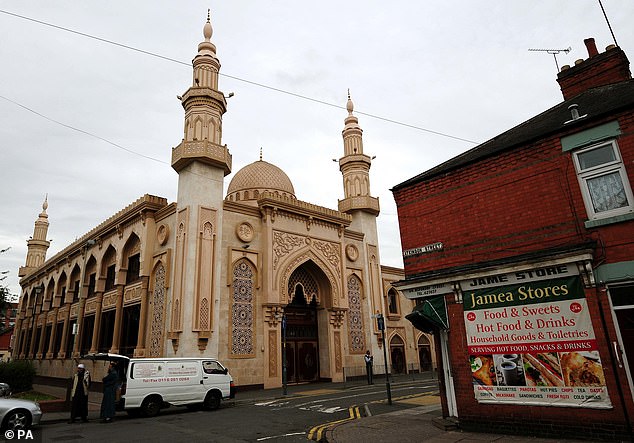
Jame Masjid Mosque in Leicester. Some 23.5% of the city’s population are Muslim, according to the 2021 Census
She said: ‘It’s absolutely awful living around here. It’s abhorrent. They think it’s culturally diverse but it’s not. It’s not.
‘I’m all for cultural diversity but it’s got to the point where if you’re just a white woman you can’t walk down the street without sexual harassment.
‘I’ve lived here about 25 years and I’d say the last ten years it’s really gone downhill.
‘There was a time, like for example, 20 years ago, when it was really diverse, lots of different cultures, and everyone would really socialise together.
‘But now it’s just become everyone is in their own cultural group. It should be integrated.’
The growing concern over the lack of integration within migrant-heavy communities comes after years of record-breaking levels of net migration.
Immigration levels peaked at 1.47m in the year to March 2023, but levels have since fallen – despite the small boats crisis worsening.
Last month, in a bid to respond to the rise of anti-immigrant Reform UK, Home Secretary Shabana Mahmood announced changes to drastically overhaul the asylum system.
Her plan will restrict the rights of those allowed to stay here, refugee status will become temporary and face a review every 30 months.
Those wishing to settle permanently will have to wait for 20 years, and anyone fleeing unrest will be ordered to return home when their country becomes safe again.
Refugees will lose the automatic right to bring their spouses and children to join them in the UK, while those still having their claims processed will no longer receive financial support unless they need it.
Judges meanwhile will be told not to let illegal migrants and foreign criminals dodge deportation by using Article 8 of the European Convention on Human Rights (ECHR), which guarantees the right to a family life.
But unlike Tory and Reform proposals, Labour will retain membership of the ECHR, which can be a block on deportations.