Donald Trump has long questioned the value of the United States’ military and security alliances – at least as far back as 2016, when, not yet president, he dismissed NATO as “obsolete.”
But the president’s derision of America’s alliances and dismissal of their utility – in particular that of NATO and European partners – in the wake of his war in Iran have many officials and analysts concluding that, this time, it’s different.
Mr. Trump, they say, has gone so far in his actions and comments that a divide has formed from which there will be no going back.
Why We Wrote This
America’s European allies have mostly found ways to appease President Donald Trump when he’s questioned the value of U.S. alliances, especially NATO. Yet amid the bitter rhetoric and growing divide over the Iran war, there’s a sense the damage might be irreparable.
“The Europeans are fed up. There’s an exasperation, but there’s also a growing sense that Trump is pushing the limits that make this something of a different order,” says Max Bergmann, director of the Europe, Russia, and Eurasia Program at the Center for Strategic and International Studies in Washington.
“I know the analogy of a divorce has been used a lot,” he adds, “but that may be because it is quite apt when what we’re seeing is much like the breakup of a long marriage.”
Over recent weeks, the president has dismissed NATO as a “paper tiger” and European partners as weaklings lacking the fortitude to take up arms alongside their longtime protector. His criticism has turned to expressions of rage as NATO members from Britain to France and Spain have denied airbase access to U.S. aircraft undertaking missions in the war.
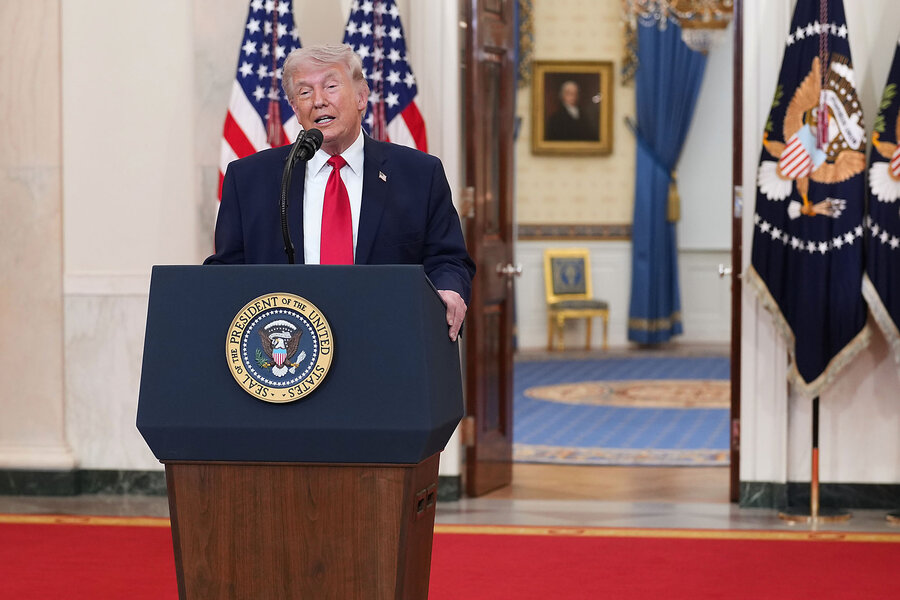
In a televised address on Wednesday evening, Mr. Trump admonished Europe to “build up some delayed courage” and take action to open up the vital Strait of Hormuz on their own. He said the U.S. has “plenty of oil” and as a result is not affected by Iran’s closure of the strait – a dubious claim according to many economists. He also said European nations depend on the oil that passes through it, so they should “take it.”
NATO, again
In an interview on Wednesday with the conservative British newspaper The Telegraph, Mr. Trump said he is “seriously considering” pulling the U.S. out of NATO. Speaking Tuesday with Fox News, Secretary of State Marco Rubio questioned “the value of NATO” and said the U.S. would need to “re-examine” its commitment to the alliance once the Iran war is over.
For their part, Europeans say they are not wavering from their decision not to get involved in a war they believe was not necessary, that they were not consulted on, and which now has triggered an avoidable global economic crisis.

“On the European side, there is less of the shock that people felt over past belligerent remarks by Trump, and more determination not to give in to the intimidation but to follow what we have decided is the right course for us,” says Sven Biscop, director of the Europe in the World program at Egmont – The Royal Institute for International Relations in Brussels.
“The pressuring of NATO and the threats to leave it are more explicit than ever,” he adds, “but leaders are quite adamant about not getting pulled into the war in Iran.”
President Trump will have an opportunity to discuss his deepening doubts about the alliance this week when NATO Secretary-General Mark Rutte visits the White House for a long-scheduled meeting.
Mr. Trump has developed a warm relationship with Mr. Rutte, who courted the president at last June’s NATO summit with effusive flattery and commitments to boosting European members’ “fair share” of alliance spending.
But he has fared less well with European leaders who face mounting political pressures at home not to roll over for a deeply unpopular American president and his equally unpopular war.
Their refusal to accommodate the U.S. president on Iran has prompted sharp rebukes from Mr. Trump of a number of European leaders.
Barbed exchange with Macron
Mr. Trump has become particularly derisive of French President Emmanuel Macron – a leader with whom he once enjoyed a cordial relationship – for not joining the U.S. in the Iran war.
The president mocked Mr. Macron at a private event on Wednesday and then singled out France as a laggard in his address that night. Mr. Macron fired back on Thursday with his own tart riposte, telling journalists, “This is not a show. We are talking about war and peace. … When you want to be serious,” he continued, “you don’t say every day the opposite of what you said the day before.”

Dr. Biscop cites a “bitterness” across Europe that Mr. Trump is disengaging from the war in Ukraine – where Western Europe faces its primary adversary, Vladimir Putin’s Russia – even as he pursues a war that is enriching Russia, easing the pressures on Mr. Putin to end his conflict.
And privately, some European officials are sharing mounting consternation over the U.S. conduct of the Iran war that they say with each passing week is moving further away from the international rules of engagement and values that underpin the NATO alliance.
Mr. Trump has threatened to blast Iran “back to the stone ages” and obliterate the country’s power plants and other civilian infrastructure. These are the same kinds of attacks Mr. Putin has carried out ruthlessly in Ukraine, the European officials note, that have brought rising accusations of war crimes.
As the Iran war accelerates a fraying of transatlantic ties, two different schools of thought on how to respond are emerging among European allies, Mr. Bergmann says.
One side of the “split” is calling for Europe to “face the music” and move ahead with steps to build its own defense, he says. That camp includes Mr. Macron, who has called on Europeans to build a “strategic autonomy.” The other half – typified by Mr. Rutte – cautions against alienating the U.S., especially when Europe simply is not ready to defend itself.
Carrying the traditional marriage analogy further, Mr. Bergmann says the reality is that the U.S., which for decades discouraged any efforts at building a European defense, is like “the husband who would never let his wife get a job and develop skills outside the home, but now … suddenly has turned critical of her for not taking a job.”
A changed alliance
Others say a realism about a permanently changed alliance has already sunk in.
“There’s definitely a growing awareness that, at some level, there is already a structural change at NATO,” Dr. Biscop says. “The emerging consensus is that the U.S. will continue to provide a nuclear umbrella, but that European militaries will have to provide Europe’s first line of defense.”
Some experts say the Iran war and the way it might have accelerated a U.S. turn away from alliances should also prompt fresh thinking among America’s Arab partners in the Gulf about their strategic dependence on the U.S.
President Trump’s statement in his televised address that “we don’t need the Middle East” should be heeded, some say.
“One of the things [the Gulf states] could do … is to become better integrated in their defense capabilities,” says retired Army Gen. Joseph Votel, former head of U.S. Central Command. “They are still focused on defending themselves and not thinking of themselves as a bloc.”
The Gulf states could “use this example” to “do more to tie themselves together,” says General Votel, now a distinguished military fellow at the Middle East Institute in Washington. More integrated air defenses, maritime capacity, and intelligence sharing, he says, would be the path for them to “taking more responsibility for the Gulf.”
As for Europe, Mr. Bergmann says America’s partners there feel like they have heeded Washington’s call under President Trump for them to take more responsibility for their defense. But he says there’s a growing sense that what Mr. Trump really wants is unquestioned fealty – and that, he says, is not going to happen.
“Europe has stepped up and replaced U.S. funding in Ukraine, for example,” Mr. Bergmann says. “But taking more responsibility is one thing. It doesn’t mean they’re going to approach the U.S. on bended knee.”