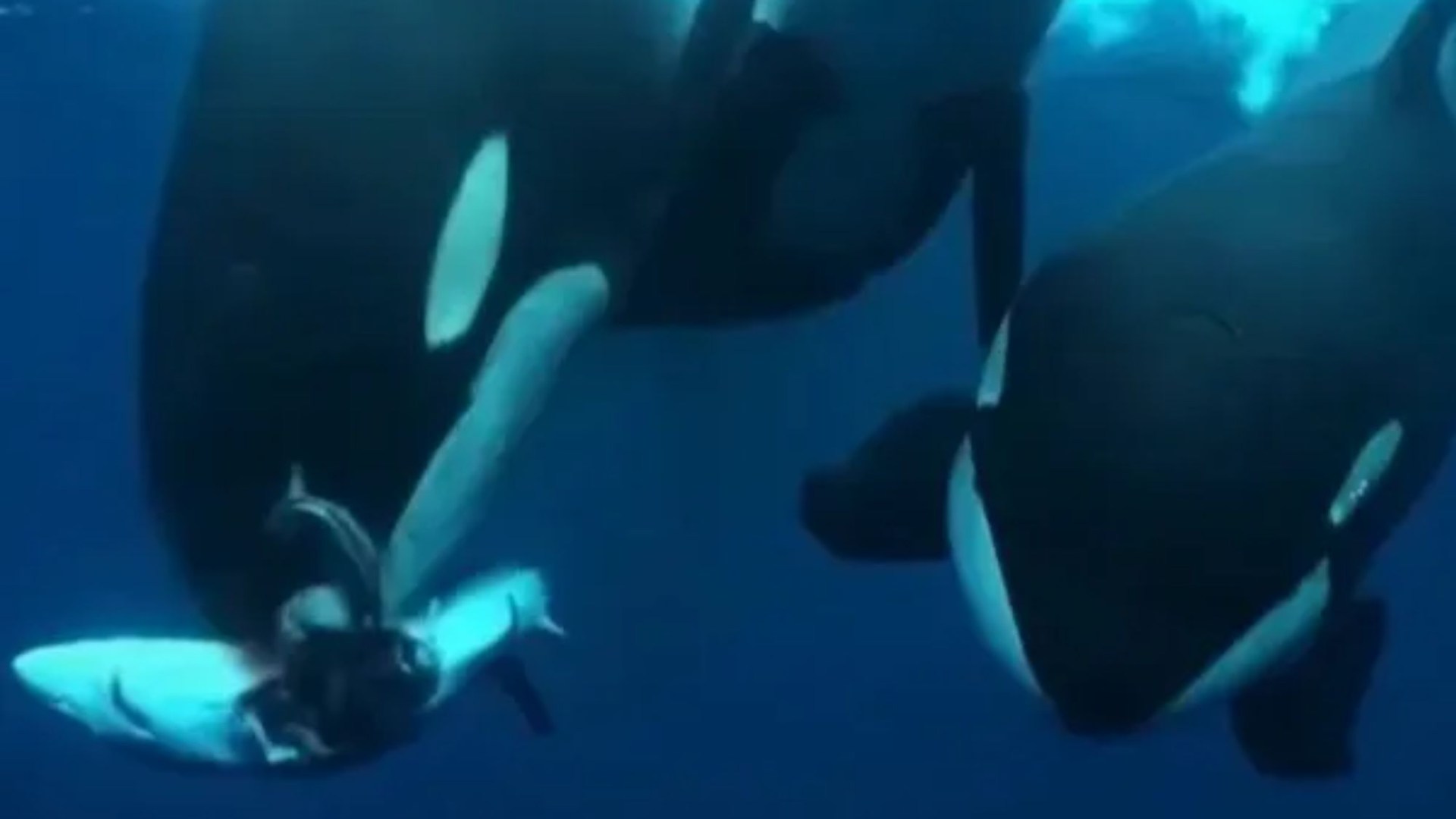
THIS is the shocking moment a pack of killer whales tear a shark to pieces, feasting on its remains.
Terrifying footage shows three huge whales passing the lifeless carcass of one of the ocean’s deadliest predators between themselves.
Suddenly, one of the whales dives towards the ocean floor, taking what’s left of the shark with it.
Wildlife guide and videographer Evans Baudin, who captured the dramatic moment in Mexico, said Orcas often target sharks‘ oil-rich livers.
This calorie-dense prize is highly sought after in the ocean food chain.
Wild scenes such as this offer researchers valuable insight into how Orcas hunt, feed and interact in the wild.


“The shark is already partially consumed, and what we are likely observing is the feeding phase that follows the initial capture,” Baudin said.
“Multiple individuals [orcas] are present around the carcass, taking turns handling and sharing the prey.”
The Blue Shark is one of the most common shark species, and is considered a very capable predator in its own right.
Despite its heavyweight status, it was no match for one of the ocean’s apex predators in the footage.
Orcas – known for their high levels of intelligence – regularly tailor their hunting technique to specific species of prey.
“Predation on sharks by orcas has been documented in different regions of the world and often reveals highly specialised feeding strategies,” Baudin said.
“In several well-documented cases, orcas have been observed targeting the liver of sharks, which is extremely rich in lipids and represents a high-energy food source.”
Orcas themselves require large amounts of calories to sustain their body mass, which is why such nutrient-dense organs are particularly desirable.
To that end, researchers have reported incidents where killer whales target sharks – sometimes leaving the entire carcass except for the liver.
In February, Baudin was able to record similar footage of a family of orcas feasting on a helpless shark.
Again, the ocean bullies can be seen tearing through their prey in just a few moments as they swim to the surface.
Speaking about the moment filmed in Mexico, Baudin said: “Observations like this help illustrate the remarkable adaptability of orcas as predators.
“Direct documentation of these interactions in the wild remains relatively limited, so every recorded event contributes valuable information about how orcas interact with shark species and how prey is shared within the group.”
For Baudin, the experience of witnessing this fateful encounter also held both personal and scientific significance.
“From a personal perspective, witnessing moments like this in the wild is always striking, not only because of the intensity of the interaction but also because it provides another opportunity to document and better understand the feeding ecology of these animals,” he said.
“Each observation adds another small piece to the broader picture of how orcas function as apex predators within marine ecosystems.”