A short interview with the actor Riz Ahmed caught my eye last weekend, headed: Hamlet is about “resistance”. My immediate thought was, no, it’s not. But I gave Ahmed — a very fine actor — the benefit of the doubt and took a closer look at his claims. Unfortunately, my doubts were justified: he is both more wrong and more unserious than I had imagined.
Ahmed is talking about Hamlet because he stars in a just-released “reimagining” of Shakespeare’s play, reset in contemporary London, with the prince recast as heir to a property empire. I will leave any comment on the film itself until such time (which may never come) as I actually see it. For now, my interest lies in Ahmed’s confidence in pronouncing on Shakespeare’s intentions; in particular, his claim that his film is
… truer to the heart and soul of this play than we’ve seen in recent years on stage or on film because it is trying to bring out the fullness of the feeling outside of the kind of defanged tradition of how it’s often performed.
There is a great deal crammed into this claim. What, we might reasonably ask, is the “fullness of feeling” of a play? And here we are not talking about any play. This is Hamlet, which wrestles with King Lear for the title of Shakespeare’s greatest work and is probably the world’s most famous drama. It is notoriously complex and notoriously long. Volumes have been written on its meanings and on its characters’ motivations; uncut performances routinely run to four hours or more. What special insight does Riz have which allows him insight into the play’s feels?
Riz Ahmed claims that Hamlet has been “really deradicalized and really defanged.” He zooms in on its most famous speech and insists that it has been fundamentally misunderstood — that “To be or not to be” is not, as he accuses some straw man of believing, “about suicide,” but is instead a call to “resistance.”
He offers little explanation for this claim in the soundbite interview but elaborates more fully in a talk he gave at the Business of Fashion VOICES conference last year. He reiterates the assertion that “most people think it’s about suicide”. Really? Do they not, rather, understand it as a meditation on endurance, conscience and mortality? Ahmed carries on to — let us be kind — interrogate the speech. But first, he drops a rather large clanger:
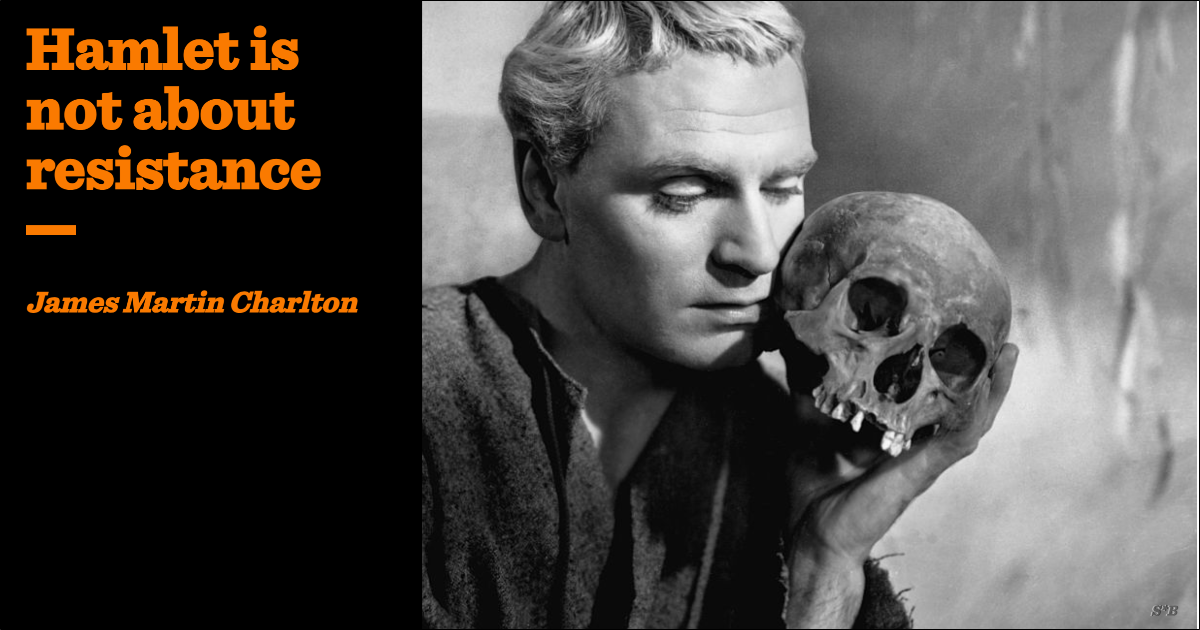
Usually what happens is the play stops. Dude comes out. He’s holding a skull. He stares at it, and he’s like, ‘to be or not to be?’
You will have noticed the error. Hamlet holding a skull — as everyone surely knows — belongs to the much later graveyard scene, where he reflects on mortality through contemplating the remains of his father’s jester, Yorick. This is not a pedantic correction. It instantly raises questions as to how seriously the play has been engaged with. Ahmed is not merely offering a speculative reading of what he himself calls “the most famous lines ever written by a human being”; he is presenting it as a corrective to centuries of supposed misunderstanding, while demonstrating a basic confusion about the play’s structure. This is a rookie error, and it sits uneasily with the confidence of someone who lectures others on the speech’s meaning.
Riz fixates on the phrase “to take arms against”, seeing it as proof that the speech is about resistance to the “slings and arrows” of oppression; only, as the “slings and arrows” are of “outrageous fortune” — a rather less concrete enemy than a tyrant — this does not convince. Still less does his claim that
It’s about fighting back against oppression, the oppressors’ wrong, the proud man’s insolence, the insolence of Office, the law’s delay.
Ahmed carefully avoids mentioning the line about the “pangs of dispriz’d love.” What has unrequited desire to do with fighting oppressors? Unless his implied revolutionary is also an incel. The line is fatal to his theory because it introduces a wounded erotic ego into what might otherwise look like a catalogue of public wrongs. Shakespeare is saying, bluntly, that what drives human misery is not only injustice out there, but humiliation, rejection and thwarted desire within.
To see Hamlet as a “resistance fighter” is therefore to ignore the play Shakespeare actually wrote
The speech is not a communal call to arms. The soliloquy is not about whether to rebel but whether to act at all. It is delivered, as soliloquies tend to be, alone on a stage emptied of everyone except the speaker. The speech moves away from action, not toward it. It is not a rallying cry but a diagnosis of paralysis. To recast this as advocacy for armed resistance is to project a contemporary political fantasy onto a speech that explicitly stages a fear of acting decisively.
To see Hamlet as a “resistance fighter” is therefore to ignore the play Shakespeare actually wrote, and the clues he leaves within it. Hamlet is a revenger, not a people’s champion. His grievance is private and genealogical: a father murdered, a mother remarried. Denmark scarcely enters his thinking at all. And frankly, given how he veers between indecision and rashness, he would make a terrible king. The council were perfectly reasonable to elect Claudius — they did not, of course, know he was a regicide — but they could see that he possessed far greater political competence than the unstable student prince. There is no implication anywhere in the play that Claudius is oppressing the Danish populace at large.
Hamlet is no poster boy for rebellion. By the end of the play, he has killed Claudius but also brought about his own death, his mother’s and the annihilation of the entire Polonius family — including the innocent young woman he once professed to love. He engineers the deaths of those poor saps of fortune, Rosencrantz and Guildenstern, with cold, managerial efficiency. It was no mistake that Steven Berkoff included Hamlet in his gallery of Shakespeare’s villains.
Hamlet is closer to Faust than to any romanticised freedom fighter. In Act 1, Shakespeare takes care to frame the Ghost not as a righteous messenger but as a demonic presence. Horatio explicitly warns that it may “tempt” Hamlet toward destruction, and its disappearance at the crowing of the cock — the “bird of dawning” — invokes Christian belief that such spirits are banished by the coming of light, a folklore expounded in the very first scene. The Ghost’s demand for revenge is flagged as theologically suspect rather than divinely sanctioned.
Such themes do not lend themselves to slogans
Ahmed’s professed access to the play’s “heart and soul” comes at the price of ignoring the play. One could overlook it if he were merely using Shakespeare as a prop in the marketing of a contemporary film — a graduate of Merchant Taylors’, Christ Church, Oxford and the Royal Central School of Speech and Drama playing at sounding edgy. But he is doing more than that: he is offering a pedagogic vocabulary devoid of erudition or insight. He acknowledges that the film presents “an abridged version of the text” yet claims that this abridgement is somehow truer to Shakespeare than Hamlet as written.
If anything has been “deradicalised and defanged” in recent decades, it is Shakespeare’s Christian imagination. He was a dramatist who understood that revenge (in the major tragedies) and resistance (in the rebellion of Jack Cade, the conspiracy against Caesar or the violence of Aaron the Moor) are alike corrosive and self-defeating. His plays do not romanticise zealous action; they anatomise its costs. Forgiveness and reconciliation are the difficult balms he repeatedly gestures toward. Such themes do not lend themselves to slogans nor do they flatter a culture impatient for the romance of insurgency.