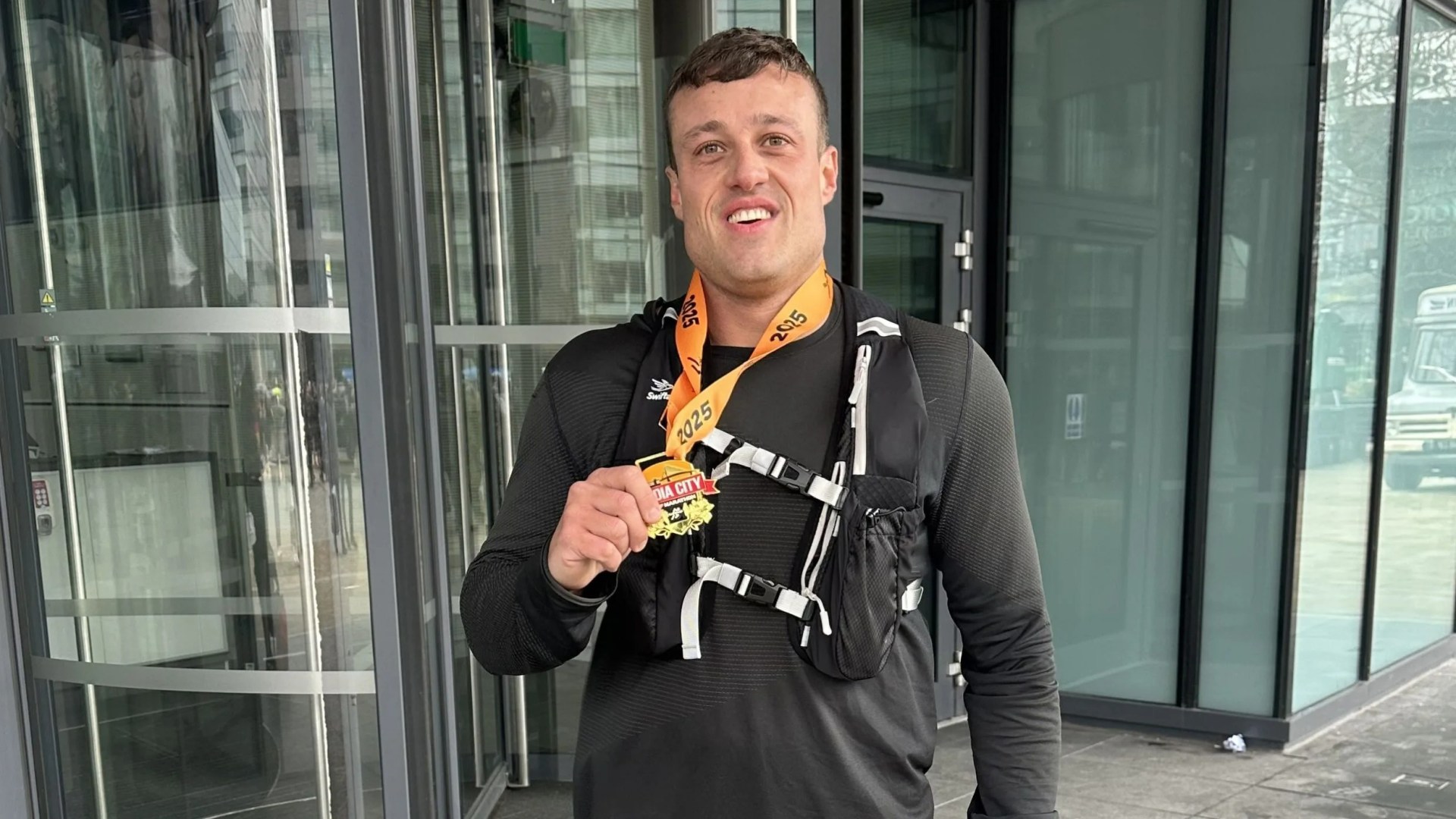
FIT and healthy, gym fanatic Ryan Mickleburg was training for four marathons, taking part in Hyrox competitions and felt “invincible”.
But out of nowhere, the 33-year-old was left fighting for his life after he suffered not one but two ‘widowmaker‘ attacks.
The chef was in training for the first of four marathons and was lifting 100kg when he had the double heart attack during a gym class in March.
Manchester-born Ryan says he was experiencing numbness and pain in his chest prior to the incident but dusted off the symptoms.
He said he was “scared he was dying” as his mum Patricia frantically rushed him to the Royal Bolton Hospital.
Upon arrival, his heart rate soared again, reaching 225 beats per minute while hospital staff were working on him.


Doctors gave Ryan liquid aspirin and monitored him as he waited to go into ICU.
‘Widowmaker’ heart attacks happen when there is a complete blockage of the left anterior descending (LAD) artery – the heart’s main artery.
The blockage cuts off oxygen supply to a large part of the heart muscle, stopping it beating and causing muscle damage and often death.
Following his miraculous recovery, Ryan is now urging young men to come forward and sign up for heart screenings through organisations like Cardiac Risk in the Young [CRY], which offers subsidised cardiac screenings to all young people between the ages of 14 & 35.
He said: “I started going to the gym around the age of 18, but over the last two or three years my fitness has really stepped up.
“I was doing Hyrox and functional fitness events – and training for four marathons this year.
“I was running up to 75k a week, plus three or four days of weight training, lifting up to 100kg on the barbell.
“I was burning the candle at both ends.
“I’m shocked how many young people in their twenties and thirties have messaged me saying they’ve had a heart attack.
“Young men are taught to push through everything – pain, stress at work or home, exhaustion.
“I was like most young men – I thought I was invincible.”
Ryan recalled the moment he knew something was wrong during the fateful gym class earlier this year.
“I kept getting numbness in the left side of my body, but I thought it was just a trapped nerve – I put it down to the gym,” he said.
“It was happening consistently for two to three months before.”
“Midway through the session, I went down on the floor to do a burpee and when I stood up my chest was really tight.
“I looked at my watch and my heartrate had gone to 195 bpm.
“I had a rest and felt fine, but after the session I was driving home and I got pain in the left side of my jaw and my arm.
“When I got home, I started to get cold sweats – I knew I was in trouble.
“I rang my mum and said, ‘I’m in a bad way here’.
Symptoms of heart attack
The filmmaker Kevin Smith survived a widowmaker heart attack early last year.
But why is it called that…and how is it any different to other types of attack?
‘Widowmakers’ are usually deadly.
“They call it the widow-maker because it’s the most deadly heart attack you can have,” Dr Ameya Kulkarni, a cardiologist, told Live Science.
Why does it happen?
You’ve got two main arteries that supply blood to the muscles of the heart, but the left one delivers more than the right one.
When that left artery becomes clogged up, the heart muscle stops receiving enough oxygen-rich blood and that results in damage to the tissue.
Usually, that’s caused by atherosclerosis – the build-up of plaque from cholesterol in the artery’s inner lining.
Despite the name, widowmakers can happen to both men and women.
Risk factors:
- smoking
- high levels of bad cholesterol and fat
- high blood pressure
- obesity
- diabetes
- not being active enough
The fact that Paul was active, a healthy weight and didn’t smoke is proof, however, that heart attacks can strike anyone.
And because of that, he missed the three vital signs of heart attack – putting them down to other, much more minor issues.
Had the people around him not acted quickly, he might not be here today.
While symptoms of heart attack vary from person to person, they can include:
- pain or discomfort in your chest
- pain that spreads to your left or right arm, neck, jaw, back or stomach. For some the tightness is painful while for others it’s uncomfortable. It can feel like indigestion.
- feeling sick, sweaty, light-headed or short of breath
- a sudden feeling of anxiety, like a panic attack
- lots of coughing or wheezing dur to a build-up of liquid in the lungs.
To find out more, visit the British Heart Foundation.
“Mum drove me to hospital and in the car I fell asleep because my body was just shutting down.
“It was scary. I knew I was dying then.”
Ryan later discovered he had an underlying health condition called a Patent Foramen Ovale [PFO], also known as ‘a hole in the heart’.
The ‘flap’ of tissue can sometimes allow blood clots or other substances to bypass the lungs and travel to the brain.
According to the NHS website, as many as 20% of the population could have a PFO.
Ryan was subsequently rushed to Wythenshawe General Hospital to have the blood clot removed.
The avid gym-goer says the near-death experience has shifted his outlook on life.
Ryan said: “It has made me more aware of who I am as a person and made me connect with friends and family a lot more.
“I do more slow living now, going out for walks. You appreciate life a lot more when you’ve been close to death.
“Anything that I do, I’ll have to report my underlying health condition.
“In a sense it’s like you’re grieving for the person you used to be.”