We are cruising down a quiet road behind Lambeth Palace when the in-car radio communications system crackles into life.
A smart phone has just been snatched on nearby Borough High Street. According to a 999 call, the assailant was a strapping young man wearing a hooded tracksuit. Having grabbed the device from his unsuspecting victim’s hand, he fled on an electric bicycle in the general direction of Waterloo Station.
In normal circumstances, that would almost certainly have been the end of it. With darkness falling, the robber could simply melt away in the maze of local housing estates.
Odds are certainly on his side. An astonishing 80,000 mobile phones are being snatched from Londoners, in largely similar incidents, each year. That’s 200 a day. Yet only around one per cent of reported cases currently result in anyone being charged or convicted.
Today is not a normal day, however. For this particular crook has unwittingly gone about his business on a night when the Metropolitan Police is rolling out a revolutionary new anti-crime initiative named Operation Baselife.
Billed ‘a return to old-fashioned policing’ by top brass, it means more than 100 extra coppers are currently being deployed around the West End, plus a few other crime hotspots in Central London. They are massing in specific areas at the times offences are statistically most likely to occur.
Working in units that consist of a mixture of plain clothes officers, uniformed motorbike riders, plus ‘interceptor’ units in unmarked cars and reinforcements riding a new fleet of high-powered e-bikes, Baselife teams are flooding some of the busiest areas of the capital this festive season.
The idea is to create an ultra-hostile environment for street criminals who prey on tourists, Christmas shoppers and revellers.
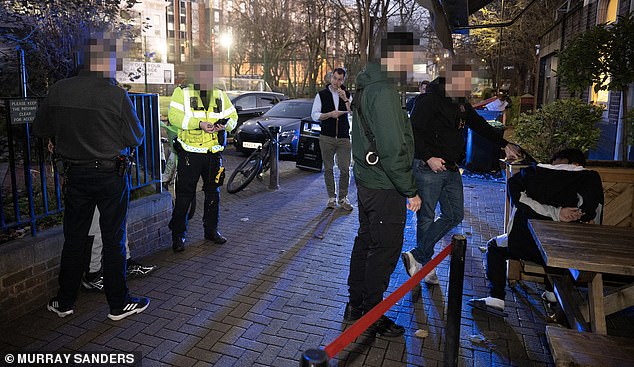
Guy Adams accompanies plain clothed and uniformed police to arrest a phone thief at a pub in Waterloo

Police arrest a man, suspected of stealing a phone, outside a pub in Waterloo and place him inside a police van
I’ve been allowed to ride along with one of Baselife’s ‘interceptor’ teams. From the back-seat of a souped-up Skoda Octavia, I’m about to get a ringside view of how this zero tolerance crackdown is playing out.
All of which brings us back to the mobile phone thief. Most of the time, he’d most likely be able to vanish with virtual impunity. It’s dark, the streets are crowded, and that e-bike can travel at serious speed.
But tonight, this corner of London is positively crawling with Baselife’s various teams. Within a few minutes, an undercover cop has spotted the young man riding down The Cut, a busy road filled with pubs and bars connecting Southwark Station with Waterloo.
Then someone else sees him whizzing across a small park. By now, a police motorcycle is giving chase, while several cars (including the one I am travelling in) and foot patrols are converging on surrounding streets.
Each co-ordinates their movements via radio, in an attempt to effectively surround their target and bring him safely to a halt.
A short chase ensues, ending behind Waterloo, where the suspect dumps his bike and runs away. But one of the team have seen him sneak into a pub called the Duke of Sussex. Here police not only arrest the thief but also detain two other, similarly dressed young men.
They were found with him, so are treated as suspected accomplices. When the group’s pockets are searched, five smartphones are discovered, along with two bags of cannabis.
The e-bike is meanwhile found to have been tampered with, allowing it to illegally reach speeds of up to 50mph. It’s thrown into the back of a van, along with all three of the handcuffed youths.
Join the debate
Is London doing enough to protect people from phone thefts and street crime, or should tougher measures be used?
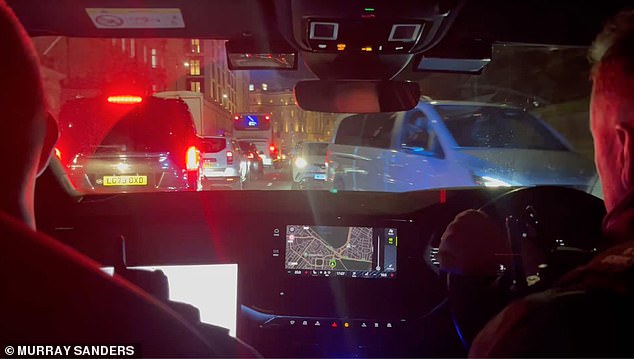
Guy Adams joins police inside an unmarked car as they cruise through the streets of London
The whole process has taken just half an hour. A highly mobile suspect has been detained thanks to our well-organised and specially equipped unit. At least one stolen phone is likely to be returned to its owner. And three undesirables have been temporarily taken off the streets.
To put things another way, the operation has chalked up a small but heartening victory. And this isn’t its only success, either.
During the initial six-day period when the operation was trialled in early November, officers carried out 146 arrests. This week, when it resumed (it will now run until at least Christmas), they took the total over 200. On Wednesday, when I followed one of its units, a total of 37 people were detained, while the whole operation resulted in 139 arrests in a week.
Those arrested have included a pair of prolific mobile phone thieves who were spotted by plain clothes officers attempting to swipe devices from women at a Leicester Square ice rink.
Footage of that arrest, filmed on police bodycams, shows them being dramatically stopped in the street.
‘It looks like you’ve made multiple attempts to try to nick phones from people,’ says one of the police officers, who then finds several iPhones while placing handcuffs on the alleged thieves, and asks ‘where did you get them from?’ In broken English, one of the suspects responds ‘I found them… here… after I heard someone calling it.’ As the handsets are placed in evidence bags, the duo were led away.
A second arrest caught on camera saw a man arrested for a so-called ‘upskirting’ offence. Again, he was spotted by sharp-eyed plain-clothes officers. They noticed the alleged pervert standing behind two women and using a smartphone to film their buttocks, as they queued to use the toilet in a Soho café.
When the man’s phone was seized, police discovered a significant number of similarly intrusive videos taken in locations around central London.
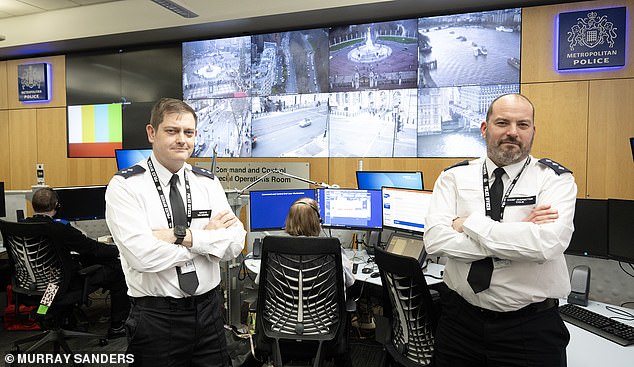
Lead police officers in the Met task force territorial support group: Chief Inspector Jim Cole (right) and Inspector Tom Beresford (left)
‘A lot of what we are doing is quite simple: looking for people who are out of place,’ is how Chief Inspector Jim Cole, the man in charge of Operation Baselife, puts it. ‘If you ‘hold a plot’ and observe an area, you get to notice what’s unusual, see someone acting differently who might be up to no good.’
In some ways, it’s old school policing, he adds. ‘You stand there, holding a cold cup of coffee, waiting for something to develop.’
But once suspects are spotted, high-tech equipment can be used to ensure that their collar actually gets felt. Baselife teams, whose officers hail from the Met Taskforce of specialist officers, often collaborate with local colleagues. But as proceedings in Waterloo have demonstrated, their extra resources and equipment allow arrests to be made in circumstances where normal units might struggle.
Cole meets me in the Met’s ‘Special Operations Room,’ a state-of-the-art facility in Lambeth, from where he and his deputy, Inspector Tom Beresford, co-ordinate the whole thing.
The secure room, perhaps the size of two tennis courts, has a touch of the James Bonds about it. On the main wall are dozens of giant televisions, each showing live CCTV footage of central London landmarks, including Oxford Street, Buckingham Palace and the Houses of Parliament.
Staff can dial up a live feed from any of the thousands of Transport for London or local authority cameras across the city, helping them locate and follow suspects. Headphone-clad teams sitting at ‘pods’ of desks then co-ordinate the movement of different units, in real time.
Inspector Beresford believes that Baselife is already having an impact on crime statistics. On Black Friday – November 25 – for example, footfall on Oxford Street was up 179 per cent on normal levels. But recorded crime that day only rose by 13 per cent.
‘Criminals are on social media, and they talk to each other. They chat on Snapchat and TikTok, and when they hear that we are about, they might decide to go away for a few days,’ is how he puts it.
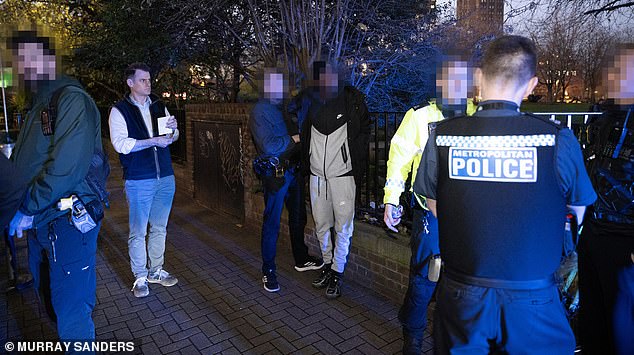
Guy Adams with plain clothed and uniformed officers as they arrest a phone thief
As the operation continues they may therefore end up recording fewer arrests (on a rainy day this week, for example, just four people were picked up). But, he says: ‘If we come away with no arrests but no reported crimes, that’s a win, isn’t it?’
In other words, visible policing works. And a zero-tolerance approach to so-called ‘low level’ offences, such as shoplifting and mobile phone theft (after a period in which the Met has chosen to focus resources on more serious criminality), is proving to be highly popular with the public.
‘It passes what I call the “mum test”,’ says Beresford. ‘By that I mean it’s the sort of thing my mum would want done. She’s a normal person and if we are focusing on something she’d approve of, I am confident we are doing the right thing.’ Even in a city the size of London, a few hundred arrests can make a huge impact on public safety, since the sort of criminals who steal mobile phones, pick pockets or shoplift each tend to carry out multiple thefts every day.
And these arrests come at a good time. For the public’s perception of the Met is in need of a serious fillip.
A recent report by the Policy Exchange think tank called for the force to be put into ‘special measures’ saying public confidence had fallen to an all-time low amid a belief that there was a ‘culture of impunity to crime in London’. It said the force is identifying a culprit in just one in 20 robberies and burglaries, one in 13 shoplifting offences, and one in a mere 179 street muggings.
This may in turn explain why when many categories of crime have actually been falling in London (murder is at a five-year low, while violent offences dropped by 12 per cent in 2024) the perception of the public is that it has instead been rising.
Following Operation Baselife also provides a fascinating insight into the changing nature of street crime, and how hard it can be to prevent.
My police companions, who sometimes work in a ‘plain clothes’ capacity so ask not to be named, point out that a few years ago, almost all of the muggers who grab mobile phones or expensive handbags and wristwatches in Central London were working in pairs, travelling on petrol scooters.
Today, their preferred vehicles are electric bikes, which have become a near-ubiquitous criminal tool.
Some criminals ride illegal models which have been adapted to travel faster than the law allows. Other offenders sabotage Lime bikes, the green rental versions, so they can ride them for free.
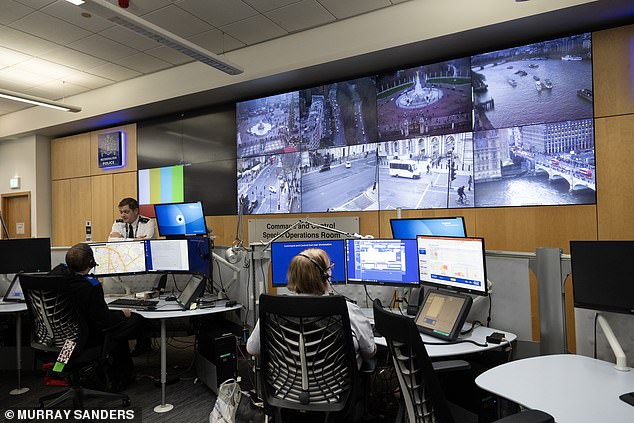
Guy Adams joined officers inside the Metropolitan Police’s special operations room
‘People use e-bikes for two reasons,’ says one of my police chaperones. ‘Firstly, unlike scooters, they are silent, so you can sneak up on someone. Secondly, they can go places our cars and motorbikes can’t, up pavements, in parks and along pedestrian streets. And they are incredibly fast. Some of them do 60mph.
‘So they’ve made it really easy for people to nick phones then get away.’ Not helping things, he adds, is the way the public use their devices on the streets.
‘People stand at junctions looking at their phone, or walk down streets after dark reading the things. They stand out like a sore thumb.
‘We’re certainly not victim blaming, but you see some people holding phones out like they are athletes holding batons in a relay race.
‘There’s so much choice for thieves that a lot of them ride around looking out for the most expensive models of phone, and targeting the people who carry them.’
Many of the plain clothes officers involved in Baselife spend their time scanning the streets for dodgy e-bikes (the sabotaged Lime bikes make a clicking noise).
In a single day on Oxford Street last week, they seized 16 illegally adapted models, making several arrests, including one of a man wanted for a sex offence.
In Ealing, a different unit seized 12 e-bikes and made one arrest on a Saturday in November. So far, some 2,500 have been seized this year. In a PR stunt, several were crushed and put under the Christmas tree outside New Scotland Yard. Of course, once a suspect is spotted, arrests don’t automatically ensue.
At one point on Wednesday, rush hour traffic prevented the team I was with from reaching a location near Oxford Circus where a potential thief was operating for more than 15 minutes, despite our flashing blue lights and siren. By the time we reached the area, he’d vanished.
The other main challenge facing officers is a more practical one: every time a suspect is detained, several officers must spend the remainder of their shift completing paperwork associated with the arrest. If charges and a court case ensue, they will be removed from the front line for even longer.
All of which brings us back to our suspected mobile phone thief. Once he and his alleged accomplices are driven away in a police van, the unit which detained them returns to the station to carry out clerical duties.
This ‘old fashioned policing’ is labour intensive. But for tonight, at least, the streets of London will be that little bit safer.