The fatal shooting of a protester by federal agents in Minneapolis has opened an unusual rift between a Republican administration and gun rights advocates – and has prompted rapid efforts by the White House to close that divide.
For years, Republican leaders – including President Donald Trump – have championed gun rights and cast themselves as defenders of those rights against Democratic opponents. Meanwhile, groups supporting gun ownership have framed the Second Amendment as not just a foundational right, but an existential one. An armed populace is not only safer from crime, the argument goes, but it is also protected against tyranny.
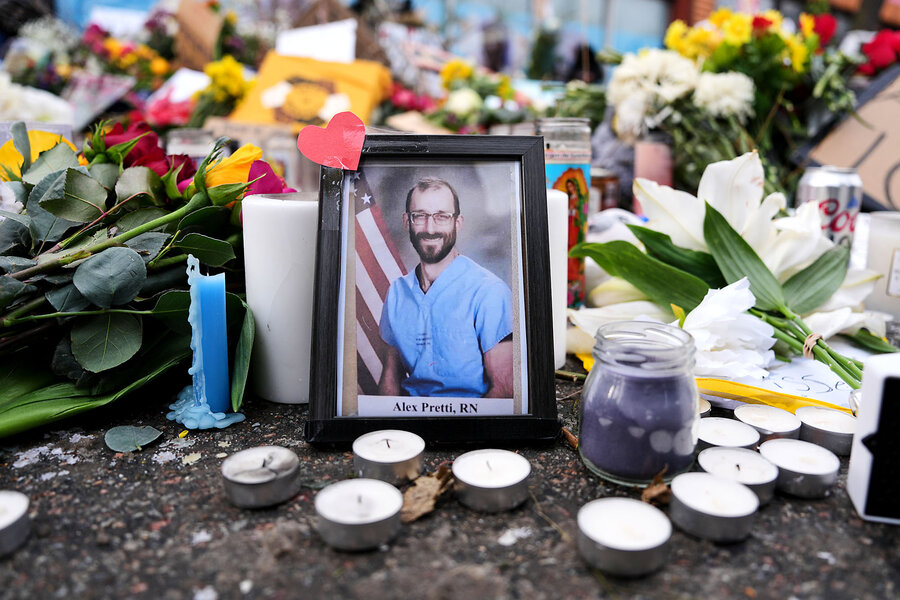
However, after the death of U.S. citizen Alex Pretti on Saturday, the picture got more complicated.
Why We Wrote This
Alex Pretti was a lawful gun owner, and not brandishing his weapon, when he was disarmed and then fatally shot by federal agents. The resulting controversy focuses on an incident that appears to contradict decades of conservatives’ efforts to legitimize public gun carry.
Mr. Pretti, with a licensed handgun concealed at his side, can be seen on witness videos calmly approaching a fellow protester, on a street where some are blowing whistles to alert people about immigration enforcement. Videos then show him being tackled by agents, disarmed, and shot in the back. The video footage has compromised the administration’s initial defense of its agents as battling a politically driven “assassin.”
And a growing number of conservatives, a voting bloc that has generally backed the administration’s deportation moves and includes the lion’s share of gun-rights advocates, have taken umbrage. Especially the gun-rights advocates.
“This is the most extreme test case for the claims of gun groups over the last couple of decades,” says Chad Kautzer, an associate professor of philosophy at Lehigh University and author of a forthcoming book on gun culture in America. “It’s a heightened moment of contradiction and revelation,’’ he says.
The National Rifle Association, meanwhile, called a federal prosecutor’s remarks “dangerous and wrong’’ in saying that people who carry guns risk being lawfully shot by officers.

The standoff is forcing many Americans to confront the reality of political conflict in an armed nation: Is the right to defend one’s self universal? Or is it tied to identity and politics? And how do expanding gun rights as a defense against governmental tyranny coexist with law enforcement that might be pushing constitutional boundaries?
What happened in Minneapolis?
By most accounts, the recent immigration enforcement efforts in Minneapolis have been fluid and messy. A high-profile influx of federal immigration agents was met with organized protests at the sites of their operations. The shooting of Mr. Pretti, a registered nurse, came nearly three weeks after the fatal shooting of another protester, Renee Good. In both cases, administration officials claimed the protesters were violent aggressors. Videos taken during both incidents appear to contradict those assertions.
While carrying a weapon to a protest is legal in Minnesota, interfering with law enforcement while armed raises the stakes and the potential for mistakes.
In Saturday’s shooting, multiple videos taken at the scene appear to indicate that Mr. Pretti carried, but didn’t brandish, a pistol. But experts warn that the sequence of events remains murky. The Trump administration says it is now reviewing body-camera footage as it is facing growing calls for a thorough and impartial probe into Mr. Pretti’s death.
“Many critical facts remain unknown,” writes Brian Strawser of the Minnesota Gun Owners Caucus in a news release. But, “every peaceable Minnesotan has the right to keep and bear arms – including while attending protests, acting as observers or exercising their First Amendment rights.”
Such pushback from the politically powerful gun lobby has had an immediate impact.
On Monday, the White House toned down its rhetoric, calling Mr. Pretti’s death a “tragedy.” Press secretary Karoline Leavitt tempered the administration’s initial defensive tone and refused to endorse adviser Stephen Miller’s characterization of Mr. Pretti as a “would-be assassin.” Also on Monday, Mr. Trump said he had “a very good call” with Minnesota Gov. Tim Walz, whom the president had initially blamed for Mr. Pretti’s death.
From “absolute” to “qualified” immunity
The administration has also backed off claims that federal immigration agents have “absolute immunity” from prosecution. U.S. law enforcement has “qualified immunity,” which does not protect them from consequences for unreasonable and unconstitutional acts. On Monday, the administration also reassigned Gregory Bovino, the agent in charge of the Minneapolis immigration enforcement surge, and sent border czar Tom Homan to the state in his stead.
Ms. Leavitt has meanwhile signaled an effort to repair any rift, real or perceived, with gun-rights groups and conservative constituents.
“While Americans have a constitutional right to bear arms, Americans do not have a constitutional right to impede lawful immigration enforcement operations,” she said during a White House briefing on Monday. “There has been no greater supporter or defender of the right to bear arms than President Donald J. Trump,” she added.
Gun carry has become ubiquitous in the U.S., and law enforcement experts say that local police are often more experienced than federal agents at assessing the dangers around guns in public places, especially during protests. Armed Second Amendment protests cropped up during the COVID-19 era, for example, but remained largely peaceful. Many U.S. conservatives hailed Kyle Rittenhouse as a hero after the then-teenager fatally shot two people in Kenosha, Wisconsin, during a 2020 confrontation amid protests over the killing of a man by police there. Mr. Rittenhouse was viewed by critics as having created the dangerous situation that resulted in the deaths. But he was later found not guilty of homicide.
“Carry everywhere,’’ Mr. Rittenhouse wrote on Tuesday on X. “It is your right.’’

Grace Ramey/Daily News/AP/File
GOP support for federal troop deployments
A Washington Post/Schar School survey last year on sending federal troops to quell anti-deportation protests in Los Angeles found that nearly 9 in 10 Republicans supported that deployment. A 2023 Pew Research Center survey also said 79% of Republicans and Republican-leaning independents said gun ownership increases safety. Only 39% of gun owners supported banning open carry at protests, according to a 2021 poll.
But while gun rights and law enforcement are often seen working in tandem, the killing of Mr. Pretti underscores the inherent dangers and contradictions when legal protest and gun carry end in fatalities.
Enforcement tactics that many see as being in conflict with citizens’ constitutional rights have only raised the political stakes for the administration.
“The Trump administration faces a conundrum,” says Paul Valone, founder of Grass Roots North Carolina, a gun-rights group. Mr. Pretti’s plight “was amplified by his own decisions,’’ he says. But “I suspect that [the Department of Homeland Security] is kind of forced into calling him a domestic terrorist by the political environment.”
Truth and consequences
It’s not uncommon for authorities, including politicians, to impugn the character of people killed by police in an effort to hold some sense of moral authority.
But what’s at stake now, says Republican Sen. Bill Cassidy of Louisiana, is the credibility of federal agencies. “There must be a full joint federal and state investigation,” Mr. Cassidy wrote on social media. “We can trust the American people with the truth.”
Mr. Pretti’s death also comes as American gun culture has grown more diverse. It is not just Republicans or conservatives who are defending the rights of citizens to bear arms. In fact, one-third of liberals say they now live in homes with guns present. As a result, laws protecting self-defense rights and permit-less carry have proliferated, sometimes with deadly consequences.
The U.S. has gone through periods of restless civil conflict before, including during the civil rights and Vietnam War eras. In 1970, National Guardsmen killed four students and injured nine during anti-war protests at Kent State University in Ohio.
But holding the nation together, then and now, experts say, are strong protections, including the right to self-defense and the right not to be victimized by federal agents.
This is a “potential crisis moment” for the nation, says Professor Kautzer from Lehigh University.
“We’ve all been talking about freedom and how much we value it, and this is the moment when we realize we have a different understanding of freedom – that what you’re thinking about is not what I’m thinking about.’’
But to Dru Stevenson, a South Texas College of Law professor who has studied the intent behind the Second Amendment, the tension is not a new challenge for the nation.
“Did the framers foresee the type of thing that is happening today? I think they did,” he says. “They had a healthy fear of centralized federal government having shock troops and armed forces engaging with people that are otherwise law-abiding citizens.”